What to Expect During a Professional Tree Removal in Wichita Falls
📍 Wichita Falls, Tex
Quick Answer
A professional tree removal in Wichita Falls follows six clear stages: a site assessment by a certified arborist, a permit check under local city ordinances, property preparation, systematic branch and trunk removal, stump handling, and final site cleanup. Most residential jobs take between two and eight hours. Standard removal costs average $490, while emergency removals run around $731. Texoma Tree Service handles every one of these stages for homeowners across Wichita Falls, Burkburnett, Iowa Park, and surrounding Texoma communities.
If you have a dying cedar elm leaning toward your fence line, a post oak that survived one too many North Texas windstorms, or a honey mesquite that has simply taken over your yard, the idea of getting it removed can feel overwhelming. Most homeowners have never been through a professional tree removal before, and the uncertainty alone is enough to delay making the call.
This guide walks you through exactly what happens, from the moment a crew pulls up your driveway to the moment they leave your property clean and clear. No vague promises, no filler. Just a straightforward breakdown of what professional tree removal in Wichita Falls actually looks like, what it costs, what the city requires, and how to make sure your property is protected throughout the entire process.
Step One: The Initial Site Assessment
Everything begins with an in-person inspection. Before a single branch is touched, a trained arborist walks your property to assess the tree and its surroundings. This is not a glance from the street. It is a structured evaluation of the tree’s health, its structural stability, its proximity to your home, and the safest possible path for removal.
In Wichita Falls, this step matters more than most homeowners realize. The red clay soil common throughout Wichita County weakens root systems over time, especially during the region’s recurring drought cycles. A tree that looks stable from the outside may have compromised root anchoring below grade. Severe thunderstorms, high plains winds, and summer heat stress are all factors that experienced local arborists account for during the assessment. A company based in the Texoma region understands these conditions in a way that an out-of-town crew simply does not.
What the arborist evaluates during the site visit
- Overall tree health, including signs of hypoxylon canker, oak wilt, or internal decay.
- Structural integrity of the trunk, major limbs, and root flare.
- Proximity to your home, fence, driveway, pool, or neighboring structures.
- Overhead power lines, utility service drops, and cable lines in or near the canopy.
- Equipment access points for bucket trucks, wood chippers, or cranes.
- The safest felling direction or whether sectional dismantling is required.
- Whether the tree can potentially be saved through pruning or treatment rather than being removed.
During the assessment, speak up. Ask what specific risks exist, whether any roots are close to your foundation or sewer lines, and what the crew’s plan is if something unexpected happens. A reputable tree service welcomes these questions because they share your goal: a safe, clean job with no surprises.
Red flag to watch for: If a company quotes you over the phone without visiting the site first, or if they skip the walkthrough on arrival and jump straight to cutting, that is a sign they are not taking the job seriously. Reputable tree removal crews always assess before they act.
Do You Need a Permit to Remove a Tree in Wichita Falls?
This is one of the most common questions homeowners ask, and the answer for most residential properties in Wichita Falls is straightforward: no special permit is required to remove a tree on your own private residential property. The City of Wichita Falls does not mandate the removal of dead trees on private land. The only code enforcement requirement is that tree limbs already on the ground be removed from the premises.
That said, there are important exceptions. Trees located near public easements, within commercial developments, or on or near city property fall under different rules. The City of Wichita Falls zoning ordinances require that any development project submit a landscape plan identifying trees proposed for removal, and the plan must demonstrate that sufficient remaining trees meet local canopy requirements. If your project involves any kind of commercial construction or significant land alteration, that step is required before removal begins.
Additionally, if your tree is growing into overhead power lines managed by Oncor Electric Delivery, those lines serve Wichita Falls and the surrounding Texoma area. Do not attempt to remove or trim a tree in contact with utility lines on your own. Oncor has dedicated line-clearing crews, and your tree service should coordinate with utility providers before any work begins near energized lines.
Permit summary for Wichita Falls homeowners
- Private residential tree removal: generally, no permit required.
- Commercial development requiring tree removal: landscape plan is required under the city zoning ordinance.
- Trees in public parks or on public property: unlawful to remove without city authorization.
- Trees near HOA-governed streets or easements: check your HOA covenants before scheduling.
- Trees touching Oncor power lines: notify Oncor and confirm clearance before any work begins.
How to Prepare Your Property Before the Crew Arrives
Once your estimate is confirmed and a removal date is scheduled, a little preparation on your end goes a long way toward making the job faster, safer, and cleaner.
- 1Clear the work zone. Move outdoor furniture, potted plants, lawn decorations, grills, and any other movable items well away from the tree and the area where the crew will work. The more open the space, the more efficiently they can maneuver equipment.
- 2Move vehicles out of the driveway. Bucket trucks and chippers need staging room. Parking vehicles around the block or down the street for the day prevents damage and removes obstacles for the crew.
- 3Keep pets and children indoors. Chainsaws, rigging ropes, and falling timber create real hazards. The safest place for pets and children on removal day is well inside the house, away from windows facing the work area.
- 4Mark underground utilities if you know where they are. Irrigation systems, septic tanks, and buried utility lines can be damaged by heavy equipment. Texas 811 (Dig Safe) can locate public utility lines, but private irrigation lines are your responsibility to flag.
- 5Give your neighbors a heads up. A courtesy call or knock on the door the day before goes a long way, especially if the crew will need to work close to a shared fence or if debris might cross the property line.
- 6Confirm stump handling in advance. Decide before removal day whether you want the stump ground or left in place. This affects pricing, crew equipment, and how long the job takes.
What Happens on Removal Day: Step by Step
On the day of the job, the crew will arrive and do one final walkthrough with you before any equipment is unloaded. This is your last chance to confirm the scope of work, point out any concerns, and ask about anything that came up since the initial assessment. A well-run crew will not begin cutting until everyone is aligned.
Site Setup and Safety Zones
Before the first cut, the crew sets up a secured work zone. Cones or rope barriers mark off the fall radius of the tree and the equipment staging area. Personal protective equipment including hard hats, chainsaw chaps, gloves, and eye protection is required for every crew member throughout the job. If the tree is near a road or sidewalk, traffic control measures may be placed to protect pedestrians.
Branch Removal from the Top Down
The actual cutting starts at the top. Working downward through the canopy, crew members remove large limbs first, using ropes and rigging systems to control how each section descends. This controlled approach protects your roofline, fence, landscaping, and any structures in the surrounding area. In tight yards, which are common in established Wichita Falls neighborhoods around Sikes Senter and Tanglewood, sectional dismantling is the standard method because there is simply no room for the tree to fall in a single piece.
Trunk Sectioning
Once the canopy is cleared, the trunk is reduced in sections from top to bottom. Each section is cut, guided down with rigging if needed, and moved to a staging area where it is either run through the wood chipper or cut into manageable rounds. For large, healthy trunks, some homeowners choose to keep the wood for firewood. This should be discussed with your crew before the job begins so they know how to process the material on site.
Crane-Assisted Removal
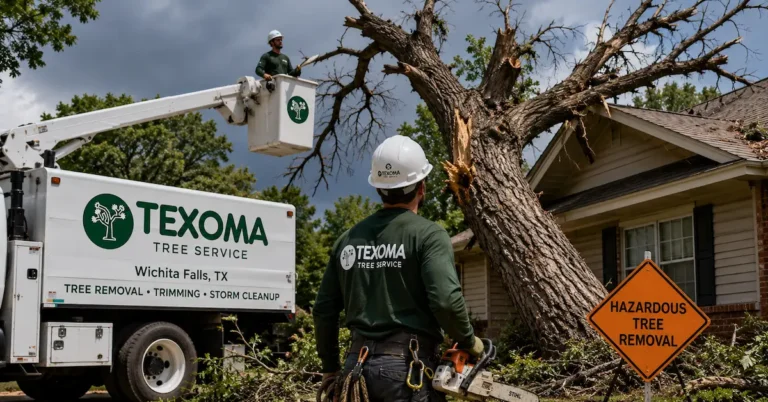
For very large trees, trees directly over structures, or trees with severe lean and compromised root systems, crane-assisted removal is the safest option. A crane stages nearby and lifts large trunk sections or entire canopy portions up and away from the structure below. This method takes longer and costs more, but it virtually eliminates the risk of property damage for complex removals. If your assessment identified any of these conditions, ask your tree service whether crane assistance is part of their plan.
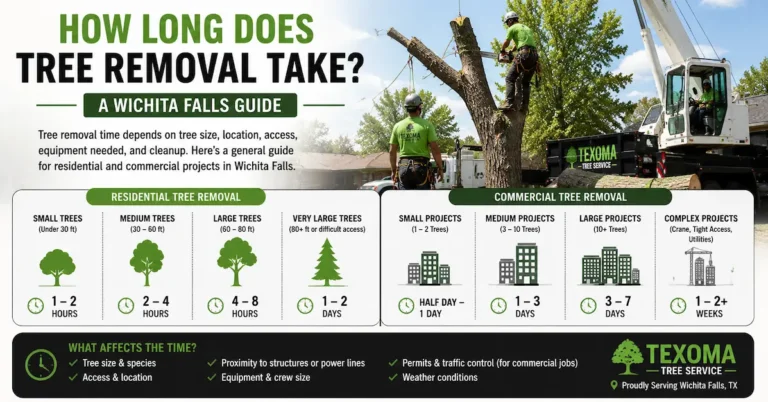
Typical removal day timeline
- Small tree under 30 feet: 1 to 3 hours
- Medium tree 30 to 60 feet: 3 to 6 hours
- Large tree 60 to 80 feet: 6 to 8 hours or a full day
- Crane-assisted removal of large or structurally compromised trees: 1 to 2 days
Stump Grinding vs. Full Stump Removal: Which Option Is Right for You?
After the tree comes down, you are left with the stump. This is where a lot of homeowners get surprised, because stump handling is typically quoted separately from the removal itself and involves its own set of considerations.
Stump grinding is the most common choice for Wichita Falls properties. A stump grinder chews the stump down eight to twelve inches below the surface, converting it into wood chip mulch that stays in place or can be raked away. The root system remains in the ground and decomposes naturally over time. For Wichita Falls clay soil, stump grinding is preferred because the dense, compact soil makes full excavation slow and labor-intensive.
Full stump removal involves extracting the stump and the primary root ball entirely. This is the right choice if you plan to pour a foundation, install a new tree in exactly the same spot, or build a structure in that area. It costs more and takes longer, but it leaves you with a completely clear, fillable space.
If you leave the stump untouched, be aware that many North Texas tree species, including honey mesquite, hackberry, and certain oak varieties, will resprout from the stump unless the root system is treated or fully removed. Your crew can apply a stump treatment at the time of cutting to reduce this risk if grinding is not in your budget right away.
For a full breakdown of your options, visit our stump grinding and removal service page.
What the Cleanup Process Looks Like
When the last trunk section hits the ground, the job is not over. A professional crew spends significant time on the final cleanup phase, and this part of the process separates a quality tree service from a mediocre one.
All branches, leaf debris, and wood chips are either loaded into the truck for hauling or left on site if you choose to keep the mulch. Trunk rounds are stacked if you requested firewood. The work area is raked, blown, and inspected to make sure no debris, hardware, or hazards remain. If stump grinding was performed, the resulting wood chip material is raked level and the surrounding turf is restored as much as possible.
Minor lawn disruption, such as tire ruts from equipment or compacted grass beneath rigging zones, is normal and typically resolves on its own within a few weeks of regular watering. If the disruption is more significant, your crew should note it and discuss remediation options with you before they leave.
Before the crew drives away, do a final walkthrough with the crew lead. Confirm all debris is cleared, verify the stump was handled as agreed, and check that no structures, irrigation heads, or landscaping features were damaged during the job. Any concerns should be addressed on site, not after the crew has packed up and gone home.
How Much Does Tree Removal Cost in Wichita Falls?
Cost is almost always the first question homeowners ask, and the honest answer is that it depends on several variables. Tree height, trunk diameter, species, proximity to structures, and whether stump grinding is included all affect the final number.
| Tree Size | Height Range | Estimated Cost Range |
|---|---|---|
| Small | Under 30 ft | $192 to $400 |
| Medium | 30 to 60 ft | $300 to $700 |
| Large | 60 to 80 ft | $700 to $1,100 |
| Very Large | Over 80 ft | $1,100 to $1,800+ |
| Emergency Removal | Any height | Average $731 |
| Stump Grinding | Standard stump | Starting at $175 |
The average homeowner in Wichita Falls pays around $490 for a standard tree removal. If your situation involves a tree leaning over the roof, contact with utility lines, or a species like a large post oak with an extensive root system, expect the cost to land toward the higher end of the range. Getting two or three written estimates from local companies is always a reasonable step before committing.
Texas does not have a specific licensing requirement for tree removal companies, but the company you hire should carry both general liability insurance and workers compensation coverage. Ask to see proof of both before signing anything. If a worker is injured on your property and the company is uninsured, you may face liability for the medical costs.
Why Local Experience Matters in Wichita Falls
Tree removal in Wichita Falls is not identical to tree removal in Dallas, Houston, or anywhere else in Texas. The Texoma region has its own set of conditions that a locally experienced crew understands at a level that a traveling team cannot match.
The clay soils throughout Wichita County respond differently to drought stress than sandy or loamy soils. Post oaks, cedar elms, and honey mesquite each behave differently under rigging stress and respond uniquely when sectioned. The high plains wind patterns that affect the region make certain tree species more likely to fail at the trunk rather than uproot, which changes how a crew plans the felling direction. Severe weather in the Texoma area, including damaging hailstorms, derechos, and the occasional tornado, creates storm damage patterns that experienced local crews recognize and account for during assessments.
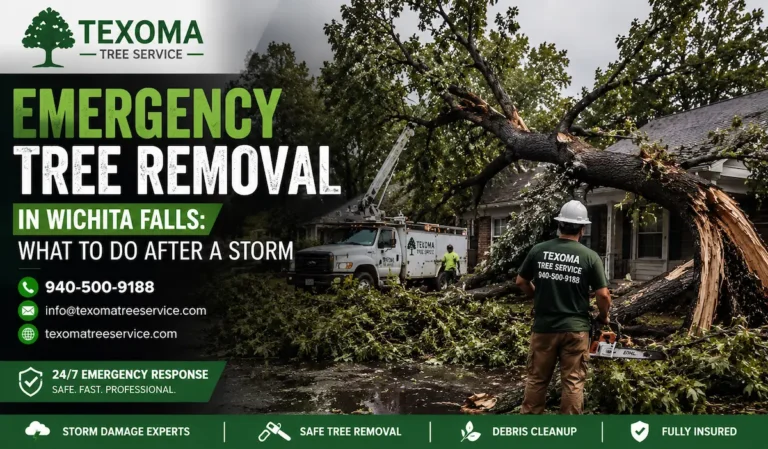
Working with a company based in Wichita Falls also means faster response times for emergency tree removal after the severe storms that roll through the area each spring. When a tree falls on your home at 11 pm in May, you want a crew that can be there quickly, not one that is two hours away.
For properties across the Texoma region including Burkburnett, Iowa Park, Henrietta, and Electra, Texoma Tree Service provides tree trimming and pruning, storm damage tree service, stump grinding, and full tree removal for both residential and commercial properties.
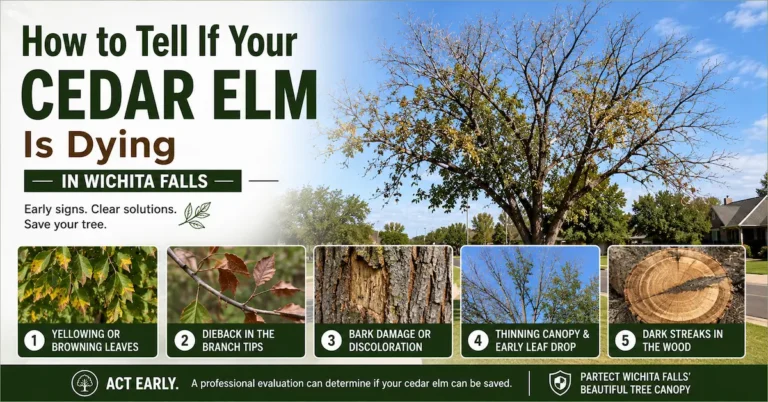
Signs Your Tree Needs to Be Removed, Not Just Trimmed
Not every problem tree needs to come down. Sometimes targeted pruning, cable bracing, or disease treatment can extend the life of a valuable tree by years. But certain conditions make full removal the only responsible option.
Conditions that typically require full removal
- More than 50% of the canopy is dead or dying with no sign of new growth
- Fungal conks or bracket fungi at the base indicate advanced internal decay
- Deep cracks running through the trunk, especially between major limbs
- The tree is visibly leaning with raised or cracked soil at the base of the root zone
- Root damage from construction, drought, or nearby pavement is severe enough to compromise anchoring
- The tree has been topped previously and developed multiple competing leaders that create structural weakness
- Dead branches are falling spontaneously, even without wind or storm activity
- The tree is too close to your home’s foundation, roofline, or utility service entry point
If you are unsure whether your tree needs removal or can be saved with treatment, request a hazard assessment before scheduling anything. A good arborist will always try to give you the option to preserve the tree if it is viable. Removal should never be the first recommendation for a tree that still has healthy structure and a reasonable remaining lifespan.
What to Do With Your Property After the Tree Is Go
Once the crew leaves, your yard will look different, and you will have some decisions to make about the cleared space. Give the area a few days to settle before doing any heavy planting or grading work. If stump grinding was performed, the wood chip material in the void will compact as it decomposes, and you may need to add topsoil and reseed the area after four to eight weeks.
If you want to replant, choose a species that fits the specific conditions of the cleared spot: sun exposure, proximity to structures, and soil type. In Wichita Falls, drought-tolerant native species like Texas red oak, Mexican plum, or desert willow tend to establish well in the clay-heavy soil and handle the hot, dry summers that the region delivers every year. Avoid replanting the same species if disease or pest pressure was a factor in the original tree’s removal.
Keep your remaining trees healthy by scheduling a routine inspection annually, ideally in late winter before new growth begins. Trees in Wichita Falls that survived a drought cycle or a major storm may have hidden structural damage that does not become visible until the following growing season. Early detection is always less expensive than emergency removal later.
Frequently Asked Questions
How long does a tree removal typically take in Wichita Falls?
Most residential removals in Wichita Falls take between two and eight hours depending on tree size, location, and complexity. Large or structurally compromised trees requiring crane assistance may take a full day or extend into a second day including equipment setup and breakdown.
Will the tree removal crew damage my lawn?
Some minor disturbance is normal, particularly in areas where heavy equipment moves across the turf or where rigging systems are anchored. Professional crews use protective mats where possible and take care to minimize ground impact. Any visible tire ruts or compacted areas typically recover within a few weeks with regular watering.
Can I keep the wood after the tree is removed?
Yes. Let your crew know before the job begins that you want to keep the wood, and they will cut the trunk into rounds of a size you specify rather than feeding everything into the chipper. Cedar elm and post oak both make good firewood if properly seasoned.
Is stump grinding included in the removal price?
Not always. Many tree services quote stump grinding separately. Confirm during your estimate whether stump grinding is included or priced as an add-on, and specify how deep you want the stump ground if you plan to replant or sod over the area.
What should I do if a tree falls on my home during a storm?
Contact an emergency tree removal service first to make the structure safe, then file a claim with your homeowners’ insurance. Document the damage with photos before any work begins, and keep all invoices from the tree service for your claim. Texoma Tree Service offers 24-hour storm damage tree service for exactly these situations.
Ready to Schedule Your Tree Removal?
Get a free on-site estimate from Texoma Tree Service. We serve Wichita Falls, Burkburnett, Iowa Park, Henrietta, Electra, and surrounding Texoma communities.
Or call us directly: +1 940 654 8157