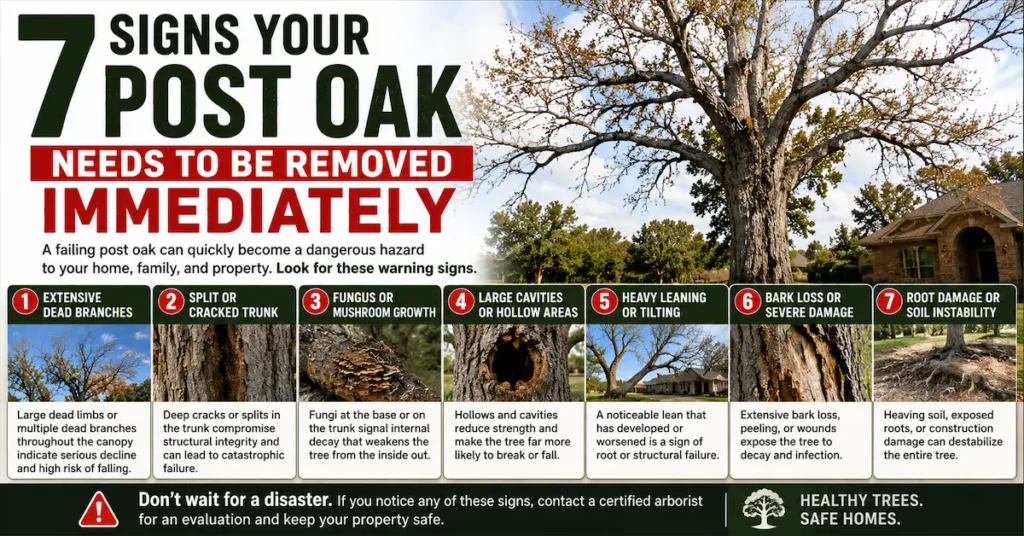
7 Signs Your Post Oak Needs to Be Removed Immediately
Quick Answer
A post oak in Wichita Falls needs to be removed immediately when it shows one or more of these seven signs: visible hypoxylon canker stroma on the bark indicating end-stage fungal colonization, a significant lean that developed suddenly or is paired with soil heaving at the base, large vertical cracks or splits running through the trunk, more than 50 percent of the canopy is dead with no new growth present, the trunk sounds hollow when struck and decay occupies more than one-third of the trunk diameter, the tree is making contact with Oncor Electric Delivery power lines or your home’s service drop, or multiple major scaffold limbs are hanging dead in the canopy over an occupied structure or high-use area. Post oaks in Wichita Falls face heightened removal risk compared to other Texas regions because of Wichita County’s clay soil shrink-swell cycles, severe storm winds, and the drought stress pattern that drives hypoxylon canker outbreaks across North Texas. According to ISA TRAQ-standard hazard assessment protocols, any post oak meeting two or more of these criteria requires professional assessment as a matter of urgency.
Post oaks are the soul of the Wichita Falls landscape. They are slow to grow, long-lived, and deeply rooted in the visual character of established neighborhoods from the older streets near Old High School, Wichita Falls High, to the semi-rural properties along FM 369 and out toward Burkburnett. A mature post oak represents decades of growth that cannot be replaced on any meaningful human timeline. Most Wichita Falls homeowners resist removing them far longer than they should, which is a completely understandable impulse.
But a post oak that has passed certain thresholds becomes something different from a landscape asset. It becomes a structural liability that the next severe North Texas storm- a 90-mph straight-line wind event, a hailstorm, or a derecho can convert from a standing tree into a disaster in minutes. The post oak that falls on your roof at 2 a.m. during a spring storm did not fail without warning. The signs were there. Most homeowners simply did not know what they were looking at.
This guide covers the seven signs that your post oak needs to be removed immediately in Wichita Falls, why each one is significant in the specific context of North Texas weather and soil conditions, and what to do after you identify any one of them on your property.
Sign 1: Does Your Post Oak Have Hypoxylon Canker on the Bark?
Sign 01 — End-Stage Indicator
Hypoxylon Canker Stroma Visible on Bark Surface
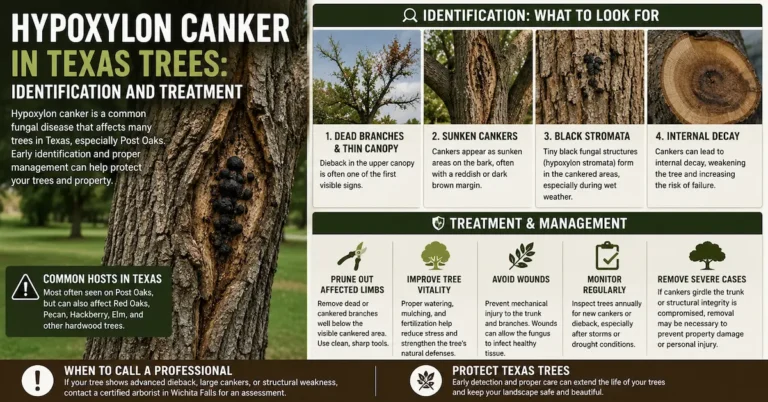
Hypoxylon canker, caused by the fungal pathogen Biscogniauxia atropunctata, is the single most definitive visual indicator that a post oak in Wichita Falls needs to come down. When the characteristic stroma, the powdery, dusty fungal fruiting structures, appear on the surface of the bark, the tree is already in what Texas Tree Surgeons and ISA-certified arborist Josh Friar of Truly Arbor Care both describe as end-stage decline. Once visible externally, internal decline is already advanced, and the structural wood is deteriorating faster than it appears from outside.
The progression is visible and distinct. In the earliest external stage, the bark peels or sloughs away in irregular patches to reveal a buff-colored or silver-gray layer beneath with a dusty texture. This is the initial hypoxylon stroma. As the fungus advances, this material transitions from buff-gray to a charcoal or dark brown-black color. At the advanced stage, the powdery stroma coats large sections of exposed wood. Texas Tree Surgeons have explicitly stated that following the 2023 North Texas drought, they expected a large increase in post oaks and red oaks affected by hypoxylon canker in subsequent years, which aligns directly with the drought conditions that Wichita Falls experienced during that period.
- Early stage: buff-gray dusty patches on exposed bark
- Mid stage: darker brown stroma expanding across exposed wood surfaces
- Late stage: charcoal-black stroma covering large sections of bark, brittle and unstable wood beneath
- Action required: professional assessment and removal planning immediately
Hypoxylon canker is not the primary killer of a post oak. According to Arborist USA and the ISA-standard analysis by Josh Friar, hypoxylon is a secondary opportunistic pathogen that exploits trees already under severe stress. Once visible, it signals that the tree’s carbohydrate reserves, its stored energy system, have been depleted beyond the point where the tree can mount an immune response. The post oak did not fail because the fungus attacked it. The fungus attacked it because the tree had already failed from drought stress, root compaction, construction damage, or extended heat stress. The fungus is the final chapter, not the cause.
Wichita Falls drought connection: Hypoxylon canker outbreaks in North Texas follow drought cycles with a lag of one to three years. The severe drought conditions that affected Wichita County during 2022 and 2023 created the stressed post oak populations that are now showing hypoxylon symptoms. Property owners across Wichita Falls should be inspecting their post oaks closely through 2025 and 2026 for early stroma development.
Sign 2: Is Your Post Oak Leaning, and When Did That Lean Develop?
Sign 02 — Structural Failure Risk
Sudden Lean With Soil Heaving or Root Exposure at the Base
Not every leaning post oak is a hazard. Post oaks that have grown at an angle toward available light over decades, with a stable root system and no change in the lean over time, may be manageable through cable bracing and routine monitoring. The lean that demands immediate action is one that developed suddenly or noticeably changed over a short period, particularly when accompanied by visible signs of root system disturbance.
Soil heaving, cracking, or lifting on the side opposite the lean is the most alarming companion sign. When a post oak begins to uproot, the root mass on the compression side lifts the soil upward as the root system begins to tip out of the ground. This soil movement can appear as a crescent-shaped raised area on one side of the trunk base, sometimes with visible root crowns being pushed to the surface. In Wichita County’s clay-heavy soil, which expands significantly during wet periods, this root heaving can develop over days following heavy spring rainfall after a dry period that had already stressed the root system.
According to the ISA Tree Risk Assessment Qualification (TRAQ) framework, a sudden lean combined with root zone soil disturbance places a tree in the highest risk category regardless of its apparent overall health, because root system failure is unpredictable and can progress to complete uprooting with minimal warning.
Sign 3: Are There Vertical Cracks Running Through the Trunk of Your Post Oak?
Sign 03 — Structural Integrity Failure
Deep Vertical Cracks or Splits in the Trunk or Major Scaffold Limbs
Vertical cracks running through the main trunk or along major structural limbs of a post oak in Wichita Falls are among the most serious structural defect indicators recognized by the ISA TRAQ hazard assessment standard. A crack of any significant depth in the trunk indicates that the wood fibers have separated under loading stress, and the structural capacity of the affected section has been permanently reduced at that point.
Two types of vertical cracking are particularly concerning. The first is a frost crack or lightning-induced crack that penetrates deep into the heartwood, leaving a visible wound that has not callused over properly. The second, and more immediately dangerous, is a crack that forms between two major co-dominant stems where included bark has developed. Included bark occurs when two major limbs grow at a narrow angle, and the bark between them becomes trapped inside the union rather than forming a proper wood-to-wood connection. An included bark union with a visible crack is a structural time bomb in any tree, and in a post oak during a Wichita Falls storm with winds exceeding 70 mph, it is a failure point that cannot be relied upon to hold.
Minor surface cracks in older post oak bark that do not penetrate the wood are normal and do not indicate structural failure. The test is depth: use a blunt probe to determine whether a crack extends beyond the outer bark layer. If it penetrates into the wood, treat it as a structural concern requiring professional assessment immediately.
Sign 4: Is More Than Half of Your Post Oak Canopy Dead or Bare?
Sign 04 — Systemic Failure Threshold
Over 50 Percent Canopy Dieback With No New Growth Response
The 50 percent canopy dieback threshold is widely recognized in the ISA TRAQ assessment framework as a critical indicator for removal consideration, and for post oaks in Wichita Falls it carries additional weight because of how this species responds to decline. Post oaks are slow-growing and have lower regenerative capacity than faster-growing species. A cedar elm or hackberry at 50 percent canopy loss may still flush meaningful new growth in the following spring if stress is relieved. A post oak at 50 percent canopy dieback is working from depleted carbohydrate reserves and is far less likely to mount a meaningful recovery.
The distinction between managed decline and irrecoverable decline in a post oak hinges on where the dead canopy is concentrated and whether any new growth has appeared. A post oak that has lost 50 percent of its canopy concentrated in the upper crown with no new growth visible anywhere in the living portion of the canopy after two consecutive growing seasons has almost certainly passed the recovery threshold. A post oak that lost 50 percent of its canopy during a single severe drought season and then showed vigorous new growth the following spring is a different situation entirely.
Truly Arbor Care’s ISA-certified assessment framework for North Texas oaks identifies greater than 30 to 40 percent canopy loss in red oaks as indicating limited recovery potential. For post oaks, given their slower recovery physiology and the Wichita County drought patterns that often span multiple years, 50 percent is a reasonable threshold to apply before seeking professional assessment.
Sign 5: Does Your Post Oak Sound Hollow and How Much of the Trunk Is Decayed?
Sign 05 — Internal Structural Compromise
Hollow Trunk Sections With Decay Exceeding One-Third of Trunk Diameter
A post oak trunk that sounds hollow when struck with the heel of your hand or a rubber mallet is telling you that internal wood decay has progressed to the point where an air cavity exists within the structural column that holds the tree upright. The threshold that triggers removal consideration in standard ISA arboricultural practice is when decay occupies more than one-third of the trunk diameter at any single cross-section, because below that threshold the remaining sound wood may still provide adequate structural capacity under normal wind loading.
The challenge with post oaks in Wichita Falls is that internal decay caused by Ganoderma, Inonotus, and other wood-rot fungal species progresses invisibly behind intact-looking bark for months before the tree shows meaningful external symptoms. A post oak that appears structurally sound from outside may have a decay column extending through 40 to 60 percent of its trunk diameter by the time the first external symptoms appear. This is why the hollow-sound test and the presence of any fungal conks or bracket fungi at the base are such important diagnostic triggers for professional assessment rather than continued monitoring.
Advanced decay detection tools including resistograph drilling and sonic tomography can map internal decay extent with far greater accuracy than visual inspection alone. An ISA Certified Arborist with TRAQ qualification can determine whether additional diagnostic testing is warranted for a post oak showing surface indicators of internal decay, and can quantify the structural risk based on both the decay extent and the target zone beneath the tree.
Sign 6: Is Your Post Oak Touching or Growing Into Power Lines?
Sign 06 — Immediate Safety Hazard
Contact With Oncor Electric Delivery Lines or Utility Infrastructure
A post oak whose branches have grown into contact with Oncor Electric Delivery power lines, whether primary distribution lines, secondary distribution lines, or the service drop running from the utility pole to your home’s meter, is an immediate safety hazard that requires action on a timeline measured in days, not weeks. Unlike most of the other signs in this guide, utility line contact does not need to be paired with other structural indicators to constitute an urgent situation. The contact itself is the hazard.
Oncor Electric Delivery manages the distribution grid serving Wichita Falls and surrounding communities including Burkburnett, Iowa Park, Henrietta, and Electra. Their line-clearance protocols establish minimum clearance distances between vegetation and energized lines, and branches making direct contact with energized lines represent both a fire risk and an electrocution risk for anyone who comes into contact with the tree, the ground beneath it, or any water or metal conducting path from the contact point.
Do not attempt to prune or remove a post oak that is in contact with energized utility lines on your own. Contact Oncor Electric Delivery to report the hazardous line contact and contact your tree service to coordinate line-clearance protocols before any work begins. A crew working near energized lines without proper clearance procedures is operating in an immediately life-threatening environment. This is not hyperbole. The City of Wichita Falls Hazard Abatement ordinance under Sec. 102-39 addresses vegetation creating sight-line hazards at traffic control points, reflecting the city’s formal recognition that tree-to-infrastructure contact is a public safety issue that warrants regulatory attention.
Sign 7: Does Your Post Oak Have Multiple Large Dead Limbs Hanging Over Your Home?
Sign 07 — Active Fall Hazard
Multiple Large Hanging Dead Limbs (Widow Makers) Over Occupied Structures
A single large dead limb hanging in the canopy of a post oak is a hazard that can usually be addressed through targeted limb removal without removing the entire tree. Multiple large dead limbs distributed throughout the canopy of a post oak positioned over your home, a neighbor’s structure, a driveway, or any frequently occupied area represent a different situation entirely, particularly when the dead limb accumulation is part of a pattern of progressive canopy dieback rather than isolated branch failures.
These hanging dead limbs, called widow makers by arborists because of their association with sudden, unexpected falls, do not need high winds to fall. A temperature change, a vibration from a nearby vehicle, a rain event that adds weight to an already-compromised attachment point, or simply the continued progress of decay at the branch attachment zone can release a large dead limb without any storm activity. Post oak limbs of 6 to 12 inches in diameter falling from 40 feet can penetrate a residential roof, crush a vehicle, or cause fatal injury to a person below.
When widow makers are concentrated in a post oak positioned directly above an occupied structure in Wichita Falls, the question is not whether to act but how quickly. If the tree still has meaningful living canopy below or surrounding the dead zone, targeted limb removal through our tree trimming and pruning service may address the immediate hazard while preserving the living portions of the tree. If the dead limb pattern reflects systemic decline throughout the entire canopy, full removal is the only responsible path.
Why Are Post Oaks in Wichita Falls at Higher Removal Risk Than in Other Parts of Texas?
Post oaks grow across a wide range of Texas, from the piney woods of East Texas to the prairie margins of the Panhandle. But the specific conditions in Wichita Falls and Wichita County create a stress environment that places established post oaks under greater pressure than they would face in most other regions of the state.
The Wichita Falls Post Oak Stress Profile
Three conditions that make Wichita Falls post oaks particularly vulnerable
Understanding why your post oak may be showing hazard signs requires understanding the specific environmental pressures that concentrate in the Texoma region.
Hypoxylon canker drought lag: As documented by Texas Tree Surgeons and multiple ISA-certified arborists working in North Texas, hypoxylon canker outbreaks follow severe drought events with a lag of one to three years. The 2022 and 2023 drought years in Wichita County are now producing the stressed post oak populations showing advanced hypoxylon symptoms in 2025 and 2026. This is not a coincidence. It is a predictable biological response to sustained environmental stress that post oak owners in Wichita Falls need to anticipate and inspect for proactively.
Wichita County clay soil shrink-swell cycles: The clay-heavy soils of Wichita County expand significantly when wet and contract dramatically during dry periods. A post oak root system growing through this soil experiences repeated mechanical stress as the soil moves around it through wet and dry cycles. Over multiple severe drought and recharge seasons, this can accumulate significant feeder root damage that reduces the tree’s drought resilience, disease resistance, and physical root anchoring capacity simultaneously. This is why sudden lean events often follow wet periods in Wichita Falls: the saturated clay loosens the soil around a root system that was already compromised by prior drought cycles.
Severe storm wind loading: The Texoma region sits in Tornado Alley and regularly experiences straight-line wind events exceeding 70 to 90 mph during spring storm season. Post oaks with structural defects that would remain stable under normal conditions face far greater failure probability under this class of wind event than post oaks in calmer climate zones. The ISA TRAQ risk assessment framework requires evaluating tree structural condition against the specific wind climate at the location, and Wichita Falls represents one of the highest-risk wind environments in Texas for this purpose.
Does the City of Wichita Falls Offer Any Help With Hazardous Tree Removal?
The City of Wichita Falls launched a Tree Abatement Program through its Neighborhood Revitalization initiative, offering financial assistance for the removal of dead or hazardous trees on eligible properties. Christal Cates, Neighborhood Revitalization Coordinator for the City of Wichita Falls, confirmed the program provides up to $4,000 per property in assistance for qualifying homeowners within the designated revitalization zone. The program operates on a first-come, first-served basis until funding is exhausted.
Eligibility requires that the property be located within the Heart of the Falls Revitalization Area, that the applicant provide proof of ownership, and that the property be current on all city fees and assessments. The program reflects the city’s formal acknowledgment that dead and hazardous trees are a community safety concern, not simply a private property aesthetic issue.
Before you schedule removal of a hazardous post oak in Wichita Falls
- Confirm whether your property falls within the Heart of the Falls Revitalization Area boundary. If it does, contact the City of Wichita Falls Neighborhood Revitalization office before paying for removal out of pocket.
- Contact your homeowners insurance carrier to determine whether hazardous tree removal is covered under your policy when the tree poses an imminent risk to an insured structure. Document all hazard signs with dated photographs before any work begins.
- Request a written hazard assessment from your tree service documenting the specific hazard indicators observed, the proposed scope of work, and the crew’s insurance coverage. This documentation supports both your insurance claim and your city program application if applicable.
- Call Texas 811 before any stump grinding or excavation work begins to have underground utilities marked at no cost. This is legally required before any ground-disturbing work in Texas and protects you, the crew, and neighboring utility infrastructure.
What Should You Do After Identifying Any of These Seven Signs on Your Post Oak?
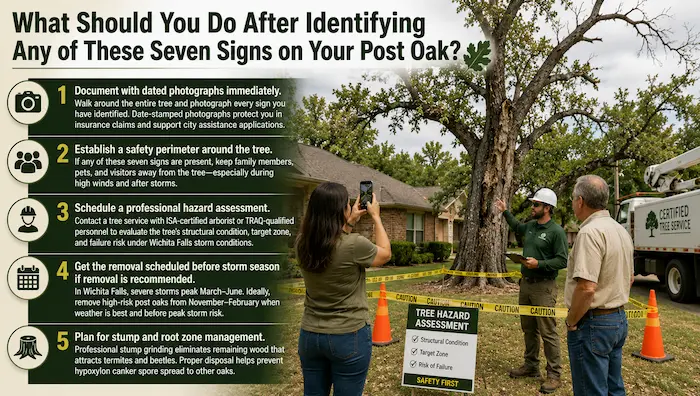
- Document with dated photographs immediately. Walk around the entire tree and photograph every sign you have identified: the Hypoxylon stromata if present, the lean and associated soil disturbance, any cracks, the dead canopy extent, utility line contact, and any widow-maker limbs visible from ground level. Date-stamped photographs protect you in insurance claims and support city assistance applications.
- Establish a safety perimeter around the tree. If any of these seven signs are present, particularly signs one through six, keep family members, pets, and visitors from spending extended time under or near the tree until a professional assessment confirms the level of risk. This is especially important during high-wind days and immediately following any storm event.
- Schedule a professional hazard assessment. Contact a tree service with an ISA-certified arborist or TRAQ-qualified personnel to conduct a formal hazard evaluation. The assessment should evaluate the tree’s structural condition, the target zone and occupancy of the area beneath the tree, and the likelihood of failure under the wind loading conditions characteristic of Wichita Falls spring storm season. An ISA Certified Arborist can locate qualified professionals serving the Wichita Falls area through the International Society of Arboriculture’s searchable database.
- Get the removal scheduled before storm season if removal is recommended. In Wichita Falls, the severe storm season peaks from March through June. A post oak that meets removal criteria should ideally come down between November and February, when weather conditions are most favorable for removal work, crew availability is at its best, and the removal happens before the highest-risk wind events of the year arrive. Waiting until the storm season has already started to schedule removal of a known hazard tree is accepting unnecessary risk.
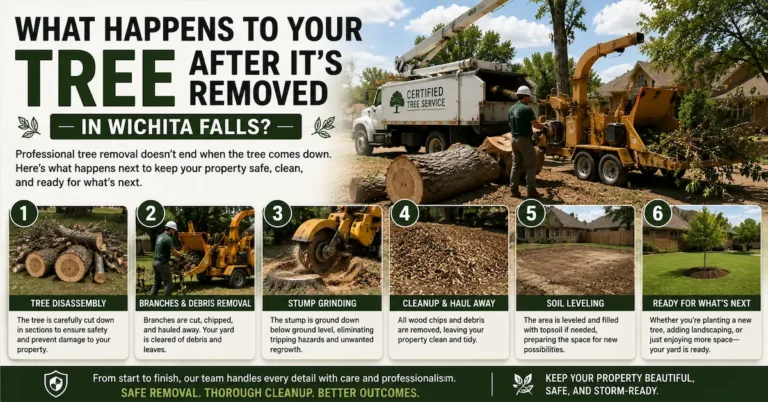
- Plan for stump and root zone management. After a post oak removal, our stump grinding and removal service handles the stump at or below grade and eliminates the remaining wood that would otherwise attract eastern subterranean termites and bark beetles common throughout Wichita County. For post oaks that died of hypoxylon canker, proper stump treatment and wood disposal prevent spore spread to other stressed oaks on your property.
Frequently Asked Questions
Can a post oak with hypoxylon canker be saved if caught early?
According to ISA-certified arborist assessments from Texas Tree Surgeons and Arborist USA, there is no cure for hypoxylon canker once the fungal stroma are visible externally, because visible stroma indicate that internal decline is already at an advanced stage. The fungus is a secondary pathogen, meaning the tree was already in severe decline before the hypoxylon became established. What can sometimes be done in the earliest stages, before stroma are visible, is aggressive stress reduction through deep root irrigation, soil amendment, and crown cleaning, which may slow the progression. Once stroma are visible on the trunk, the realistic outcome for the affected section is removal. The only variable is timing and scope, not whether removal is needed.
How much does it cost to remove a post oak in Wichita Falls?
Post oak removal in Wichita Falls typically costs between $600 and $2,000 for standard residential removals depending on tree height, trunk diameter, location relative to structures, and equipment access. Large mature post oaks over 60 feet with restricted access or requiring crane assistance can cost $2,000 to $4,000 or more. Getting a free on-site estimate before committing to a price ensures you are quoted for the specific conditions of your tree rather than a generalized size estimate. Post oaks that have reached advanced hypoxylon canker stages may require additional care during removal due to the brittle and unpredictable nature of the decayed wood, which can affect the final cost.
Do I need a permit to remove a post oak in Wichita Falls?
For most private residential property in Wichita Falls, no removal permit is required for a post oak on your own land. The city does require that tree limbs already on the ground be removed from the premises, and any removal associated with a commercial development project may require site plan review through the City of Wichita Falls Development Services Department. If your post oak is growing in or near a public easement, you should confirm with the city before scheduling removal. The Wichita Falls Hazard Abatement program through Neighborhood Revitalization may also affect the removal process and funding for qualifying properties.
Can I remove a post oak in Wichita Falls during summer?
Technically yes, but there are two important considerations. First, summer removal of a post oak with hypoxylon canker or any other active fungal disease during the warm months requires the crew to handle and dispose of wood material carefully to avoid spreading fungal spores to other stressed oaks on your property. Second, if the post oak is a healthy living tree being removed for a non-hazard reason such as construction or landscaping, summer removal during the February through June oak wilt transmission window creates fresh wound exposure during peak nitidulid beetle activity. Fresh cut surfaces on oak trees should be sealed immediately with latex-based pruning paint any time work is done during the warm months. Our team follows this protocol on every post oak job as standard practice.
Worried About a Post Oak on Your Wichita Falls Property?
Texoma Tree Service provides professional post oak hazard assessments, ISA-standard removal, stump grinding, and emergency response across Wichita Falls, Burkburnett, Iowa Park, Henrietta, Electra, and the Texoma region. Get your free on-site evaluation today.
Get Your Free Hazard Assessment
24-Hour Emergency Line: +9402237713