Emergency Tree Removal in Wichita Falls: What to Do After a Storm
Quick Answer
After a storm causes tree damage in Wichita Falls, your priority is safety, not cleanup. Stay away from downed power lines, document all damage with photos before anything is moved, and call a 24-hour emergency tree removal service to assess and secure the site. If a tree has fallen onto your home, vehicle, or is blocking access to your property, contact your homeowners’ insurance provider immediately and request a detailed written assessment from your tree service to support your claim. Texoma Tree Service provides 24-hour emergency tree removal across Wichita Falls, Burkburnett, Iowa Park, Henrietta, and surrounding Texoma communities.
Wichita Falls has a complicated relationship with severe weather. Situated in the heart of Tornado Alley, the city has been struck by some of the most destructive storms in Texas history, including the catastrophic F4 tornado of April 10, 1979, which locals still call Terrible Tuesday. That storm killed 42 people, injured more than 1,700, and left an estimated 20,000 residents homeless. Decades later, Wichita Falls continues to experience severe thunderstorms capable of producing straight-line winds exceeding 90 mph, large hail, and tornadoes with little warning.
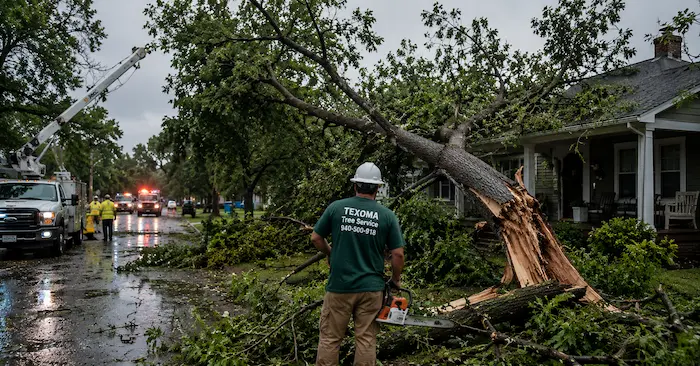
When those storms hit, the first thing most homeowners notice in their yard the next morning is tree damage. A fallen post oak across the driveway. A split cedar elm leaning against the fence. A large limb wedged against the roofline. What you do in the first few hours after a storm can determine whether the situation stays manageable or gets significantly worse. This guide walks you through every step, from the moment the storm passes to the moment your yard is clear, and your insurance claim is filed correctly.
Why Wichita Falls Gets Hit So Hard: Understanding Local Storm Risk
Before walking through what to do after a storm, it helps to understand why the Texoma region produces the kind of storm damage that creates genuine tree emergencies. Wichita Falls sits at the convergence of warm, moist air moving north from the Gulf of Mexico and cold, dry air dropping south from the Canadian plains. That collision zone produces supercell thunderstorms with alarming regularity, particularly from March through June, though severe weather can and does occur in any month.
According to the National Weather Service office in Norman, Oklahoma, which covers the Wichita Falls forecast area, the city has been struck by confirmed tornadoes dozens of times since record-keeping began. The 1979 Terrible Tuesday outbreak remains the benchmark event, but significant windstorms, derechos, and hailstorms have occurred regularly since. Oncor Electric Delivery, which manages the power distribution grid for Wichita Falls and surrounding communities, has documented storms producing gusts exceeding 90 mph that downed trees across thousands of residential and commercial accounts simultaneously.
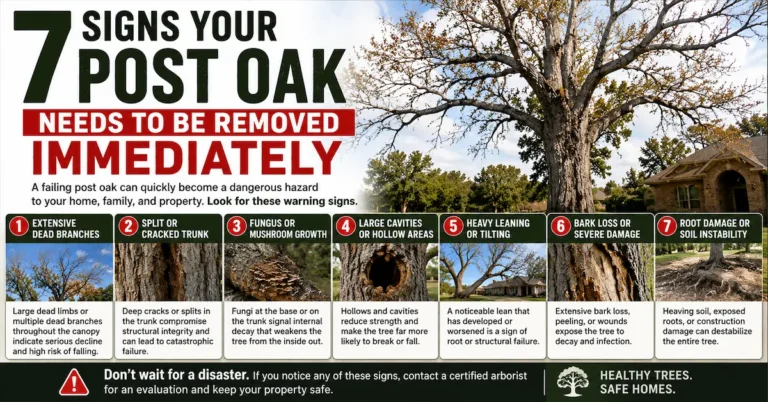
The tree species most common in Wichita Falls yards create their own layer of risk. Post oaks, cedar elms, hackberry, and honey mesquite all respond differently to wind loading and root saturation. Post oaks tend to fail at the trunk under extreme wind stress. Cedar elms split at the crotch where major limbs meet the trunk. Hackberry trees, with their comparatively shallow root systems in Wichita County clay soil, uproot more readily than species with deeper taproots. Knowing what species you have on your property helps you understand what kind of storm damage to look for after a severe weather event.
The First 30 Minutes: What to Do Immediately After the Storm
The impulse after a bad storm is to get outside immediately and assess the damage. That instinct needs to be controlled carefully. The 30 minutes following a severe weather event carry real risks that homeowners frequently underestimate, and the actions you take in this window set the stage for everything that follows.
Safety First: Do Not Do These Things After a Storm
- Do not approach a downed power line under any circumstances. According to Oncor, anything touching a downed line, including a tree branch, fence, or puddle of water, can be energized and deadly. Stay at least 50 feet back and call 911 immediately.
- Do not attempt to remove a tree that is resting on your roof, vehicle, or utility lines yourself. Storm-damaged trees hold enormous tension in their trunk and root systems. A limb that appears stable can shift or snap without warning when that tension releases.
- Do not enter a structure where a tree has fallen through the roof until the building has been assessed for structural integrity. A compromised roofline can collapse further at any time.
- Do not use a chainsaw to remove a tree that is pinned under another object. The stored energy in a bent or pinned trunk can cause the wood to kick violently when the tension releases, which is one of the most common causes of serious injury during amateur storm cleanup.
Once you have confirmed that it is physically safe to go outside, walk your property carefully from a distance first. Look for downed power lines before stepping into your yard. Wear sturdy shoes and long pants, as the City of Wichita Falls emergency management office recommends for any post-storm assessment. Check for hanging limbs, called widow makers by arborists, which are branches caught in the canopy above you that are not yet on the ground but can fall at any moment.
Your next step, before touching or moving anything, is documentation.
Document Before You Clear: Why Photos Are Non-Negotiable
Insurance adjusters need to see the damage as it occurred, not as you found it after you started cleaning up. The Texas Department of Insurance advises homeowners to photograph all storm damage before making repairs, moving the tree, or taking other cleanup steps. This guidance exists because the condition of the tree before it fell, and the specific nature of the structural damage it caused, are both material to whether and how much your claim pays.
- Photograph the fallen or damaged tree from multiple angles before any limbs are cut or moved. Include shots that show the full tree, the point of failure, and the surrounding area.
- Photograph any structural damage to your home, fence, vehicle, outbuildings, or other property from multiple distances. Include wide shots showing the relationship between the tree and the damaged structure.
- If the tree roots have been exposed, photograph the root zone. This helps establish whether the tree failed due to root decay, shallow anchoring, or saturated soil rather than a pre-existing hazard that should have been removed.
- Take a video walkthrough of the full damage area if possible, narrating what you see. Video provides context and sequence that still photos alone cannot capture.
- Save all photos with their original timestamps. Do not apply filters or edit the images before submitting them to your insurer.
- If it is safe to do so, make temporary repairs such as tarping a damaged roof section, and save all receipts. Your homeowners policy should cover materials and labor used to prevent further damage while your claim is processed.
Critical for your claim: The Texas Department of Insurance confirms that insurers may deny or reduce claims if the tree that fell was previously diseased, dying, or known to be hazardous and the homeowner failed to address it before the storm. Regular tree inspections and maintenance protect your coverage, not just your property.
When to Call an Emergency Tree Service in Wichita Falls
Not every post-storm situation qualifies as an emergency requiring immediate response. Understanding which situations demand a same-day call versus which can wait for a scheduled appointment helps you prioritize correctly and ensures emergency resources go where they are most needed after a major storm event.
Situations that require immediate emergency tree removal
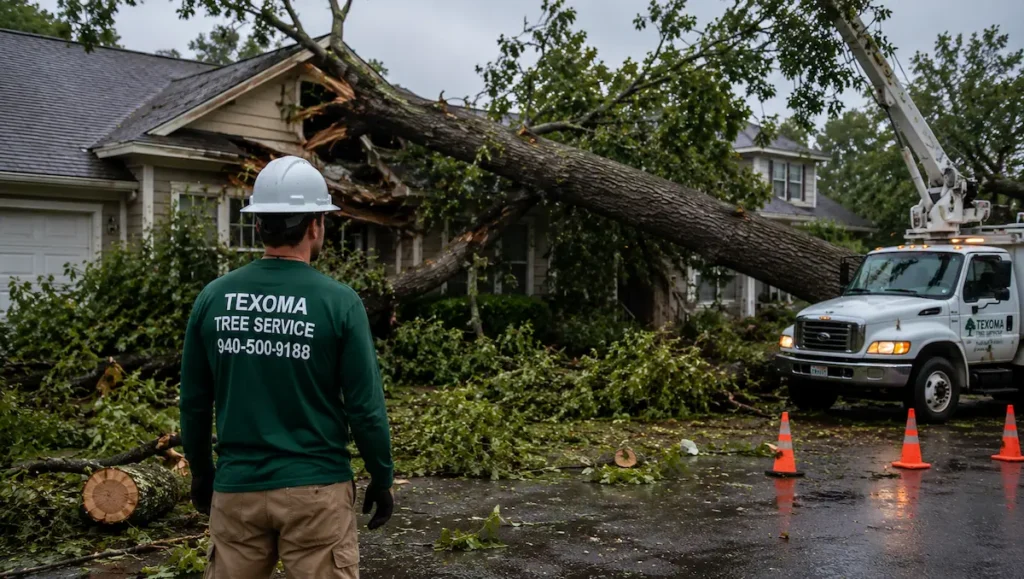
- A tree or major limb has fallen onto your home, garage, or any occupied structure
- A tree is actively pressing on your roofline and creating ongoing structural risk with rain or additional wind forecast
- A tree is blocking the only vehicle or pedestrian access to your property
- A tree is leaning dangerously toward your home or a neighboring structure and showing visible root heave or trunk cracking
- A tree or limb is in contact with overhead power lines managed by Oncor or any other utility
- A tree has fallen across a public roadway, and emergency vehicles need access
- A large hanging limb, called a widow maker, is suspended over a frequently occupied area such as a porch, walkway, or play area
Situations that can be scheduled rather than treated as emergencies
- Trees with broken or cracked limbs that are not hanging over structures or high-traffic areas
- Storm-damaged trees that are still standing need assessment, but do not pose an immediate structural threat
- Debris, small branches, and leaf litter that have landed in your yard but are not blocking access or threatening structures
- Stumps from trees that fell and were already cleared from hazardous areas
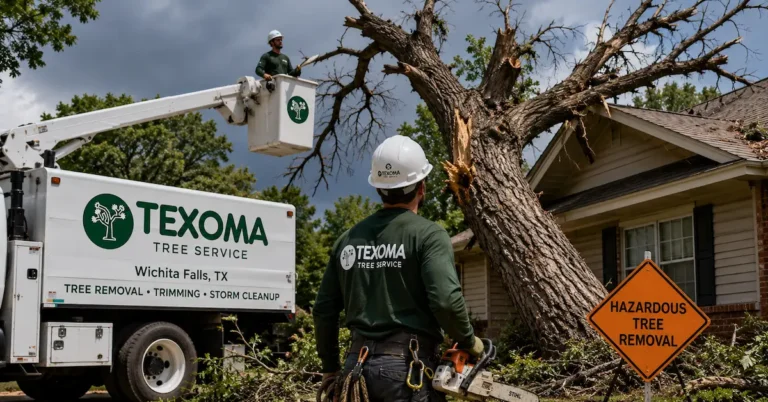
When you call Texoma Tree Service for an emergency response, a crew arrives to assess the scene, secure the hazard zone, and begin stabilizing or removing the tree using rigging, sectional dismantling, or crane-assisted techniques appropriate for the specific conditions. Every emergency call begins with a rapid assessment so you understand the risk, the approach, and the next steps before any cutting begins.
What Happens When the Emergency Tree Crew Arrives
Understanding what a professional emergency tree removal crew actually does when they arrive helps you know what to expect and how to stay out of the way during a situation that is already stressful enough. The sequence matters because storm damage introduces hazards that are simply not present during routine tree removal jobs.
Immediate Hazard Assessment
Before any equipment is unloaded, the crew lead walks the site and identifies all active hazards. This includes checking for hidden power line contact obscured by foliage, assessing tension in the fallen or damaged tree, looking for compromised soil beneath heavy equipment staging areas, and identifying any widow maker limbs in surrounding trees that the storm may have dislodged without dropping. Trees that have been uprooted are particularly hazardous because the exposed root plate can pivot and crush anything underneath if the tree shifts.
Securing the Work Zone
The area is flagged and secured before cutting begins. Nobody without personal protective equipment enters the work zone once the crew begins. In tight residential lots in Wichita Falls neighborhoods near Sikes Senter, Tanglewood, or along the older streets near Midwestern State University campus, this coordination with you and your neighbors matters significantly since the fall radius of storm-damaged trees can extend beyond your property line.
Rigging and Controlled Removal
Storm-damaged trees cannot simply be felled in a single drop the way a standing dead tree sometimes can. The stored energy, unpredictable root stability, and contact with structures all require sectional removal using rigging ropes and sometimes cranes. The crew sections the tree from the top down for standing damaged trees, or cuts and lifts sections off structures using rigging for fallen trees. Texoma Tree Service works with roofers, fence contractors, and other repair professionals so that once the tree is cleared, you have trusted local contacts ready for the structural repair phase.
Documentation for Your Insurance Claim
A quality emergency tree service provides you with a written assessment of the damage and the work performed. This document supports your insurance claim by confirming the condition of the tree, the nature of the failure, and the scope of emergency removal required. Keep this report alongside your own photographs and video for your adjuster.
How Texas Homeowners Insurance Covers Storm Tree Damage
Insurance coverage for storm tree damage is more nuanced than most Wichita Falls homeowners realize, and understanding it before you need it can save you significant frustration during an already difficult situation.
| Situation | Typically Covered? | Coverage Notes |
|---|---|---|
| Removal is not covered if no insured structure was damaged | Yes | A tree falls on your home during a storm |
| Tree falls on garage, fence, or other structure | Yes | Damage to covered structures is generally included under the standard policy |
| Yes, up to the limit | Generally No | Tree blocks the driveway or handicapped access ramp |
| Insurers may deny if tree was a known hazard owner failed to remove | Sometimes | Some policies cover debris removal if access is blocked |
| Tree removal cost when hitting a structure | The tree falls but hits nothing (lands in the yard only) | Typically $500 to $1,000 per tree; some policies up to $1,500 per event |
| Dead or diseased tree that fell (negligence) | Often Denied | Your insurer covers your damage; it may subrogate against neighbor’s policy |
| Neighbor’s tree falls onto your property | Yes | Your insurer covers your damage; it may subrogate against the neighbor’s policy |
| Preventive removal of storm-threatened tree | No | Structural damage and tree removal are typically covered as a covered peril |
The Insurance Information Institute reports that insurers paid an average of $4,110 for settled tree damage claims. Approximately 40 percent of all homeowners’ insurance losses in recent years were due to wind and hail damage, which is precisely the category of weather that Wichita Falls experiences regularly.
Protect your future claims now: If a tree on your property is known to be dead, diseased, or structurally compromised, proactively removing it before the next storm season is the responsible move. Beyond the obvious safety benefit, it protects your ability to file a successful claim for damage caused by a tree that was in good condition when it fell. Insurers send adjusters specifically to evaluate the pre-storm condition of fallen trees.
Hidden Storm Damage: What Looks Fine But Isn’t
One of the most dangerous consequences of a severe storm in Wichita Falls is the damage that does not announce itself. The fallen tree blocking your driveway is obvious. The internal fractures and compromised root systems in the trees still standing around your home are not, and they are often the source of the next emergency after the next storm.
Signs of Hidden Storm Damage in Surviving Trees
Have your remaining trees inspected after every major storm event
Storm-damaged trees that appear structurally sound immediately after a weather event may have sustained hidden internal fractures, root zone disturbance, or crotch splitting that does not become visible for days or weeks. An ISA Certified Arborist trained in hazard tree assessment can identify these conditions using methods not available to the untrained eye.
- Newly visible soil cracking or heaving around the root zone, even if the tree is still upright, indicates root zone disturbance that compromises long-term stability
- Fresh vertical cracks or splits running along the trunk, particularly at branch unions, signal internal stress fractures that weaken the tree significantly
- Canopy asymmetry after a wind event may indicate that one side of the root system lost significant anchoring during the storm
- Bark wounds, stripped bark sections, or exposed wood from wind or hail impact create entry points for fungal pathogens like hypoxylon canker, which is common in North Texas under drought stress conditions
- Hanging or partially attached limbs lodged in the canopy above, called widow makers, may not fall for days after the storm, but are among the most dangerous post-storm hazards on any property
Scheduling a post-storm tree inspection with a qualified arborist after any major weather event is one of the most cost-effective investments a Wichita Falls homeowner can make. Early identification of compromised trees allows time for careful, planned removal rather than reactive emergency response. Our tree trimming and pruning service includes hazard assessments that identify these conditions before they become the next emergency call.
Reducing Your Storm Risk Before the Next Wichita Falls Severe Weather Season
Emergency tree removal is inherently reactive. The most effective strategy is the work done before a storm arrives, and the window between October and early March, when most of Wichita Falls is between active storm seasons, is the ideal time to address tree risk on your property.
The City of Wichita Falls emergency management office recommends checking your property for storm risks before the severe weather season begins. For trees, that means scheduling a professional inspection to identify structurally compromised trees, deadwood accumulation in the canopy, and trees growing toward structures or utility lines. The National Weather Service classifies severe thunderstorms in the Wichita Falls area as capable of producing winds of 58 mph or higher, with significant events routinely exceeding 70 mph. A tree with compromised structural integrity does not need a tornado to become a hazard at those wind speeds.
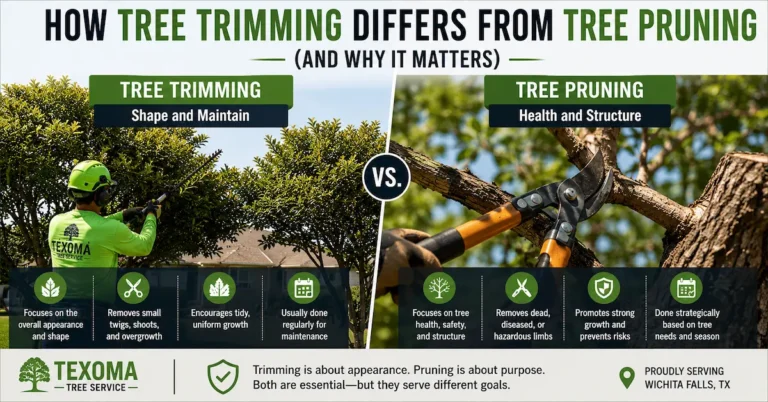
Routine tree trimming and pruning by a qualified crew removes dead branches, reduces wind resistance in the canopy, and corrects structural defects before they become failure points. For trees near your home, power lines, or frequently used areas of your property, annual pruning is not an optional luxury. It is the maintenance that keeps a predictable and manageable situation from becoming a 2 a.m. emergency call in the middle of a spring storm.
For trees that a post-storm or pre-season inspection identifies as beyond saving, our professional tree removal service handles the full process from assessment through stump management, giving you a clear yard and peace of mind before the next storm season arrives.
Frequently Asked Questions:
How quickly can you get an emergency tree crew to my Wichita Falls property?
Texoma Tree Service provides 24-hour emergency response across Wichita Falls and surrounding Texoma communities, including Burkburnett, Iowa Park, Henrietta, and Electra. Response time after a major storm event depends on the volume of simultaneous calls, but genuine structural emergencies, trees on homes, and blocked access are prioritized over non-critical situations.
Will my homeowners’ insurance cover emergency tree removal in Wichita Falls?
Coverage depends on whether the tree hit an insured structure and the cause of the storm event. Standard Texas homeowners’ policies typically cover tree removal costs up to $500 to $1,000 per tree when the tree has fallen onto a covered structure due to a covered peril like wind or lightning. Trees that fall in the yard without hitting anything are generally not covered for removal. Always photograph damage before cleanup and file your claim promptly.
A tree from my neighbor’s yard fell onto my property. Who pays?
Under Texas law, your own homeowners’ insurance generally covers the damage to your property regardless of which yard the tree came from. Your insurer may then pursue subrogation against your neighbor’s insurance if negligence on their part, such as a known dead or diseased tree, can be established. Document the source of the tree thoroughly with photographs before any cleanup begins.
There is a tree touching Oncor power lines after the storm. What do I do?
Do not approach or attempt to remove a tree or any debris in contact with Oncor power lines. Call Oncor directly to report the downed or contacted line, and call 911 if there is an immediate public safety concern. Oncor teams coordinate line clearance and can authorize contractor work near energized lines once conditions are confirmed safe. Your tree service should never begin work within the fall or contact zone of an energized line without Oncor clearance.
Can I remove a storm-damaged tree myself to save money?
For small, isolated branches that have fallen in the open and present no tension or structural complexity, homeowner cleanup is reasonable. However, any tree that is resting on a structure, in contact with a utility line, has significant tension in the trunk or limbs, or is larger than you can safely handle with a standard ladder and hand tools, is a professional job. The stored energy in storm-damaged wood is what injures and kills untrained individuals attempting DIY cleanup. The cost of professional emergency removal is almost always less than the cost of an emergency room visit or the additional property damage caused by an amateur removal gone wrong.
Storm Hit Your Property? We Respond 24 Hours a Day.
Texoma Tree Service provides emergency tree removal across Wichita Falls, Burkburnett, Iowa Park, Henrietta, Electra, and the surrounding Texoma area. Call now for an immediate response.
24-Hour Emergency Line: +1 (940) 654-8157