Residential vs. Commercial Tree Removal: Key Differences Explained
Quick Answer
Residential and commercial tree removal are not the same service, even when the tree being removed is identical in size and species. Residential tree removal in Wichita Falls typically involves smaller crews, lighter equipment, and lower insurance thresholds, with costs ranging from $300 to $1,800 per tree. Commercial tree removal requires larger crews, heavy equipment such as cranes and aerial lifts, commercial liability coverage of $2 million to $5 million, stricter permit compliance under City of Wichita Falls zoning and development ordinances, and significantly higher project management coordination. The key differences span six categories: project scale and access, equipment requirements, insurance and liability standards, permitting obligations, crew size and scheduling, and total cost structure. Understanding which category your project falls into before you call a tree service company saves time, prevents underinsurance surprises, and ensures your crew is actually equipped for the job.
When a property manager for a commercial strip mall on Kemp Boulevard calls Texoma Tree Service and a homeowner in a Tanglewood neighborhood calls about the same-sized post oak in their backyard, both calls are about tree removal. But the two jobs could not be more different in how they are planned, staffed, insured, and priced. The tree in both scenarios may be the same height and the same species, but everything surrounding it changes the complexity, cost, and risk profile of the removal entirely.
This confusion between residential and commercial tree removal is one of the most common sources of scope mismatch, permit violations, and underinsurance problems in the tree service industry. A homeowner who hires a crew built for residential work to handle a commercial removal near Sheppard Air Force Base or along a busy Wichita Falls retail corridor may find themselves facing liability exposure their crew’s insurance does not cover. A property manager who calls a commercial-grade crew for a routine backyard removal will pay a premium they do not need to.
This guide breaks down every meaningful difference between residential and commercial tree removal in Wichita Falls so that homeowners, landlords, property managers, and developers can make informed decisions before the chainsaw arrives.
The Foundational Difference: Scope, Scale, and Surrounding Environment
The most fundamental difference between residential and commercial tree removal is not the tree itself. It is everything surrounding the tree that determines how the job must be planned, executed, and insured.
Residential tree removal in Wichita Falls typically involves a single tree or a small number of trees on a private property. The surrounding environment includes a home, a fence, a driveway, landscaping, and perhaps neighboring properties. The primary audience for the work is the homeowner and their family. The removal timeline is flexible, access is generally straightforward for residential-scale equipment, and the liability chain is relatively contained.
Commercial tree removal involves trees on properties where the surrounding environment includes multiple structures, active businesses, employee parking areas, customer foot traffic, loading zones, utilities serving multiple tenants, and in some cases public roadways. Commercial properties around Wichita Falls, including retail centers near Sikes Senter, industrial properties near the Wichita Falls Regional Airport, multifamily complexes along Southwest Parkway, and institutional campuses associated with Midwestern State University, all present surrounding environments that make every cut, every falling section, and every equipment placement decision significantly more consequential than a residential removal in a backyard.
Residential Removal
Typical Environment
- Single family home or small multifamily property
- Backyard, front yard, or side lot
- 1 to 5 trees per project on average
- Audience limited to homeowner and neighbors
- Flexible scheduling with limited time pressure
- Standard equipment access via residential driveway or gate
- Liability primarily between homeowner and tree service
Commercial Removal
Typical Environment
- Retail center, office complex, multifamily, or industrial property
- Active customer and employee traffic during business hours
- 5 to 50 or more trees in a single contract
- Multiple stakeholders including tenants, property managers, and lenders Strict scheduling around business operating hours
- Access requires coordination with parking management and traffic control
- Liability chain includes property manager, tenants, customers, and public
Equipment Requirements: Where Residential and Commercial Tree Removal Diverge Most Visibly
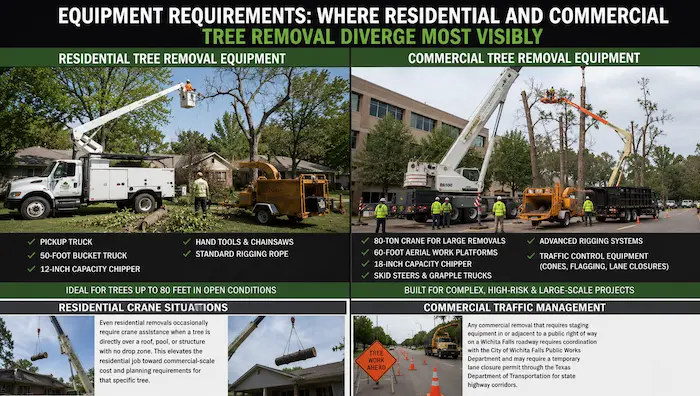
The equipment difference between residential and commercial tree removal is where most homeowners and property managers first notice that they are dealing with fundamentally different service categories. A residential removal crew typically arrives with a pickup truck, a wood chipper, a bucket truck for taller trees, and standard chainsaw and rigging equipment. This setup is efficient and appropriate for the access conditions and tree sizes common in Wichita Falls residential neighborhoods.
Commercial tree removal on a property with large, mature trees near structures, overhead utilities, or active traffic zones requires a meaningfully different complement of equipment. Large cranes, aerial work platforms, multiple chippers, skid steers for debris management, and specialized rigging systems are all standard on complex commercial jobs. The difference is not optional equipment or a luxury upgrade. It is the only approach that manages the risk appropriately when trees are being removed in environments where a mistake affects more than a single homeowner’s property.
Equipment comparison by project type
- Residential standard: Pickup truck, 50-foot bucket truck, 12-inch capacity chipper, hand tools, and standard rigging ropes for trees up to 80 feet in open conditions
- Commercial standard: 80-ton crane for large or structurally complex removals, 60-foot aerial work platforms for multiple simultaneous operations, high-capacity chippers processing 18-inch material, skid steers and grapple trucks for debris management, and traffic control equipment including cones, flagging, and sometimes lane closure permits
- Residential crane situations: Even residential removals occasionally require crane assistance when a tree is directly over a roof, pool, or structure with no drop zone. This elevates the residential job toward commercial-scale cost and planning requirements for that specific tree.
- Commercial traffic management: Any commercial removal that requires staging equipment in or adjacent to a public right-of-way on a Wichita Falls roadway must be coordinated with the City of Wichita Falls Public Works Department and may require a temporary lane-closure permit from the Texas Department of Transportation for state highway corridors.
Insurance and Liability: The Difference That Protects You Most
Insurance is where the residential versus commercial tree removal distinction has the most direct financial consequence for the property owner or manager hiring the crew. This is also the area most consistently underexplained in competitor content, which tends to mention insurance in passing without quantifying what the difference actually means for the hiring party.
For residential tree removal in Wichita Falls, the standard general liability insurance requirement is $1 million per occurrence. This level of coverage is appropriate for the risk profile of a residential job where the potential property damage and bodily injury exposure is bounded by the value and occupancy of a single home and its immediate surroundings.
For commercial tree removal, the standard general liability requirement rises to $2 million to $5 million per occurrence, and most commercial property managers and institutional clients require proof of this coverage level before authorizing any work. According to ArborNote’s 2025 tree service insurance guidance, commercial projects require $2 million to $5 million in liability coverage versus $1 million for residential work, and most commercial clients specifically request proof of these higher limits before hiring. The reason is straightforward: the exposure on a commercial property includes potential damage to multiple tenant spaces, customer vehicles in parking areas, interruption of business operations, and third-party bodily injury from members of the public accessing the property during removal work.
Texas Tree Service Insurance: What Both Property Types Require
What to verify before any crew starts work on your property
Texas does not require a statewide contractor license for tree service companies. This means that insurance verification is your primary protection as a property owner, regardless of whether your project is residential or commercial. Before any crew begins work on your Wichita Falls property, verify the following:
- General liability insurance: Minimum $1 million per occurrence for residential work. Minimum $2 million to $5 million per occurrence for commercial properties, institutional campuses, or multifamily developments. Request the certificate of insurance directly from the insurer, not just a copy from the contractor.
- Workers compensation insurance: Texas is the only state where workers compensation is not legally mandatory for private employers. However, tree service is classified among America’s most dangerous occupations, with a fatality rate of 110 per 100,000 workers according to industry insurance data. A tree crew without workers’ compensation means that an injured worker on your property may have a direct claim against you as the property owner.
- Commercial auto insurance: Covers the crew’s vehicles, trailers, and equipment in transit to and from your property. Standard personal auto insurance does not cover commercial vehicle use or equipment hauling.
- Equipment coverage: Specialized equipment coverage for cranes, aerial lifts, and chippers protects against equipment damage that could otherwise delay your project and expose you to claims if rented equipment damages your property.
An ISA Certified Arborist leading your project adds professional liability protection to this insurance stack, covering claims related to incorrect assessment or recommendations in addition to the standard general liability coverage.
Permitting and Regulatory Requirements in Wichita Falls
The permitting landscape for tree removal in Wichita Falls follows the same residential versus commercial divide as equipment and insurance requirements, with commercial projects facing a significantly more complex regulatory environment.
Residential Permitting in Wichita Falls
For most private residential tree removal in Wichita Falls, no removal permit is required as long as the work does not involve grading, drainage alteration, or removal as part of a larger development project. The City of Wichita Falls code enforcement ordinance requires that tree limbs already on the ground be removed from the premises promptly, and property owners in HOA-governed neighborhoods must check their covenants before scheduling any removal work. Trees growing into or near Oncor Electric Delivery service lines require coordination with Oncor before any work begins, regardless of property type.
Commercial Permitting in Wichita Falls
Commercial tree removal in Wichita Falls operates under a meaningfully different regulatory framework. The City of Wichita Falls zoning ordinance and subdivision regulations require that any development project, including site preparation and landscape modification on commercial parcels, submit a site plan identifying trees proposed for removal. Commercial removals that alter drainage patterns or involve grading activity may require additional approvals through the City of Wichita Falls Development Services Department and potentially through the Texas Commission on Environmental Quality for projects near waterways or drainage easements.
Commercial permit checklist for Wichita Falls property managers
- Site plan review confirming tree removal is consistent with approved development envelope and landscaping requirements under the Wichita Falls Unified Development Code
- Landscape plan amendment if tree removal changes the canopy coverage calculation that was part of original site approval
- Temporary lane closure permit from City of Wichita Falls Public Works or Texas Department of Transportation if equipment staging requires use of a public right of way
- Oncor Electric Delivery coordination for any removal within the line clearance zone of primary distribution lines serving commercial properties
- Texas Commission on Environmental Quality review if the project involves grading or land disturbance of one acre or more, triggering stormwater permit requirements
- HOA or property association approval if the commercial property operates under a planned development association with landscape maintenance covenants
Property manager tip: Always confirm permit requirements with the City of Wichita Falls Development Services Department before scheduling a commercial tree removal. Proceeding without required site plan approval can result in a stop-work order, fines, and required restoration planting that exceeds the original removal cost. Most established Wichita Falls tree service companies with commercial experience handle permit coordination as part of the project scope.
Crew Size, Scheduling, and Project Management
The operational differences between residential and commercial tree removal extend well beyond equipment and insurance into how the project is staffed, scheduled, and coordinated from start to finish.
Residential Crew and Schedule
A standard residential tree removal crew in Wichita Falls typically consists of two to four people: a lead climber or bucket truck operator, a ground crew member managing rigging and debris, and a chipper operator. The schedule for residential work is generally flexible, with most homeowners able to accommodate the crew’s availability within a reasonable window. Emergency residential removals after storm events follow a priority queue based on hazard severity, with trees actively on structures or blocking access addressed first.
Commercial Crew and Schedule
Commercial tree removal crews are larger, often six to twelve or more people depending on project scope, and the scheduling requirements are significantly more rigid. A retail property on Kemp Boulevard cannot have its parking lot blocked during Saturday business hours. A multifamily complex cannot have its main access road obstructed during weekday morning and evening commute windows. Work must often be phased across multiple early morning or after-hours sessions to avoid disrupting tenant operations and customer access.
This scheduling complexity adds project management overhead that residential jobs simply do not carry. A commercial tree removal contract with a property management company typically involves a pre-job site walk with the property manager, a written project plan identifying each removal phase and equipment staging location, daily cleanup requirements to restore access between sessions, and a designated point of contact for tenant communication during the project.
- 1Pre-job site assessment with property manager and tenants. Commercial removals begin with a stakeholder walkthrough that maps equipment access routes, identifies utility locations, confirms staging areas, and establishes communication protocols with tenants whose operations may be affected during the removal window.
- 2Phased removal plan development. Unlike residential removals that typically complete in a single session, commercial projects are sequenced to minimize disruption. Trees near active building entrances are often scheduled last, while those in peripheral parking areas or along fence lines are addressed first.
- 3Traffic and access management setup. Cones, signage, and sometimes flagging crews are positioned before equipment arrives. On commercial properties adjacent to public roads, temporary traffic control plans may need to be in place and approved before equipment staging begins.
- 4Phased execution with daily site restoration. At the end of each day’s work session, the site is cleared of debris to restore normal access for the following business day. This adds labor cost but is non-negotiable for commercial clients whose operations cannot be interrupted overnight.
- 5Final inspection and documentation. Commercial removals typically close with a written completion report documenting each tree removed, the method used, and any stump or debris handling completed. This documentation supports property manager reporting to building owners, lenders, and municipal records.
Cost Differences Between Residential and Commercial Tree Removal in Wichita Falls
The cost difference between residential and commercial tree removal is real, consistent, and driven by everything covered in the sections above: larger crews, heavier equipment, higher insurance premiums, permit fees, scheduling complexity, and project management overhead. Understanding the cost structure helps both homeowners and property managers evaluate quotes accurately and avoid the trap of comparing residential-scale pricing to commercial-scope work.
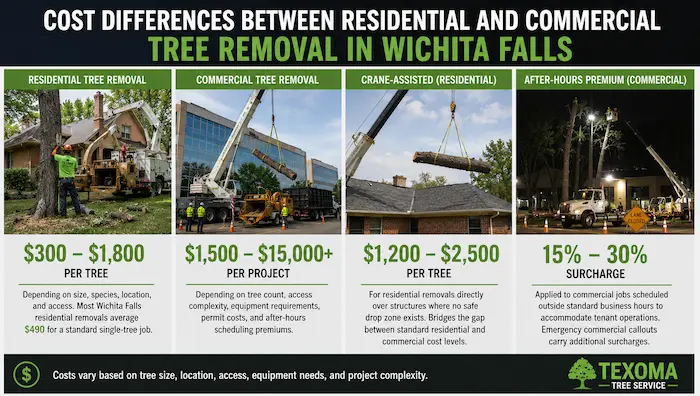
Residential Tree Removal
$300 to $1,800
Per tree, depending on size, species, location, and access. Most Wichita Falls residential removals average $490 for a standard single-tree job.
Commercial Tree Removal
$1,500 to $15,000+
Per project, depending on tree count, access complexity, equipment requirements, permit costs, and after-hours scheduling premiums.
Crane-Assisted (Residential)
$1,200 to $2,500
For residential removals directly over structures where no safe drop zone exists. Bridges the gap between standard residential and commercial cost levels.
After-Hours Premium (Commercial)
15% to 30% surcharge
Applied to commercial jobs scheduled outside standard business hours to accommodate tenant operations. Emergency commercial callouts carry additional surcharges.
Common Cost Mistakes on Both Sides
Residential property owners frequently underestimate total cost by forgetting stump grinding, debris haul-off, and permit fees when comparing quotes. Always confirm whether stump handling is included or priced separately, and ask whether the quote covers complete debris removal or only limb cutting and stacking.
Commercial property managers frequently award tree removal contracts based solely on per-tree pricing without accounting for after-hours scheduling premiums, traffic control costs, permit filing fees, and the insurance coverage tier the project actually requires. A low per-tree quote from a crew carrying only residential-level insurance is not a bargain for a commercial property owner whose exposure exceeds that coverage ceiling.
How to Know Which Service Category Your Wichita Falls Project Needs
The practical question most Wichita Falls property owners arrive at is straightforward: how do I know whether my project requires a residential or commercial tree removal approach? The answer comes down to four qualifying criteria.
| Qualifying Factor | Residential Approach | Commercial Approach |
|---|---|---|
| Property type | Single family home, small duplex, or private lot | Retail, office, multifamily of 5 or more units, industrial, or institutional |
| Number of trees | 1 to 4 trees per project | 5 or more trees, or any number on an active commercial site |
| Public exposure | Work area limited to private property with no public access during removal | Customer, employee, or pedestrian traffic present or adjacent during work |
| Insurance requirement | $1M general liability sufficient | $2M to $5M general liability required by most commercial clients and lenders |
| Permit complexity | Generally no permit required in Wichita Falls for residential removal | Site plan review, lane closure, and potentially TCEQ compliance required |
| Scheduling flexibility | Flexible, typically completed in a single session | Phased around business hours, may span multiple days |
| Equipment scale | Bucket truck, standard chipper, hand rigging | Crane, aerial platform, high-capacity chipper, traffic control equipment |
If your project falls into any commercial category above, working with an ISA Certified Arborist from the beginning of the planning process protects you in multiple ways. A certified arborist can prepare the written hazard assessment and tree inventory that commercial permit applications require, advise on which trees can be retained as part of your landscape plan rather than removed, and provide the professional opinion documentation that some commercial property insurers require before authorizing removal of trees that are near insured structures.
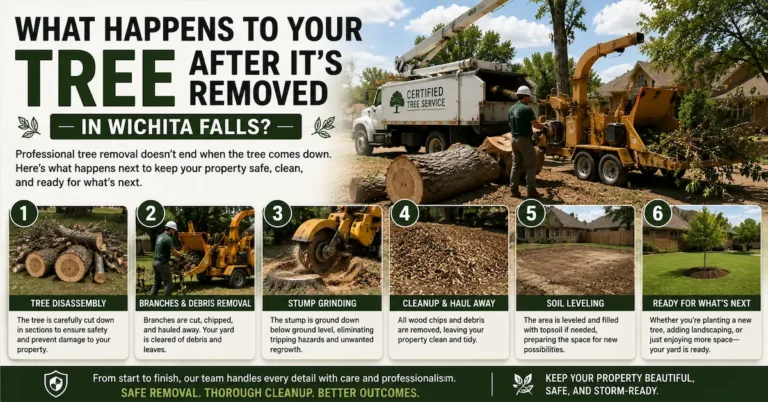
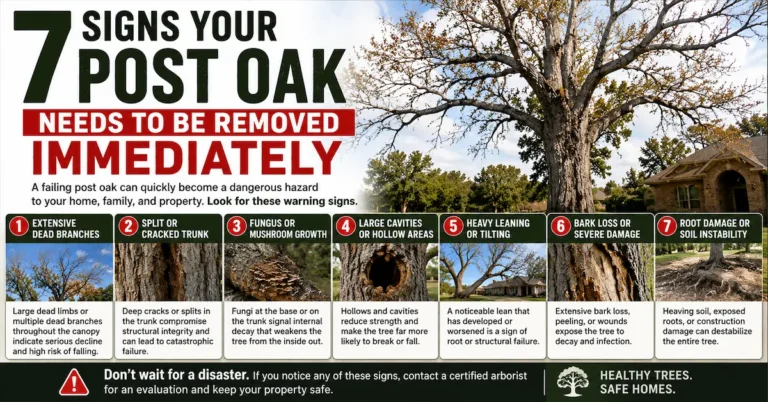
For residential properties with a complex tree situation, including trees directly over rooflines, trees in contact with utility lines, or trees showing signs of hazardous structural decline, our professional tree removal service includes a full site assessment before any work begins so you understand the scope, the method, and the total cost before committing. For commercial properties requiring phased removal, permit coordination, and after-hours scheduling, our team handles the full project management scope from initial site walk-through to final cleanup and documentation.
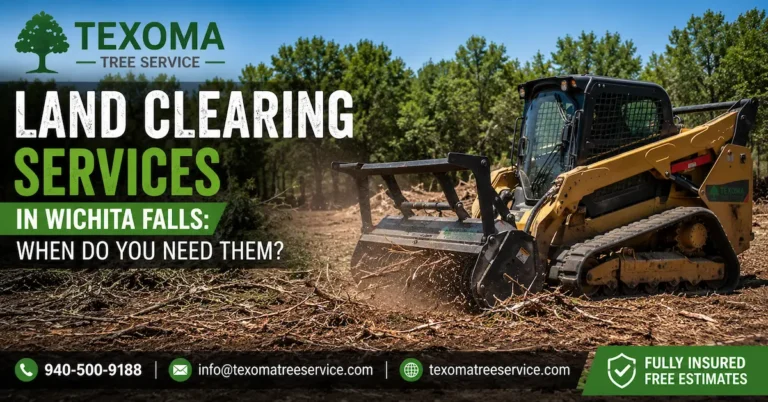
Properties that need land preparation beyond individual tree removal, including brush clearing, stump grinding across multiple trees, or site grading preparation for construction, benefit from reviewing our stump grinding and removal service and our land clearing capabilities as part of the overall project scope discussion.
Frequently Asked Questions
Can the same tree service company handle both residential and commercial removals in Wichita Falls?
Yes, but not all companies that handle residential work are equipped or insured for commercial projects. Before hiring any company for a commercial removal in Wichita Falls, confirm that they carry commercial-level general liability coverage of $2 million or higher, have experience with commercial permit coordination, and have access to the crane and aerial equipment that complex commercial removals typically require. Texoma Tree Service handles both residential and commercial tree removal across the Wichita Falls and Texoma region.
Is stump grinding always included in tree removal quotes for commercial properties?
Rarely automatically. Stump grinding is quoted separately in the vast majority of both residential and commercial tree removal estimates. For commercial properties where the cleared area will be resurfaced, planted, or paved, specifying stump grinding and the required grind depth in the contract before work begins prevents the additional mobilization cost of bringing grinding equipment back to the site after the removal crew has departed.
How does storm damage tree removal work differently for commercial properties in Wichita Falls?
After major storm events in Wichita Falls, commercial properties face the same emergency removal needs as residential ones but with significantly higher complexity. A fallen tree blocking a retail entrance, a compromised tree leaning over a customer parking area, or storm debris restricting access to a multifamily complex all represent situations where business operations and liability exposure are simultaneously at stake. Our emergency tree removal service operates 24 hours a day and is equipped to handle both residential and commercial emergency situations across the Wichita Falls and Texoma area.
What documentation does a commercial property manager need from their tree service after removal?
At a minimum, a commercial property manager should receive a written scope completion report identifying each tree removed, a certificate of insurance confirming coverage was active during the work period, and before-and-after photographs of the work area. For properties that require permit compliance, copies of any permit applications and approvals should be retained in the property file. This documentation supports reporting to building owners, satisfies lender inspection requirements, and provides evidence of professional maintenance in the event of a future liability claim.
Does the type of property affect how quickly a Wichita Falls tree service can respond to an emergency?
Response time is driven by hazard severity rather than property type for genuine emergencies. A residential tree on a roof and a commercial tree blocking a business entrance are both high-priority calls. What differs is the equipment and crew required on arrival. A commercial emergency that requires crane assistance or traffic control takes longer to fully stage than a residential emergency that can be addressed with a bucket truck and a small crew. Describing the situation accurately when you call, including property type, tree location, and surrounding hazards, helps the dispatcher send the right equipment on the first response rather than escalating after arrival.
Residential or Commercial Tree Removal in Wichita Falls?
Texoma Tree Service handles both residential and commercial tree removal across Wichita Falls, Burkburnett, Iowa Park, Henrietta, Electra, and surrounding Texoma communities. Get a free on-site estimate tailored to your property type.
Call us: +1 940 223-7713