How Tree Trimming Differs From Tree Pruning (And Why It Matters)
Quick Answer
Tree trimming and tree pruning are two distinct tree care practices that serve completely different purposes. Tree trimming is about controlling size, shape, and appearance by cutting back overgrown or wayward branches to keep a tree looking tidy and fitting within its space. Tree pruning is a health and structure-focused practice that involves the selective removal of dead, diseased, damaged, or structurally weak branches according to ISA and ANSI A300 standards to improve long-term tree vitality and safety. Using the wrong method at the wrong time can stress your trees, invite disease, and create long-term structural problems. In Wichita Falls, where post oaks, cedar elms, and pecan trees grow under significant heat and drought stress, understanding which service your trees actually need is not a minor detail.
Most Wichita Falls homeowners use the terms tree trimming and tree pruning interchangeably, as if they are just two ways of saying the same thing. The tree service industry, and particularly the professionals who carry ISA certification and follow the ANSI A300 standard for tree care, treat them as meaningfully different services with different tools, different techniques, different timing, and different goals. Calling the wrong one by the right name might seem like semantics until you realize that a crew applying the wrong approach to a stressed post oak or a mature cedar elm can do lasting structural damage with every cut.
This guide is written for Wichita Falls homeowners who want to understand the real difference, make better decisions when calling a tree service, and avoid the mistakes that end up shortening the life of some of the most valuable and irreplaceable trees on their property.
What Tree Trimming Actually Means
Tree trimming is primarily a cosmetic and practical service. Its goal is to control the size, shape, and spread of a tree so that it looks neat, fits within the available space, and does not encroach on structures, utility lines, rooflines, or neighboring properties. When you call a tree company because branches are scraping your gutters, overhanging the fence line, growing into the power lines on your property, or making your front yard look overgrown and untidy, tree trimming is what you are describing.
The cuts made during trimming are not driven by a detailed assessment of the tree’s internal structure or long-term health. They are driven by where the tree is growing and how much space it has available. Trimming typically uses lighter equipment, including hand shears, hedge trimmers, pole saws, and small chainsaw units, because the branches being removed are generally the younger, smaller, fast-growing portions of the canopy rather than large structural limbs.
When tree trimming is the right service to call
- Branches are growing over your roof, scraping shingles, or making contact with your gutters
- Canopy growth is encroaching on Oncor Electric Delivery lines, or service drops running to your home
- Overgrown branches are blocking natural light to a patio, garden bed, or interior rooms
- Trees along your fence line are pushing branches into a neighboring property
- Fast-growing ornamental trees and shrubs have lost their desired shape and need reshaping
- Tree canopy is growing unevenly and affecting curb appeal
- Branches are hanging low enough to block visibility on a driveway or walkway
Tree trimming is typically performed once or twice a year for fast-growing ornamental and shade trees, and less frequently for slower-growing species. For Wichita Falls properties, the best trimming windows align with periods that minimize stress on the tree: late winter before new spring growth, or early fall before the first frost. Trimming during the peak summer heat, when Wichita Falls regularly records temperatures above 100 degrees Fahrenheit, stresses trees that are already working hard to manage heat and drought.
What Tree Pruning Actually Means
Tree pruning is a fundamentally different kind of work. Where trimming is reactive, pruning is deliberate and strategic. A pruning job begins with a trained arborist assessing the tree’s health, identifying its structural strengths and weaknesses, locating dead wood, diseased tissue, crossing branches, included bark, and competing leaders, and then making calculated cuts designed to improve how the tree will grow over the next five to twenty years.
The International Society of Arboriculture defines tree pruning as the selective removal of specific branches to benefit the health, structure, safety, and longevity of the tree. The cuts made during professional pruning follow the ANSI A300 standard developed jointly by the American National Standards Institute, the ISA, and the Tree Care Industry Association. Under this standard, every cut must be placed correctly at the branch collar, which is the swollen area at the base of each branch where the tree produces callus tissue for wound closure. Flush cuts that remove the branch collar are explicitly prohibited under ANSI A300 because they prevent proper healing and create entry points for fungal pathogens.
Pruning also has strict quantity limits. Certified arborists following ANSI A300 should not remove more than 25 percent of a tree’s live canopy in a single pruning session. Removing more than this threshold removes too much of the leaf area that produces the photosynthate the tree uses to sustain its roots, trunk, and remaining branches. This is why professional pruning is often staged over two growing seasons for trees with significant structural problems.
When tree pruning is the right service to call
- Dead, dying, or diseased branches are visible in the canopy and need to be removed before they fall or spread infection
- Two or more main leaders are competing for dominance in a young tree and structural training is needed to establish a single central leader
- Crossing or rubbing branches are creating bark wounds where pathogens like Hypoxylon canker can enter
- A tree has included bark at major crotch unions, a condition where two limbs grow tightly together and create a structurally weak joint prone to splitting under wind load
- Storm damage has left broken or hanging limbs that need hazard reduction pruning to prevent injury or further structural failure
- An oak is showing signs of oak wilt, and selective removal of symptomatic wood is part of a broader management plan
- A mature post oak or pecan has not been professionally assessed in several years and may have accumulated deadwood that creates a fall hazard over a frequently used area of the yard
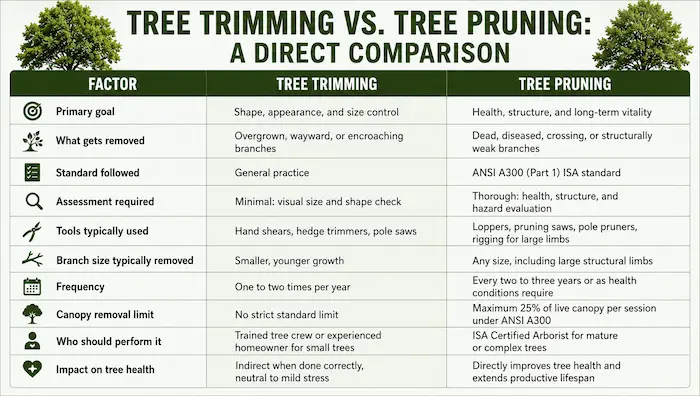
Tree Trimming vs. Tree Pruning: A Direct Comparison
| Factor | Tree Trimming | Tree Pruning |
|---|---|---|
| Primary goal | Shape, appearance, and size control | Health, structure, and long-term vitality |
| What gets removed | Overgrown, wayward, or encroaching branches | Dead, diseased, crossing, or structurally weak branches |
| Standard followed | General practice | ANSI A300 (Part 1) ISA standard |
| Assessment required | Minimal: visual size and shape check | Thorough: health, structure, and hazard evaluation |
| Tools typically used | Hand shears, hedge trimmers, pole saws | Loppers, pruning saws, pole pruners, rigging for large limbs |
| Branch size typically removed | Smaller, younger growth | Any size, including large structural limbs |
| Frequency | One to two times per year | Every two to three years or as health conditions require |
| Canopy removal limit | No strict standard limit | Maximum 25% of live canopy per session under ANSI A300 |
| Who should perform it | Trained tree crew or experienced homeowner for small trees | ISA Certified Arborist for mature or complex trees |
| Impact on tree health | Indirect when done correctly, neutral to mild stress | Directly improves tree health and extends productive lifespan |
The Four Types of Pruning Your Trees May Need
Professional tree pruning is not a single monolithic service. The ANSI A300 standard defines several distinct pruning types, each addressing a different objective. Understanding these helps Wichita Falls homeowners have more informed conversations with tree service companies and ask better questions when reviewing estimates.
Crown Cleaning
The selective removal of dead, dying, diseased, and broken branches from throughout the canopy. Crown cleaning is the most commonly needed pruning type for mature shade trees in Wichita Falls and is the first step in any comprehensive pruning assessment. It improves tree health, reduces fall risk, and allows remaining branches to grow more vigorously.
Crown Thinning
The selective removal of live branches throughout the canopy to increase light penetration and air circulation without reducing the overall size or shape of the tree. Crown thinning is particularly valuable for dense species like cedar elm and hackberry, which can accumulate enough canopy density to create excessive wind resistance during North Texas severe weather events.
Crown Raising
The removal of lower branches to provide clearance beneath the canopy for pedestrians, vehicles, structures, or lines of sight. Crown raising is the pruning type most often confused with trimming, because the result looks similar to trimming. The key difference is that crown raising follows ANSI A300 cut standards and is planned to leave the tree with appropriate live crown ratio, meaning enough lower foliage to sustain the root system.
Crown Reduction
The selective removal of terminal branches to decrease the height or spread of the tree while maintaining the tree’s natural form. This is not the same as topping, which removes the dominant leader using heading cuts that leave large, unprotected stubs. Crown reduction follows the natural branching structure of the tree and is used when a tree has grown beyond the space available or when end-weight reduction is needed on long, heavy limbs.
The ANSI A300 Standard: What It Means for Your Wichita Falls Trees
Why the standard your tree service follows is as important as the service itself
The ANSI A300 Part 1 standard, developed by the American National Standards Institute in collaboration with the International Society of Arboriculture and the Tree Care Industry Association, is the professional baseline for all tree pruning work in the United States. It defines not just what types of pruning are appropriate, but precisely where every cut must be made, how much live tissue can be removed, and which practices are explicitly prohibited.
- Cut placement: Every cut must be made at the branch collar, never flush to the trunk. The branch collar contains specialized tissue that the tree uses to form callus and compartmentalize the wound. Flush cuts remove this tissue, leaving large, unprotected wounds that invite decay and pathogen entry.
- Maximum canopy removal: No more than 25 percent of live canopy should be removed in a single pruning session. Removing more than this threshold reduces the tree’s ability to photosynthesize enough energy to sustain its remaining tissue and root system.
- Prohibited practices: ANSI A300 explicitly prohibits topping, which is the indiscriminate removal of large portions of the canopy using heading cuts, because it creates multiple large wounds, stimulates rapid growth of structurally weak water sprouts, and permanently disfigures the tree’s architecture.
- Three-cut method: For heavy branches, ANSI A300 requires the three-cut method to prevent bark tearing. The first cut is an undercut partway through the branch from below. The second removes the branch weight. The third makes the final flush cut at the collar. Skipping this sequence causes large sections of bark to strip down the trunk during removal, creating wounds far larger than the branch diameter itself.
When hiring a tree service in Wichita Falls, asking whether their crew follows ANSI A300 standards and whether their lead arborist holds ISA Certified Arborist credentials is the single most important qualification question you can ask.
When to Trim and When to Prune: Timing Matters in North Texas
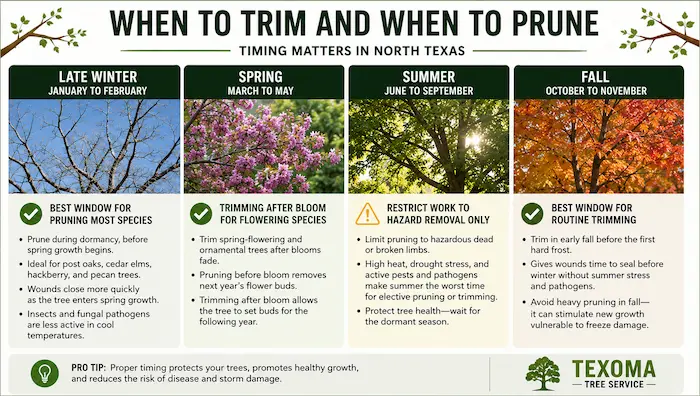
Timing is one of the most consequential differences between tree trimming and tree pruning in Wichita Falls, and it is an area where competitor content consistently falls short by offering generic national guidance that does not account for the specific climate and tree species of the Texoma region.
Late Winter — January to February
Best Window for Pruning Most Species
Pruning during dormancy, before spring growth begins, is ideal for post oaks, cedar elms, hackberry, and pecan trees in Wichita Falls. Wounds close more quickly when the tree enters the spring growth flush immediately after pruning, and insects and fungal pathogens that exploit fresh wounds are less active in cool temperatures.
Spring — March to May
Trimming After Bloom for Flowering Species
Spring-flowering trees and ornamentals such as Mexican plum and flowering crabapple should be trimmed immediately after their bloom cycle ends. Pruning before bloom removes the flower buds that formed the previous fall. Trimming for shape and size after blooms fade allows the tree to set buds for the following year undisturbed.
Summer — June to September
Restrict Work to Hazard Removal Only
Summer pruning in Wichita Falls should be limited to genuinely hazardous dead or broken limbs that cannot wait for the dormant season. The combination of high temperatures, extended drought stress, and active insect and pathogen populations makes summer the worst season for elective trimming and pruning work on most North Texas tree species.
Fall — October to November
Best Window for Routine Trimming
Early fall, before the first hard frost, is a practical and reasonably safe window for routine trimming work to control size and shape. Trimming at this point gives wounds time to begin sealing before winter without the extreme heat and pathogen activity of summer. Avoid heavy pruning in fall, as it can stimulate new growth that is vulnerable to freeze damage.
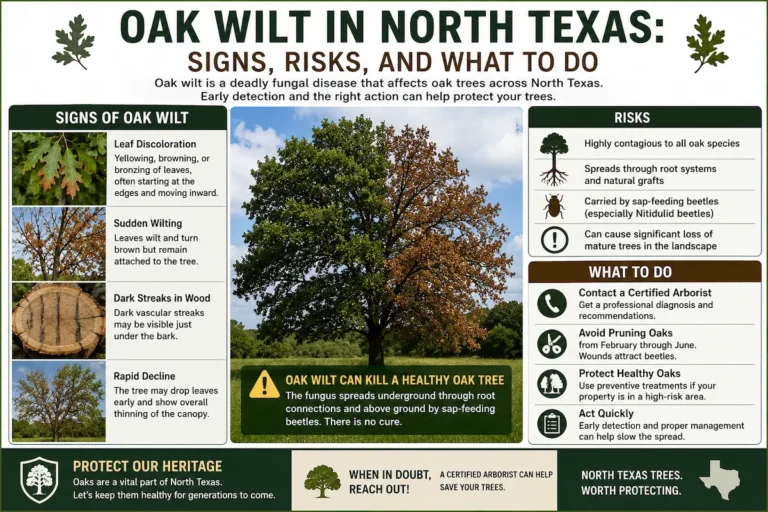
Critical timing note for oak trees in Wichita Falls: Oak wilt is present in North Texas and spreads through fresh pruning wounds via sap-feeding beetles during warm months. The Texas A&M Forest Service recommends avoiding any pruning, trimming, or wounding of oaks between February and June when the disease-spreading beetle populations are at their peak. If oak work cannot wait, all fresh cuts should be immediately sealed with latex-based pruning paint, which is recommended specifically for oak wilt prevention in Texas even though it is not recommended for most other tree species.
The Most Damaging Mistakes Wichita Falls Homeowners Make
One gap stands out in most general advice about trimming and pruning: it explains what trimming and pruning are but rarely spends meaningful time on the specific mistakes that actually harm trees in a residential context. These are the errors that cost Wichita Falls homeowners their most valuable landscape trees.
Topping Instead of Crown Reduction
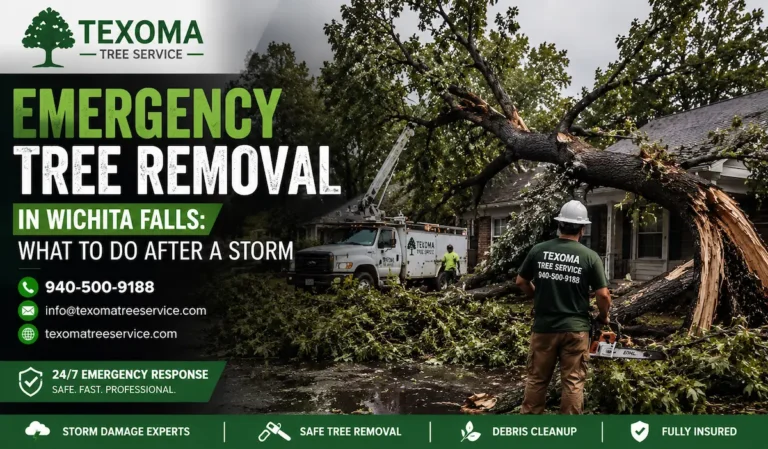
Tree topping, the practice of cutting back all major branches to a predetermined height using heading cuts, is the most destructive common practice in residential tree care. It is explicitly prohibited under ANSI A300 and condemned by every major arboricultural organization. Yet it continues because it looks dramatic, homeowners assume the tree will simply regrow from the stubs, and some unqualified crews offer it as a standard service.
The reality is that topped trees respond by producing multiple fast-growing water sprouts from each stub, creating a dense new canopy that grows back to the original height within three to five years but with dramatically weaker branch attachments than the original structure. In Wichita Falls, where severe thunderstorms regularly produce winds exceeding 70 mph, a topped tree is a structural liability. Those water sprouts, which attach at the bark surface rather than the wood, can fail at wind speeds that the original tree would have easily survived. If your tree has grown too large for its space, crown reduction performed by an ISA-certified arborist is the right answer, not topping.
Removing Too Much at Once
Over-pruning, the removal of more than 25 percent of live canopy in a single session, is one of the most common pruning mistakes made by unqualified crews who mistake dramatic-looking cuts for thorough work. In Wichita Falls, where trees already operate under significant summer heat stress and periodic drought conditions, removing too much canopy in a single session forces the tree to redirect energy reserves from root development to emergency canopy replacement. The result is a stressed tree with a compromised root system that is more vulnerable to drought, disease, and wind failure.
Making Flush Cuts
A flush cut removes the branch collar along with the branch, leaving a large, flat wound directly against the trunk. Without the branch collar tissue, the tree cannot properly compartmentalize the wound or produce callus closure. The wound remains open as a direct entry point for decay fungi, wood-boring insects, and the bacterial pathogens that cause internal wood rot in mature trees. In post oaks and cedar elms, which are already prone to hypoxylon canker under stress, flush cuts on large limbs can introduce decay that compromises the entire stem over the following decade.
Three questions to ask any tree service before they touch your trees
- Do your arborists follow ANSI A300 standards for all pruning work? A hesitation, a dismissive response, or a crew that does not know what ANSI A300 is should prompt you to look for a different company.
- Do you make cuts at the branch collar? If the crew member cannot explain what a branch collar is and why it matters for wound closure, they should not be making pruning cuts on your mature trees.
- How much of the canopy do you plan to remove? Any answer above 25 percent requires a clear justification and ideally a plan to stage the work over two growing seasons rather than removing too much in a single visit.
How Local Tree Species Affect Trimming and Pruning Decisions in Wichita Falls
Generic national content about tree trimming and pruning rarely accounts for the specific biology and behavior of the species most common in Wichita Falls yards. The Texoma region’s clay soils, drought cycles, and severe storm exposure create conditions that make local species knowledge essential when making pruning and trimming decisions.
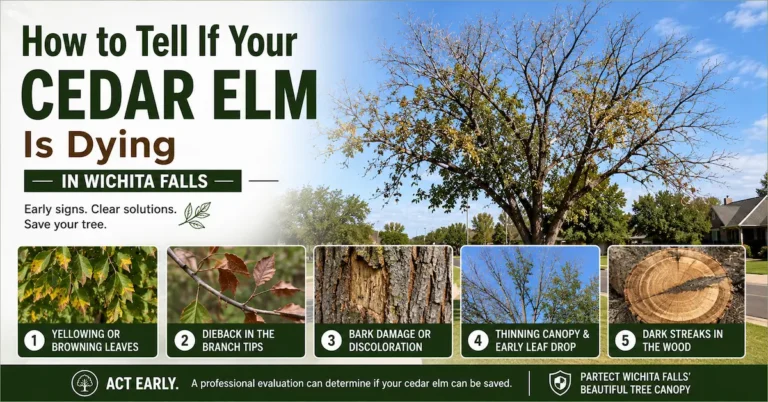
Post oaks are the defining shade tree of many established Wichita Falls neighborhoods, and they require careful treatment. They are slow-growing, compartmentalize wounds slowly compared to faster-growing species, and are vulnerable to oak wilt during the months when trimming and pruning work is most often requested. An ISA Certified Arborist with local experience understands the oak wilt transmission risk in North Texas and will schedule and manage post oak work accordingly.
Cedar elms grow quickly relative to post oaks and respond well to crown thinning that reduces wind resistance without reducing overall canopy. Their tendency to develop dense, cluttered canopies benefits from crown cleaning to remove accumulated deadwood. Hackberry trees, which are common in Wichita Falls and surrounding Wichita County neighborhoods, are fast growers with brittle wood that benefits from regular structural pruning while young to establish strong architecture before the branches become large enough to create hazard risks.
Pecan trees on Wichita Falls properties present their own timing considerations. The Texas A&M AgriLife Extension Service recommends pruning pecans during late winter dormancy and limiting structural pruning to no more than one-third of the canopy per session. Heavy pruning of pecan trees during the growing season redirects energy away from nut production and into wound response, reducing crop yield on productive trees significantly.
Frequently Asked Questions
Can I trim or prune my own trees, or should I always hire a professional?
For small ornamental trees, shrubs, and hedges under your own reach and below the height where a fall would be dangerous, routine trimming with hand pruners and loppers is well within a careful homeowner’s capability. For mature shade trees, any branch over two inches in diameter, any work that requires climbing or a ladder above six feet, or any tree near utility lines or structures, professional service is the right answer. The stakes from a single bad cut on a mature post oak or cedar elm, including wound decay, structural failure, and hazard risk, are significantly higher than the cost of professional service.
How often should trees in Wichita Falls be trimmed or pruned?
Routine trimming for shape and clearance is typically needed once or twice a year for fast-growing species. Professional structural pruning for health and hazard reduction is generally recommended every two to three years for mature shade trees. After any significant storm event in Wichita Falls, a post-storm assessment by a qualified arborist is worthwhile to identify hidden structural damage and widow-maker limbs that may not be obvious from ground level.
Does trimming hurt a tree if done correctly?
Trimming done correctly, meaning cuts made at the right location and no more than necessary to achieve the goal, causes minimal stress to a healthy tree. The tree responds to each cut by producing callus tissue and compartmentalizing the wound, which is a natural and manageable process. Over-trimming, topping, or making cuts at the wrong time or location turns a manageable stress event into lasting structural damage that the tree may never fully recover from.
What is the difference between crown cleaning and crown thinning?
Crown cleaning removes only dead, dying, diseased, and broken branches from the canopy. It does not remove any healthy live wood. Crown thinning selectively removes some live branches to reduce canopy density and improve light and air penetration. Crown cleaning is the standard starting point for any pruning job and is always performed before crown thinning is considered. Both are defined and governed by the ANSI A300 Part 1 pruning standard.
My neighbor’s tree is hanging over my property. Can I trim it myself?
Under Texas law, you have the right to trim branches that extend over your property line back to the property boundary, at your own expense. However, if the trimming would damage the overall health or structural integrity of the tree, you may face liability for the resulting damage. For any significant branch removal, particularly on a large tree, consulting a professional is strongly recommended before cutting to avoid both tree damage and legal complications.
Ready for Professional Trimming or Pruning in Wichita Falls?
Texoma Tree Service provides ISA-standard tree trimming and pruning for residential and commercial properties across Wichita Falls, Burkburnett, Iowa Park, Henrietta, Electra, and surrounding Texoma communities.
Get your free on-site assessment today. Book Your Free Assessment
Call us: +1 940 223-7713