Oak Wilt in North Texas: Signs, Risks, and What to Do
Quick Answer
Oak wilt in North Texas is caused by the fungus Bretziella fagacearum and is one of the most destructive tree diseases in the United States, confirmed in 76 Texas counties as of 2025. In Wichita Falls and across Wichita County, oak wilt spreads through two routes: root-to-root contact between interconnected oak trees and through sap-feeding nitidulid beetles attracted to fresh wounds from February through June. Signs include veinal necrosis in live oaks, where leaf veins turn yellow then brown in a fishbone pattern, and out-of-season defoliation in red oaks during spring and summer. Red oaks typically die within 30 days of infection. Live oaks die within six months. Treatment using propiconazole fungicide injection under the brand name Alamo is effective as a preventive measure and during the earliest stages of infection. The Cost-share funding may be available through state oak wilt suppression programs — check with your county extension office for current eligibility and funding levels. If you suspect oak wilt on your Wichita Falls property, call a professional before pruning anything.
There is a reason North Texas arborists wince when homeowners mention they trimmed their oak trees in April. Oak wilt is not a disease that announces itself politely with one yellowing branch and months of warning. It moves fast, spreads silently underground through connected root systems, and kills the trees most homeowners consider the most valuable on their property. A mature post oak or Texas red oak that took 80 years to reach its current size can be dead within a season once infection takes hold.
Wichita Falls and the surrounding Wichita County area sit within a disease corridor that has seen oak wilt confirmed across dozens of surrounding North Texas and West Texas counties. The clay-heavy soils of the Texoma region, combined with the extended drought cycles that stress oak root systems, create conditions where a single infected tree can silently transmit the fungus to dozens of neighboring oaks before the first visible symptom appears. Understanding oak wilt in North Texas, specifically how it behaves in this climate, with these species, in this soil, is not optional for any property owner with oak trees.
What Is Oak Wilt and Why Is It So Devastating in North Texas?
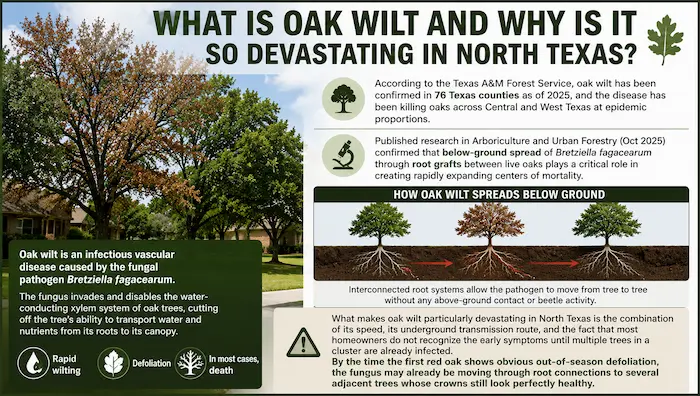
Oak wilt is an infectious vascular disease caused by the fungal pathogen Bretziella fagacearum, previously classified as Ceratocystis fagacearum before a 2018 reclassification by the mycological community. The fungus invades and disables the water-conducting xylem system of oak trees, essentially cutting off the tree’s ability to transport water and nutrients from its roots to its canopy. The result is rapid wilting, defoliation, and in most cases death.
According to the Texas A&M Forest Service, oak wilt has been confirmed in 76 Texas counties as of 2025, and the disease has been killing oaks across Central and West Texas at what the agency describes as epidemic proportions. Published research in Arboriculture and Urban Forestry in October 2025 confirmed that below-ground spread of Bretziella fagacearum through root grafts between live oaks plays a critical role in creating rapidly expanding centers of mortality, with interconnected root systems allowing the pathogen to move from tree to tree without any above-ground contact or beetle activity involved.
What makes oak wilt particularly devastating in North Texas compared to other tree diseases is the combination of its speed, its underground transmission route, and the fact that most homeowners do not recognize the early symptoms until multiple trees in a cluster are already infected. By the time the first red oak in a neighborhood shows obvious out-of-season defoliation, the fungus may already be moving through root connections to several adjacent trees whose crowns still look perfectly healthy.
Which Oak Species in Wichita Falls Are Most at Risk From Oak Wilt?
Not all oak species respond to oak wilt infection the same way. In Wichita Falls and across Wichita County, the oak species most commonly found in residential and rural landscapes fall into three distinct susceptibility categories based on how quickly the disease progresses after infection.
Highest Risk: Dies in Weeks
Texas Red Oak (Spanish Oak)
The most susceptible species in North Texas. A Texas red oak infected with oak wilt typically dies within seven to thirty days of showing first symptoms. Also produces the fungal spore mats that serve as the primary insect-spread vector. Any red oak showing out-of-season color change should be investigated immediately.
High Risk: Dies in Weeks
Shumard Oak and Blackjack Oak
Both are members of the red oak group and share the same rapid mortality timeline as Texas red oak. Shumard oaks are frequently planted as shade trees in Wichita Falls residential landscapes and are among the species that property owners most often lose before identifying the cause.
Moderate Risk: Dies in Months
Live Oak (Texas Live Oak)
Live oaks die within approximately six months of infection but spread the disease very efficiently through interconnected root systems. A single infected live oak in Wichita Falls can transmit the fungus to dozens of connected neighbors underground before dying itself, creating expanding mortality centers that are difficult to contain.
Moderate Risk
Water Oak
Classified within the red oak group and susceptible to oak wilt disease. Found in some Wichita Falls landscapes near creek drainages and in older established neighborhoods. Mortality timeline is similar to other red oak group members.
Lower Risk: May Survive
Post Oak
The dominant shade tree of many established Wichita Falls neighborhoods. Post oak is in the white oak group and shows lower susceptibility than red oaks. Most infected post oaks do not die from oak wilt alone, though a combination of oak wilt infection and significant drought stress can be lethal. Post oaks can also serve as a slow transmission bridge in some conditions.
Lower Risk
Bur Oak and Chinkapin Oak
Both are white oak group members and the least susceptible to oak wilt in the North Texas landscape. Bur oaks in Wichita County can contract the disease but rarely die from it alone, and they do not produce the fungal mats that drive insect-mediated spread the way red oaks do.
What Are the Signs of Oak Wilt on My Trees in Wichita Falls?
Identifying oak wilt correctly and quickly is the most important action a Wichita Falls property owner can take, because the management options narrow dramatically as the disease progresses and spreads to additional trees. The signs differ meaningfully between red oak group species and white oak group species, and confusing one for the other leads to incorrect and ineffective responses.
Signs in Red Oaks: Texas Red Oak, Shumard Oak, Water Oak
Red oak group species defoliate rapidly in a pattern that resembles forced autumn coloring at the wrong time of year. Young leaves in spring wilt and turn pale green, then bronze or brown. Mature leaves may show a dark green water-soaking appearance first, then transition to pale green or bronze from the margins inward. The discoloration starts at the leaf edges and progresses toward the center, giving the leaf a margin-burn appearance. Unlike live oak symptoms, red oaks rarely show the fishbone veinal pattern. The most definitive sign in a dead or dying red oak is the presence of fungal mats beneath the bark in late fall through early spring, producing a sweet, fermenting-fruit odor that attracts sap beetles and serves as the primary overground transmission source for the disease.
Signs in Live Oaks
The most distinctive and widely recognized sign of oak wilt in live oaks is veinal necrosis, known colloquially as the fishbone pattern. The leaf veins turn yellow first, then brown, while the tissue between veins may remain green temporarily. The result is a leaf that looks like a green leaf with brown veins running through it. The diagnostic organization Stop Oak Wilt describes this pattern as reminiscent of fish bones, and it is so distinctive that an experienced arborist can identify it from a distance. Rapid defoliation follows quickly after the veinal necrosis pattern develops, with leaves dropping while still partially green rather than completing a normal senescence process. Live oaks typically show symptoms starting in the upper canopy and progressing downward and outward through the crown.
Signs in Post Oak and White Oaks
White oak group species like post oak rarely show the distinctive veinal necrosis pattern associated with live oaks. Decline in post oaks is more gradual and diffuse, often resembling drought stress or general decline rather than a specific disease pattern. Canopy thinning, early leaf drop, and gradual branch dieback from the upper crown are the most common presentations. Distinguishing oak wilt from drought stress in a post oak often requires laboratory confirmation rather than visual diagnosis alone.
Visual diagnostic checklist for Wichita Falls oak trees
- Leaves turning bronze or brown from the edges inward during spring or summer, not during normal fall senescence
- Yellow or brown veins visible in leaves that are still partially green, the distinctive fishbone pattern in live oaks
- Rapid defoliation affecting most of the canopy within two to four weeks in summer
- Dead or dying branches progressing from the canopy top downward or from a single side of the crown expanding outward
- A sweet, fermenting-fruit odor from a recently dead or dying red oak trunk, indicating potential fungal mat development beneath the bark
- Multiple oaks in proximity showing similar decline patterns starting from a central point and expanding outward, indicating possible root transmission from a central infection source
- Death of oaks in a roughly circular expanding pattern, each successive ring dying after the trees inside it
Visual diagnosis alone is not sufficient for confirmed oak wilt: Oak wilt can only be definitively confirmed through laboratory testing of wood samples. Texas A&M Forest Service maintains a laboratory confirmation process, and samples can be submitted through the Wichita County Extension Office or through a certified arborist who will collect and submit samples to the Texas Plant Disease Diagnostic Laboratory at Texas A&M University in College Station. Visual diagnosis is a critical first step but should not be the basis for major management decisions without laboratory confirmation where feasible.
How Does Oak Wilt Spread Through Wichita Falls Neighborhoods?
Oak wilt in North Texas spreads through two distinct routes, and understanding both is essential for protecting your trees because the prevention strategies for each route are completely different.
How Does Oak Wilt Spread Underground?
The underground route is responsible for the majority of tree losses in oak wilt outbreaks across Texas. Oak roots, particularly live oak roots, naturally graft together when they make contact beneath the soil surface. Through these root grafts, the fungal pathogen moves directly from an infected tree’s vascular system into the vascular system of a connected neighboring tree. The fungus does not need to travel through the air or through any insect. It simply follows the connected plumbing.
In Wichita Falls neighborhoods where oak trees were planted in rows or clusters, this underground connection can link dozens of trees into a single connected system. When one tree in that system becomes infected through the overground beetle route, the pathogen can spread to every connected tree simultaneously. This is why oak wilt centers in North Texas neighborhoods can expand from one affected tree to a ring of ten or twenty dead and dying trees within a single growing season.
How Do Beetles Spread Oak Wilt Overground?
The overground route is driven by sap-feeding nitidulid beetles, primarily from the genus Colopterus and Carpophilus, which are attracted to two things: the volatile compounds from fresh wounds in oak trees and the sweet-smelling fungal spore mats that develop on infected red oak trees in late fall and early spring. When a beetle visits a fungal mat on an infected red oak, spores adhere to its body. If that beetle then visits a fresh wound on a healthy oak during the February to June window when fungal mat activity and beetle populations are at their peak, it deposits those spores directly into the tree’s vascular system through the open wound, starting a new infection center.
This is why the Texas A&M AgriLife Extension Service and every certified arborist working in North Texas repeats the same critical guidance every year without exception: do not prune, wound, or create any fresh cuts on oak trees between February and June. The risk is not theoretical. Demian Gomez, the Texas A&M Forest Service regional forest health coordinator, stated directly in a February 2025 Texas Standard interview that avoiding pruning during this window is the single most effective action Texans can take to prevent oak wilt from spreading.
Actions that create oak wilt risk in Wichita Falls
- Pruning oak trees between February and June is the highest-risk action and should be avoided entirely unless the tree is a confirmed imminent hazard. Even small cuts made during peak nitidulid beetle activity represent a transmission risk.
- Storm damage to oak trees during spring creates fresh wounds that should be treated immediately with latex-based pruning paint or sealant to reduce beetle attraction. This is the only situation where wound sealants are recommended; standard arboricultural practice does not use wound sealants outside of this specific oak wilt prevention context in Texas.
- Moving firewood from infected areas can transport fungal spore material to areas without existing oak wilt. Do not move firewood from a tree that died of suspected oak wilt out of your property or to camping sites where oak trees are present. Failing to sterilize pruning tools between trees allows spores to transfer from an infected tree to a healthy one. Pruning equipment should be sterilized with a 10 percent bleach solution or 70 percent isopropyl alcohol between cuts when working near or on oak trees.
What Can You Actually Do About Oak Wilt in Wichita Falls?
This is where most competitor content on oak wilt in North Texas stops being specific enough to be useful. The treatment landscape for oak wilt involves several distinct interventions, each appropriate for a different stage of disease progression and a different susceptibility level by species. Understanding the options allows Wichita Falls property owners to make informed decisions with their tree service professional rather than accepting a single recommendation without context.
Propiconazole Fungicide Injection: What Is It and Does It Work?
Propiconazole, commercially available under the brand name Alamo and applied as a macro-infusion at the root flare, is the only fungicide scientifically tested and proven effective for oak wilt management in field conditions. According to peer-reviewed research and confirmed by the Texas A&M Forest Service, propiconazole is most effective when applied preventively to healthy oaks adjacent to a confirmed infection center before symptoms appear. When applied as a true preventive treatment, propiconazole has demonstrated meaningful success rates in protecting treated trees from developing symptoms.
Therapeutic use on trees already showing early-stage symptoms has shown limited success in some cases, particularly for live oaks where the disease progresses more slowly than in red oaks. However, for red oak group species showing active symptoms, propiconazole treatment is generally not recommended because the disease moves faster than the systemic fungicide can be distributed through the tree’s compromised vascular system.
Treatment costs with propiconazole run approximately $10 per inch of trunk diameter at breast height, meaning a 24-inch post oak treatment costs roughly $240. Treatments must be repeated every 18 to 24 months per Texas A&M Forest Service guidance. Over a multi-year program, this is significantly less than the cost of losing and replacing a mature shade tree, which adds meaningful financial justification to the preventive approach for high-value specimens.
Root Graft Interruption Through Trenching
Trenching is the primary tool for stopping below-ground transmission of oak wilt from an infected tree to its healthy neighbors. A trench at least four feet deep is installed between the infected tree and the nearest healthy oaks, severing the root connections through which the fungus travels. The trench must be placed a minimum of 100 feet beyond the outermost symptomatic tree to be effective, which requires a thorough understanding of root system extension in the clay soils of Wichita County.
Trenching does not cure the infected tree. It contains the spread. Combined with removal of the infected tree and propiconazole treatment of healthy adjacent trees, trenching is the most complete management response available for an active oak wilt center.
Texas A&M Forest Service Oak Wilt Cost-Share Program
Financial assistance is available for Wichita County landowners
The Texas A&M Forest Service Oak Wilt Suppression Program provides cost-share funding to eligible Texas landowners for approved oak wilt suppression treatments. This program can meaningfully reduce the financial barrier to professional treatment for Wichita Falls and Wichita County property owners.
- Trenching cost-share: Up to 50 percent of approved costs, maximum $2,000 per cooperator per year. For multi-cooperator projects involving multiple adjacent property owners, the cap increases to $6,000 per project year.
- Tree pushing within trenched areas: Up to 50 percent of approved costs, maximum $2,000 per cooperator per year.
- Removal of certain diseased red oaks: Up to 50 percent of approved costs, maximum $2,000 per cooperator per year.
- Application requirement: Cost-share applications must be approved by Texas A&M Forest Service personnel before any cost-shareable treatment begins. Contact the Wichita County AgriLife Extension Office or the Texas A&M Forest Service district office serving the Texoma region to initiate an application.
- All treatments must follow program guidelines: Work must be performed by approved contractors and documented according to Texas A&M Forest Service requirements. An ISA Certified Arborist familiar with the program requirements is the appropriate professional to involve in your application.
Neighbor coordination significantly strengthens a cost-share application. If multiple property owners in a Wichita Falls neighborhood are dealing with the same expanding oak wilt center, a coordinated multi-cooperator application is both more effective as a management strategy and eligible for higher total program funding than individual applications.
Which Oak Wilt Treatment Is Right for My Wichita Falls Situation?
| Treatment Option | Best For | Effectiveness | Estimated Cost Range | Cost-Share Eligible? |
|---|---|---|---|---|
| Propiconazole injection (preventive) | Healthy oaks adjacent to infection center; high-value specimens in risk zones | High (preventive) | $10 per inch DBH; repeat every 18 to 24 months | Not directly; reduces removal need |
| Propiconazole injection (therapeutic) | Live oaks in earliest stages of infection only | Limited | $200 to $600 per tree | No |
| Root graft trenching | Stopping underground spread to adjacent healthy trees | High (containment) | $1,500 to $5,000+ depending on linear footage | Yes, up to 50% or $2,000 |
| Infected tree removal | Removing active infection source, especially red oaks with fungal mats | High (when combined with trenching) | Standard removal pricing based on tree size | Yes, red oaks; up to $2,000 |
| No treatment | Trees already too far progressed for treatment to affect outcome | None | Eventual removal cost only | No |
What Should You Do Right Now If You Suspect Oak Wilt in Wichita Falls?
- Stop all pruning of oak trees immediately. If you are reading this between February and June, do not create any fresh wounds on any oak tree on your property until a professional assessment confirms the situation and advises on appropriate timing. If storm damage has already created fresh wounds, apply latex-based pruning paint to the cut surfaces immediately to reduce beetle attraction.
- Document the symptoms. Photograph affected trees from multiple angles, capturing the leaf discoloration pattern, the area of the crown affected, and the proximity of affected trees to each other. Note when you first noticed symptoms and which trees are showing them. This documentation supports laboratory diagnosis and cost-share program applications.
- Contact an ISA Certified Arborist for a professional assessment. An ISA Certified Arborist with oak wilt experience is the appropriate professional to assess your trees, collect wood samples for laboratory confirmation, and recommend a management plan appropriate for your specific situation. The International Society of Arboriculture maintains a searchable database of certified arborists by location so you can find qualified professionals serving the Wichita Falls area.
- Contact the Wichita County AgriLife Extension Office. The Texas A&M AgriLife Extension Service has local offices throughout North Texas that can assist with oak wilt identification, provide laboratory submission guidance, and help you apply for the Texas A&M Forest Service cost-share program if your situation qualifies.
- Talk to your neighbors. If oak wilt is moving through root connections underground, the problem is not limited to your property line. Coordinating with adjacent property owners about a shared management plan is both more effective from a disease control standpoint and eligible for higher cost-share program funding than individual applications.
- Do not move firewood from affected trees. Wood from oak wilt-infected trees should be burned on site, buried, or covered with a clear plastic tarp sealed at the edges with soil to prevent beetle access. Do not transport it to other properties, campgrounds, or other locations where healthy oaks may be present.
Texoma Tree Service works with property owners across Wichita Falls, Burkburnett, Iowa Park, Henrietta, Electra, and surrounding Wichita County communities to assess oak wilt risk, coordinate laboratory confirmation, advise on propiconazole treatment programs, and perform the professional tree removal of confirmed infected specimens as part of a comprehensive oak wilt management approach. Our tree trimming and pruning service is scheduled outside of the February to June high-risk window for all oak species to eliminate pruning as a transmission pathway for every customer we serve.
Frequently Asked Questions
Is oak wilt confirmed in Wichita County, Texas?
Oak wilt has been confirmed in 76 Texas counties as of the Texas A&M Forest Service 2025 reporting. While the highest-density confirmed outbreak zones are concentrated in Central Texas counties around Austin and the Hill Country, North Texas, including Wichita County, sits within the documented and expanding disease range. Property owners in the Wichita Falls area with oak trees in proximity to confirmed cases in surrounding counties should treat oak wilt prevention as an active concern rather than a theoretical future risk.
Can a tree recover from oak wilt?
Red oak group species, including Texas red oak, Shumard oak, and water oak, do not recover from oak wilt and will die within weeks to months of infection. Live oaks also do not recover from oak wilt. Still, they may survive longer, and early-stage therapeutic propiconazole injection has shown some success in slowing disease progression in live oaks caught at the very earliest stages. White oak group species, including post oak and bur oak, have a lower mortality rate from oak wilt and may survive an infection, though their long-term structural health may be compromised.
How do I know if my tree has oak wilt or just drought stress?
Both conditions cause leaf discoloration and early defoliation in North Texas oaks, and they frequently occur in the same trees simultaneously because drought stress makes oaks more vulnerable to oak wilt infection. The most distinguishing features of oak wilt versus drought stress are the fishbone veinal necrosis pattern in live oaks, which does not occur in drought stress, and the timing and speed of decline. A tree that goes from normal to mostly defoliated in two to four weeks during spring or summer is showing a pace of decline more consistent with oak wilt than drought alone. Laboratory confirmation through wood samples is the only definitive diagnostic tool.
What time of year is the highest oak wilt transmission risk in Wichita Falls?
The highest transmission risk period in North Texas runs from February through June, when nitidulid beetle populations are most active and fungal mats on infected red oaks produce viable spores. Texas A&M AgriLife Extension formally advises avoiding all oak pruning and wounding during this window. Demian Gomez of the Texas A&M Forest Service stated in February 2025 that avoiding pruning during this period is the single most effective preventive action available to Texas property owners.
How much does it cost to treat oak wilt in Wichita Falls?
Propiconazole injection runs approximately $10 per inch of trunk diameter at breast height and must be repeated every 18 to 24 months. A mature 24-inch post oak would cost roughly $240 per treatment cycle. Root graft trenching ranges from $1,500 to over $5,000 depending on linear footage required. The Texas A&M Forest Service Oak Wilt Suppression Program provides cost-share funding covering up to 50 percent of approved treatment costs. Over the lifetime of a mature oak tree, a preventive propiconazole program typically costs significantly less than removal and replacement, which for a large post oak or Texas red oak on a Wichita Falls residential property can reach $1,500 to $3,000 just for removal.
Worried About Oak Wilt on Your Wichita Falls Property?
Texoma Tree Service provides professional oak wilt assessment, ISA-standard pruning management, and tree removal for infected specimens across Wichita Falls, Burkburnett, Iowa Park, Henrietta, Electra, and the Texoma region. Get a free on-site consultation today.
Get your free on-site assessment today. Book Your Consultation
Call us: +1 940 223-7713