Stump Grinding vs. Stump Removal: Which Is Right for Your Wichita Falls Yard?
For most Wichita Falls homeowners, stump grinding is the right choice. It is faster, more affordable, less disruptive to your yard, and well-suited to the clay-heavy soils found across Wichita County. Stump grinding typically costs between $75 and $400 and leaves roots to decompose underground. Full stump removal, which costs $370 to $675 per stump, is the better option when you plan to build a structure, install a pool, or plant a new tree in the same spot. The tree species also matters here: honey mesquite, hackberry, and cedar elm are known resprouters in North Texas, and the right method depends on how aggressively you need to prevent regrowth.
A tree comes down, the crew packs up, and there it sits: a stump sitting in the middle of your yard looking like it has no intention of leaving on its own. For most Wichita Falls homeowners, this is the moment the real question arrives. Do you grind it or remove it entirely?
Both options solve the problem, but they solve it differently, cost differently, and leave your yard in a different condition afterward. The wrong choice for your situation can mean wasted money, a yard that takes longer to recover, or a stump that sprouts new growth a few months later because the root system was left untreated. This guide walks you through everything you need to know to make the right call for your specific yard, your specific soil, and the specific tree species most common here in the Texoma region.
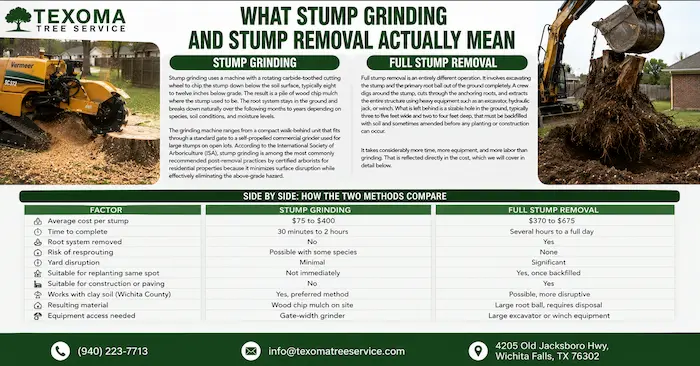
What Stump Grinding and Stump Removal Actually Mean
Before comparing them, it helps to understand exactly what each process involves, because homeowners often assume they are more similar than they are.
Stump Grinding
Stump grinding uses a machine with a rotating carbide-toothed cutting wheel to chip the stump down below the soil surface, typically eight to twelve inches below grade. The result is a pile of wood chip mulch where the stump used to be. The root system stays in the ground and breaks down naturally over the following months to years, depending on species, soil conditions, and moisture levels.
The grinding machine ranges from a compact walk-behind unit that fits through a standard gate to a self-propelled commercial grinder used for large stumps on open lots. According to the International Society of Arboriculture (ISA), stump grinding is among the most commonly recommended post-removal practices by certified arborists for residential properties because it minimizes surface disruption while effectively eliminating the above-grade hazard.
Full Stump Removal
Full stump removal is an entirely different operation. It involves excavating the stump and the primary root ball out of the ground completely. A crew digs around the stump, cuts through the anchoring roots, and extracts the entire structure using heavy equipment such as an excavator, hydraulic jack, or winch. What is left behind is a sizable hole in the ground, typically three to five feet wide and two to four feet deep, that must be backfilled with soil and sometimes amended before any planting or construction can occur.
It takes considerably more time, more equipment, and more labor than grinding. That is reflected directly in the cost, which we will cover in detail below.
Side by Side: How the Two Methods Compare
| Factor | Stump Grinding | Full Stump Removal |
|---|---|---|
| Average cost per stump | $75 to $400 | $370 to $675 |
| Time to complete | 30 minutes to 2 hours | Several hours to a full day |
| Root system removed | No | Yes |
| Risk of resprouting | Possible with some species | None |
| Yard disruption | Minimal | Significant |
| Suitable for replanting same spot | Not immediately | Yes, once backfilled |
| Suitable for construction or paving | No | Yes |
| Works with clay soil (Wichita County) | Yes, preferred method | Possible, more disruptive |
| Resulting material | Wood chip mulch on site | Large root ball requires disposal |
| Equipment access needed | Gate-width grinder | Large excavator or winch equipment |
Pros and Cons of Each Method
Stump Grinding
Advantages
- Significantly more affordable than full removal
- Faster, often completed within an hour or two
- Minimal disruption to the surrounding lawn and landscaping
- Works well in Wichita Falls clay soil without heavy excavation
- Produces wood chip mulch you can use in garden beds
- Compact grinders can access gated backyards
- Recommended by ISA-certified arborists for most residential situations
Disadvantages
- The root system stays underground and decays over time
- Some North Texas tree species resprout from remaining roots
- Cannot build structures or pour concrete in that spot
- Cannot plant a new tree immediately in the same location
- Roots may continue to affect nearby irrigation lines as they decompose
Side by Side: How the Two Methods Compare
| Factor | Stump Grinding | Full Stump Removal |
|---|---|---|
| Average cost per stump | $75 to $400 | $370 to $675 |
| Time to complete | 30 minutes to 2 hours | Several hours to a full day |
| Root system removed | No | Yes |
| Risk of resprouting | Possible with some species | None |
| Yard disruption | Minimal | Significant |
| Suitable for replanting same spot | Not immediately | Yes, once backfilled |
| Suitable for construction or paving | No | Yes |
| Works with clay soil (Wichita County) | Yes, preferred method | Possible, more disruptive |
| Resulting material | Wood chip mulch on site | Large root ball, requires disposal |
| Equipment access needed | Gate-width grinder | Large excavator or winch equipment |
Pros and Cons of Each Method
Stump Grinding
Advantages
- Significantly more affordable than full removal
- Faster, often completed within an hour or two
- Minimal disruption to the surrounding lawn and landscaping
- Works well in Wichita Falls clay soil without heavy excavation
- Produces wood chip mulch you can use in garden beds
- Compact grinders can access gated backyards
- Recommended by ISA-certified arborists for most residential situations
Disadvantages
- The root system stays underground and decays over time
- Some North Texas tree species resprout from remaining roots
- Cannot build structures or pour concrete in that spot
- Cannot plant a new tree immediately in the same location
- Roots may continue to affect nearby irrigation lines as they decompose
Full Stump Removal
Advantages
- Removes all traces of the tree, including the root ball
- Eliminates any possibility of resprouting
- Clears the space for construction, concrete, or foundation work
- Allows immediate replanting of a new tree in the same spot
- Ideal for development projects and major landscape overhauls
Disadvantages
- Considerably more expensive than grinding
- Leaves a large hole requiring backfill and soil amendment
- More disruptive to the surrounding lawn, irrigation, and landscaping
- Requires heavy equipment that may not access gated or tight spaces
- Wichita Falls clay soil makes excavation more labor-intensive
- Takes longer from start to finish
Why Wichita Falls Soil and Tree Species Change the Decision
This is where local knowledge really matters. What works well for a tree removal in a sandy-loam coastal soil behaves completely differently in the dense, expansive clay that covers most of Wichita County and the surrounding Texoma region. And the tree species that dominate Wichita Falls yards have their own resprouting personalities that every homeowner should understand before choosing a stump method.
Clay Soil and Equipment Access
Wichita Falls sits on some of the deepest clay soil in North Texas. This soil shrinks significantly during the prolonged dry summers and swells back during spring rains, putting enormous lateral pressure on tree root systems over time. The upside of this clay for stump grinding is that the roots are often more concentrated and shallower than they would be in looser soils, meaning grinding tends to address most of the root mass within the reachable depth of the grinder.
For full stump removal, clay soil is genuinely challenging. Heavy excavation equipment compacts an already dense soil, and the backfilled void may settle unevenly over the following year as the clay adjusts. Most experienced tree service crews in the Wichita Falls area recommend stump grinding as the default approach for this reason, reserving full removal for situations where it is truly necessary.
The Resprouting Problem with North Texas Tree Species
Not all stumps behave the same way after cutting. In Wichita Falls yards, several of the most common tree species are aggressive resprouters, meaning the root system will send up new shoots if left untreated. This is one of the most important factors in choosing your stump handling method.
Resprouting risk by common Wichita Falls tree species
- Honey mesquite: Among the most persistent resprouters in North Texas. The dormant bud zone sits two to six inches below the soil surface along the basal root system. Even after stump grinding, surface sprouts are possible unless the stump treatment or grinding depth is sufficient to destroy the bud zone completely. According to the USDA Forest Service, honey mesquite can resprout from rhizomes and roots even after top-kill events far more destructive than cutting.
- Hackberry: Resprouts readily from shallow lateral roots. Both stump grinding and a cut-surface herbicide treatment are often used together for hackberry to prevent regrowth without requiring full removal.
- Cedar elm: Moderately likely to resprout from the root collar area. Standard grinding depth is usually sufficient, but a stump treatment applied immediately after cutting adds insurance.
- Post oak: Generally a low resprouting risk. Stump grinding alone is typically sufficient with no additional treatment needed.
- Eastern redcedar: Does not resprout after cutting. Stump grinding handles this species completely with no regrowth concerns.
Texas A&M AgriLife Extension recommends applying a cut-surface herbicide treatment such as Remedy to the freshly cut stump surface of hackberry, mesquite, and elm immediately after the tree is felled. This step, done at the time of tree removal rather than after the stump sits, dramatically reduces regrowth risk even when full stump removal is not in the budget.
Important for honey mesquite owners: If your primary concern is permanent elimination of a honey mesquite on your Wichita Falls property, full stump removal combined with a root treatment is the most reliable long-term solution. Grinding alone at standard depths may not fully destroy the dormant bud zone for this species.
The Practical Decision Guide: Which Option Is Right for You?
Rather than applying a one-size answer, use your specific situation to drive the decision. Here are the clearest scenarios for each method.
Choose Stump Grinding if you:
- Want the most affordable, fastest solution with minimal lawn disruption
- Plan to reseed, sod, or plant shrubs and flowers over the area
- Have a gated backyard where large excavation equipment cannot access
- Are you removing a post oak, eastern redcedar, or other low-resprouting species
- Want to keep the wood chip mulch for use in your garden beds
- Are removing multiple stumps across a large property, and the budget is a consideration
- Had a storm-damaged tree removed and simply need the stump cleared safely
Choose Full Stump Removal if you:
- Plan to build a deck, shed, addition, or pour a concrete pad in that location
- Want to install an in-ground pool or underground irrigation system in the area
- Plan to plant a new tree in the same spot and want full root clearance
- Are you removing a honey mesquite or hackberry, and need guaranteed prevention of regrowth
- Are you undertaking a significant land clearing or development project
- Have HOA requirements or property sale conditions requiring complete stump elimination
How Much Does Each Option Cost in Wichita Falls
Cost is almost always the deciding factor for homeowners who are unsure which way to go, and the difference between grinding and removal is significant enough to matter for most budgets.
| Service | Typical Price Range | Key Cost Driver |
|---|---|---|
| Stump grinding (small stump) | $75 to $175 | Diameter under 12 inches |
| Stump grinding (medium stump) | $175 to $300 | Diameter 12 to 24 inches |
| Stump grinding (large stump) | $300 to $400+ | Diameter over 24 inches or difficult access |
| Full stump removal | $370 to $675 | Applied at the time of removal for resprouting species |
| Cut stump herbicide treatment | $50 to $100 add-on | 3 or more stumps in the same visit |
| Multiple stump discount | 10 to 20% reduction | Multiple-stump discount |
North Texas Tree Expert, a Wichita Falls competitor, advertises stump grinding starting at $175. Stumpeeze, another local specialist, advertises grinding eight to twelve inches below grade and emphasizes lawn-friendly equipment. These figures are consistent with regional market rates across the Texoma area.
One strategy worth knowing: if you are having a tree removed, scheduling stump grinding at the same time as the removal often costs less than returning for a separate visit. The grinding equipment is already on site, the work area is already staged, and many companies apply a combined-service discount. This approach also gets the stump handled before it becomes a tripping hazard for children and pets, a nesting site for termites and carpenter ants, or an eyesore that lowers your curb appeal.
What to Do With Your Yard After the Stump Is Gone
The work is not quite finished once the stump is handled. What you do with the cleared space in the days and weeks following removal affects how well your yard recovers and how usable that area becomes.
After Stump Grinding
You will be left with a shallow depression filled with wood chip material. This mulch layer is actually useful, but it needs some management. Rake the wood chips away from the center if you plan to reseed, since fresh wood chips are high in carbon and can temporarily tie up soil nitrogen as they decompose, which competes with grass seed germination. Mix the wood chips into surrounding garden beds instead, where they function as excellent moisture-retaining mulch. Backfill the depression with topsoil, tamp it level with the surrounding grade, and reseed or sod as desired. Most Wichita Falls lawns recover fully within four to eight weeks with regular watering.
After Full Stump Removal
The excavated hole needs to be backfilled with quality topsoil rather than just the clay fill that came out of the ground. Wichita County clay alone compacts poorly in a backfilled void and may settle unevenly over time. Add organic matter or a sandy loam blend when backfilling to improve drainage and give any future plantings a better root environment. If you plan to plant a tree in the cleared space, allow the soil to settle for 2 to 4 weeks before digging a new planting hole, so the surrounding soil is stable enough to support the tree’s roots.
Protecting Nearby Trees
Whenever a tree is removed and the stump is handled, the surrounding root environment shifts. Adjacent trees that shared root zone space with the removed tree may experience reduced competition for soil moisture, which is actually beneficial. However, any mechanical disruption from stump removal equipment near neighboring trees should be reviewed to ensure no significant surface roots are damaged. A routine tree trimming and pruning inspection of your remaining trees shortly after the removal is a good way to catch any signs of stress early before the next North Texas storm season arrives.
Can You Grind or Remove a Stump Yourself?
Stump grinder rentals are available at hardware stores in the Wichita Falls area, and some homeowners consider the DIY route to save money. It is worth understanding what you are actually taking on before you go that direction.
Rental grinders are smaller and less powerful than commercial units. A large post oak or pecan stump that a professional could handle in an hour may take three or four hours with a rental machine, and the grinding depth may not reach as deep as needed to prevent resprouting. The equipment is also significantly heavier than it looks, produces a high-velocity spray of wood chips and debris that requires full eye, face, and body protection, and must be kept clear of buried utility lines, irrigation heads, and exposed tree roots that can catch the cutting wheel unexpectedly.
For small stumps under ten inches in diameter that are well away from structures, irrigation, and utilities, a competent homeowner can manage a rental grinder safely. For anything larger, or for stumps anywhere near a structure, fence, or underground line, the professional service is genuinely worth the cost. A single mistake with a commercial grinder can cause more damage in seconds than the rental savings are worth.
If you do decide to DIY, always call Texas 811 before any digging or grinding to have underground utilities marked. This is a free service and is legally required before any ground-disturbing work in Texas.
The Hidden Risks of Leaving a Stump Untreated in Wichita Falls
Some homeowners choose to leave the stump and simply mow around it. This is understandable when the budget is tight, but it is worth knowing what an untreated stump invites over time, particularly in the warm, humid summers that the Texoma region delivers.
What an untreated stump attracts in North Texas
- Termites: Decaying wood is a primary food source for subterranean termites, which are active throughout Wichita Falls. A stump sitting close to your home’s foundation creates a bridge between the soil and your structure that termites readily use.
- Carpenter ants: These establish colonies in soft, moist, decaying wood and can spread from the stump into adjacent wooden structures including fencing, decking, and siding.
- Bark beetles: These are particularly concerning for any remaining live trees on your property, as decaying wood draws beetle species that can then migrate to healthy nearby trees.
- Tripping hazards: A stump at or just below lawn surface level is one of the most common causes of yard injuries for children and older adults.
- Regrowth: Without treatment, honey mesquite and hackberry stumps will send up multiple new shoots that form dense, thorny thickets if left unchecked over a single growing season.
Frequently Asked Questions From Wichita Falls Homeowners
How long does stump grinding take for a standard yard stump?
Most residential stumps in Wichita Falls take between 30 minutes and two hours depending on diameter and access. Larger stumps over 24 inches may take longer. Multiple stumps can often be completed in a single half-day visit.
Will the wood chips left behind hurt my grass?
Fresh wood chips temporarily tie up soil nitrogen during decomposition, which can slow grass seed germination if chips are mixed directly into the seed bed. Rake chips away, backfill with topsoil, and reseed over clean soil. Use the chips as mulch in landscape beds instead, where the nitrogen-binding effect actually benefits plants by slowing moisture loss.
Can I plant a new tree right after stump grinding?
Not immediately in the same spot. The remaining root mass underground will continue decomposing for one to three years depending on species, and the soil in the old stump zone may be too loose and nutrient-depleted to support a new tree effectively. Most arborists recommend waiting at least six months, or shifting the new planting location a few feet away from the old stump center. If you need to plant immediately, full stump removal with proper backfill is the better starting point.
Does my homeowners insurance cover stump removal in Wichita Falls?
Generally, insurance covers stump removal only if the tree fell due to a covered peril such as a storm, lightning strike, or vehicle impact and the fallen tree caused structural damage to your property. Proactive stump removal of a standing dead tree or a tree removed for landscaping reasons is not typically covered. Document all storm damage with photos before cleanup begins and review your specific policy language with your carrier.
Is stump grinding or removal better after an emergency storm removal?
After a storm takes down a tree, the stump is typically left cut flush with the ground while the priority is clearing the hazard. Once the emergency is resolved, stump grinding is the most common and practical follow-up step. For storm damage tree service in Wichita Falls, Texoma Tree Service handles both the emergency removal and the follow-up stump work so you are not coordinating two separate crews.
How deep does stump grinding go, and does it prevent regrowth?
Professional stump grinders typically cut eight to twelve inches below grade, which is sufficient to prevent resprouting for most tree species. For honey mesquite, where the dormant bud zone extends up to twelve inches below the soil surface, a combination of deeper grinding and a cut-surface herbicide treatment gives the most reliable prevention. Standard grinding alone at eight to ten inches handles post oak, pecan, and eastern redcedar without additional treatment.
Ready to Clear That Stump for Good?
Texoma Tree Service handles stump grinding and removal for homeowners across Wichita Falls, Burkburnett, Iowa Park, Henrietta, and Electra. Get a free on-site estimate today.
Call us: +1 940 223-7713