How to Tell If Your Cedar Elm Is Dying in Wichita Falls
Quick Answer
A cedar elm that is dying in Wichita Falls will typically show one or more of these nine warning signs: wilting and yellowing leaves on isolated branches that spread progressively through the canopy, shepherd’s crook curling at branch tips, premature defoliation during summer or early fall, brown streaking in the sapwood beneath the bark, bark cracking or sloughing from the trunk, fungal conks or weeping sap at the base, deadwood accumulation concentrated in the upper canopy, stunted or deformed new spring growth, and significant root zone soil compaction or heaving. The four most common causes of cedar elm decline in Wichita Falls are native elm wilt caused by Dothiorella ulmi, Dutch elm disease caused by Ophiostoma novo-ulmi, bacterial leaf scorch caused by Xylella fastidiosa, and extreme drought stress amplified by Wichita County clay soil conditions. Not all of these conditions are fatal if caught early. An ISA Certified Arborist assessment is the only reliable way to confirm the cause and determine whether your cedar elm can be saved.
Cedar elms are the backbone of the Wichita Falls urban forest. Drive through any established neighborhood from Tanglewood to the older streets near Midwestern State University, and you will see them everywhere: medium to large trees with small, rough-textured leaves, distinctive winged bark ridges, and a spreading canopy that provides the most reliable summer shade available in a climate that regularly pushes past 105 degrees Fahrenheit. In Wichita County, cedar elms are not just common. They are the defining native tree of the landscape.
That is precisely why it is so unsettling to watch one decline. Cedar elms are tough trees built for North Texas conditions. They tolerate the alkaline clay soils of Wichita County better than almost any other shade species. They handle drought reasonably well once established. They rebound from storm damage with more vigor than most hardwoods of similar size. When a cedar elm starts dying in Wichita Falls, something significant is usually driving the decline, and understanding what that something is as early as possible is the difference between a tree that can be saved and one that eventually has to come down.
This guide covers every meaningful warning sign that a cedar elm in Wichita Falls is in serious trouble, the diseases and conditions most likely causing it, and the actions that give your tree the best chance of recovery before the decline passes the point of no return.
What Are the Nine Warning Signs That Your Cedar Elm Is Dying in Wichita Falls?
Cedar elm decline rarely announces itself with a single dramatic symptom. More often, it builds through several overlapping signs that individual homeowners attribute to seasonal stress, drought, or normal variation before realizing the pattern points toward something more serious. Knowing all nine warning signs and what each one means in the context of North Texas conditions gives you the diagnostic foundation to act early.
Sign 01
Wilting on Isolated Branches That Spreads
Individual branches wilt and their leaves yellow and curl while surrounding branches still appear healthy. This flagging pattern, where a single limb or section wilts while the rest of the canopy looks normal, is one of the earliest and most diagnostically significant signs of vascular disease in cedar elms. As the disease progresses, the wilted area expands outward and downward through the canopy over days or weeks.
Sign 02
Shepherd’s Crook at Branch Tips
The terminal ends of affected branches curl downward in a distinctive curved shape resembling a shepherd’s staff. This occurs when the vascular tissue in the young tip dies faster than the surrounding tissue, causing the still-alive portion to curve under the weight of the dead tip. The shepherd’s crook is a classic diagnostic sign of Dutch elm disease in elm species and is clearly visible from ground level in the canopy.
Sign 03
Leaves Falling While Still Green
Normal cedar elm leaf drop in Wichita Falls happens in late fall through early winter. When leaves begin dropping during summer or early fall while still partially or fully green, the tree is experiencing a physiological crisis. Green leaf drop during the growing season is a sign the vascular system is failing to support the canopy it would normally sustain through seasonal dormancy.
Sign 04
Brown Streaking in Sapwood
Using a pocket knife or a scratch test, peel back a small section of outer bark on an affected branch. Healthy sapwood is cream or light tan. Brown or dark discoloration in a ring or streak pattern directly beneath the bark of an affected branch is one of the most reliable diagnostic indicators of fungal vascular disease in elm species, including both native elm wilt and Dutch elm disease.
Sign 05
Bark Cracking or Sloughing
Bark that separates from the trunk in large sections or develops unusual longitudinal cracks indicates significant internal stress. In cedar elms, bark sloughing combined with yellowing foliage above the affected area points toward a trunk-level disease or wound entry point. Bacterial wetwood, sometimes called slime flux, can also cause sap to weep through bark cracks with a sour odor that attracts insects to the oozing site.
Sign 06
Fungal Conks or Bracket Fungi
The appearance of bracket fungi, conks, or shelf mushrooms on the trunk or at the root flare signals active internal wood decay. In Wichita Falls, Ganoderma and Inonotus species are the fungal genera most commonly encountered on declining hardwood trees including cedar elms. Their presence indicates that decay has already begun inside the structural wood, and the degree of internal compromise is almost always greater than what is visible at the surface.
Sign 07
Deadwood Concentrated in the Upper Canopy
A few dead branches scattered through any mature cedar elm canopy is normal and manageable. When deadwood concentrates in the upper third of the canopy and the dead branch count increases noticeably from season to season, it signals systemic decline rather than isolated branch death. Upper canopy dieback in a cedar elm is particularly concerning because it indicates that the vascular system is struggling to supply water to the highest and most recently grown portions of the tree.
Sign 08
Stunted or Deformed Spring Growth
Cedar elms in Wichita Falls flush new growth in early to mid-spring. If the new spring leaves emerge smaller than normal, crinkled, chlorotic, or with abnormal coloration rather than the healthy deep green of a well-functioning tree, something is suppressing the tree’s ability to produce and sustain new tissue. Bacterial leaf scorch caused by Xylella fastidiosa is one condition that produces stunted and margined new growth in elm species in North Texas.
Sign 09
Root Zone Soil Heaving or Cracking
Visible soil cracking or heaving around the base of the tree, particularly after a wet period, can indicate root system compromise from decay, construction damage, or soil compaction. In Wichita County’s clay-heavy soil, which swells significantly when wet and shrinks during dry periods, cedar elms whose root systems are compromised show above-ground canopy stress that progressively worsens with each subsequent drought cycle.
What Diseases Are Most Likely Killing Cedar Elms in Wichita Falls?
Identifying the specific disease or condition driving a cedar elm’s decline is the prerequisite to any effective management response. Four conditions account for the vast majority of serious cedar elm decline cases in Wichita Falls and across North Texas, and each requires a meaningfully different response.
Disease 01 — Most Common in Texas
Native Elm Wilt (Dothiorella Wilt)
Native elm wilt, caused by the fungal pathogen Dothiorella ulmi, is described by Dr. Dave Appel, Professor Emeritus of Plant Pathology and Microbiology at Texas A&M University, as currently a far more pervasive problem in Texas than Dutch elm disease. Native elm wilt affects cedar elms all across the state and becomes significantly more prevalent during extended drought conditions, precisely the pattern that Wichita Falls experiences during its periodic multi-year dry cycles.
The pathogen reproduces in tiny structures on the surface of recently killed twigs and bark, with spores dispersed by wind and rain. Infection enters through wounds on the youngest twig tissue, which may be created by insects, hail damage, freeze cracks, or other mechanical injury. The symptoms begin with wilting and yellowing on isolated small branches and can progress to involve larger sections of the canopy as the pathogen spreads internally. Wichita Falls’ frequent severe hailstorms and late spring freeze events create abundant wound entry points each year.
- Initial symptoms: wilting and yellowing on isolated small branches
- Progression: expanding to larger branches and canopy sections
- Contributing factors: drought stress, hail wounds, freeze damage, insect activity
- Confirmation: laboratory testing at the Texas Plant Disease Diagnostic Laboratory at Texas A&M in College Station
Disease 02 — Serious but Moderate Risk for Cedar Elm
Dutch Elm Disease (Ophiostoma Novo-Ulmi)
Dutch elm disease is caused by the fungal pathogen Ophiostoma novo-ulmi and is spread by elm bark beetles, primarily the North American elm bark beetle and the European elm bark beetle, as well as through root grafts between closely spaced elm trees. The American elm is the most susceptible species. Cedar elm is classified as intermediate in susceptibility, meaning it can contract Dutch elm disease but is far more resistant than American elm, which explains why the mass elm die-offs seen in the Midwest and Northeast have been comparatively limited in Texas, where cedar elm dominates over American elm.
Within weeks of infection, individual limbs and branches rapidly wilt and die. The leaves on affected branches yellow, then dry out, and in some cases fall while still green. A diagnostic cross-section of a twig from an affected branch reveals brown or dark discoloration in the sapwood, the water-conducting tissue, visible as a ring of brown beneath the cream-colored outer wood. The Texas Plant Disease Diagnostic Laboratory at Texas A&M in College Station is the appropriate resource for laboratory confirmation of Dutch elm disease in suspected Wichita Falls cases.
- Initial symptoms: flagging of individual branches, shepherd’s crook at branch tips
- Diagnostic indicator: brown streaking in sapwood of affected branches
- Spread: elm bark beetles and root grafts between adjacent elms
- Cedar elm susceptibility: intermediate, significantly lower than American elm
Disease 03 — Slow Chronic Decline
Bacterial Leaf Scorch (Xylella Fastidiosa)
Bacterial leaf scorch, caused by the bacterium Xylella fastidiosa, is a chronic disease of elms in Texas that progresses slowly over years rather than killing quickly the way native elm wilt or Dutch elm disease does. The bacterium lives in the xylem tissue of the tree and is spread by certain leafhoppers and sharpshooter insects. Unlike fungal vascular diseases, bacterial leaf scorch does not typically kill a cedar elm rapidly, but it progressively weakens the tree’s vigor over five to ten years, making it increasingly susceptible to secondary stressors including drought, other pathogens, and bark beetle attack.
The typical leaf symptoms begin as marginal scorch, where the edges of leaves turn brown and dry as if burned from the outside in, during mid-to-late summer. This scorch pattern progresses inward, and eventually the entire leaf browns and falls prematurely. The pattern often worsens progressively each summer. Because bacterial leaf scorch does not kill quickly, many Wichita Falls homeowners do not connect the worsening summer scorch they see each year to an underlying bacterial disease.
- Leaf symptoms: brown marginal scorch progressing inward from leaf edges, most visible in July through September
- Progression: chronic and worsening over years rather than acute seasonal collapse
- Spread: leafhopper and sharpshooter insects
- Management: no cure; stress reduction, irrigation, and pruning of affected branches can slow progression
Condition 04 — Often Misidentified as Disease
Drought Stress in Wichita County Clay Soil
Not every dying cedar elm in Wichita Falls has a disease. The Texoma region’s periodic multi-year drought cycles combined with Wichita County’s clay soil create a particularly damaging condition for established cedar elms. Clay soil retains water when wet but becomes as hard as concrete when dry, and it does not gradually transition between these states. During extended drought periods, the clay around cedar elm root systems desiccates, shrinks away from feeder roots, and deprives the tree of moisture just when ambient temperatures are at their highest and water demand from the canopy is greatest.
A cedar elm under severe drought stress shows symptoms that can look remarkably similar to early-stage vascular disease: yellowing leaves, premature defoliation, upper canopy dieback, and reduced growth. The key diagnostic difference is that drought stress typically affects the canopy in a diffuse, generalized pattern rather than the branch-by-branch flagging progression characteristic of native elm wilt or Dutch elm disease. A cedar elm that has been severely drought-stressed for two or three consecutive years may also become susceptible to the fungal and bacterial pathogens described above, as its natural disease resistance declines alongside its overall vigor.
How Can You Do the Scratch Test to Check Your Cedar Elm at Home?
Before calling anyone, there is a simple field diagnostic you can perform on any cedar elm branch showing symptoms. It takes 30 seconds and tells you whether the branch in question still has living vascular tissue or has already died internally.
- Select a branch from an area of the canopy that is showing yellowing, wilting, or early dieback. Choose a branch that is still attached to the tree but visibly affected, not a branch that has already fallen or been removed.
- Use your fingernail, a pocket knife, or a small screwdriver to scratch lightly through the outer layer of bark, removing just enough to expose the inner bark and sapwood beneath. You only need to scratch an area the size of a fingernail.
- Observe the color of the tissue you have exposed. Healthy living sapwood is cream, light tan, or pale green in a newly growing branch. This indicates the branch is still alive and vascular tissue is intact.
- Brown, dark, or streaked tissue beneath the bark indicates dead or dying vascular tissue in that branch. In cases of Dutch elm disease and native elm wilt, the browning appears as a distinct ring or streak rather than uniform discoloration throughout the wood.
- Perform the test on multiple branches at different heights in the canopy and at different distances from the trunk. A pattern of brown sapwood in branches throughout the canopy indicates systemic disease rather than an isolated branch failure.
The scratch test tells you a branch is dead but not why: Brown sapwood confirms that vascular tissue has died in the affected branch. It does not distinguish between native elm wilt, Dutch elm disease, or severe drought stress without additional investigation. For any cedar elm showing brown sapwood across multiple branches, laboratory confirmation through the Texas Plant Disease Diagnostic Laboratory is the definitive next step before committing to a treatment plan.
Can a Dying Cedar Elm in Wichita Falls Actually Be Saved?
This is the question every Wichita Falls homeowner asks, and the honest answer depends on which condition is causing the decline and how far that condition has progressed before it is identified and addressed.
| ISA hazard assessment; if decay exceeds one-third of trunk diameter, the tree may pose an unacceptable structural hazard and require removal | Early Stage Prognosis | Late Stage Prognosis | Primary Action |
|---|---|---|---|
| Native Elm Wilt (Dothiorella ulmi) | Possibly Saveable | Remove | Remove affected branches at least five feet below visible symptoms; reduce drought stress through deep watering; consult certified arborist for fungicide options |
| Dutch Elm Disease (Ophiostoma novo-ulmi) | Monitor Closely | Remove | Prune affected branches immediately; sever root grafts if adjacent elms are involved; consider fungicide injection for high-value specimens caught early |
| Bacterial Leaf Scorch (Xylella fastidiosa) | Manageable | Manageable with care | Reduce summer heat and drought stress through irrigation; annual pruning of affected branches; no cure but tree may survive years with support |
| Drought Stress Only | Highly Saveable | Often Recoverable | Deep root watering during summer drought; mulch the root zone to conserve moisture; remove deadwood; reduce competition from turf and competing plants at root zone |
| Root System Damage | Saveable if Limited | Often Remove | Assess extent through professional evaluation; if more than one-third of root system is compromised, removal may be the only safe outcome |
| Trunk Decay or Hollow Sections | Evaluate Carefully | Structural Hazard | ISA hazard assessment; if decay exceeds one-third of trunk diameter the tree may pose an unacceptable structural hazard and require removal |
What Makes Cedar Elms in Wichita Falls More Vulnerable Than in Other Parts of Texas?
Cedar elms grow across a broad range of Texas, from the Central Texas Hill Country to the Panhandle margins. But the conditions in Wichita Falls and Wichita County create a specific vulnerability profile that differs meaningfully from what cedar elms experience in Dallas, Fort Worth, or further south.
The primary factor is the combination of extreme summer heat, low humidity, and clay soil. Wichita Falls regularly records temperatures above 100 degrees Fahrenheit for weeks at a stretch during July and August, with low relative humidity that increases the evaporative water demand from cedar elm canopies beyond what the root system in compacted clay can reliably supply. When a cedar elm is operating at the edge of its moisture capacity during peak summer heat, even a week without rain can push it into physiological stress that opens the door to opportunistic pathogen infection.
The severe hailstorms that affect Wichita Falls two to four times per year on average create wound entry points across the canopy and bark that serve as infection sites for Dothiorella ulmi spores, which the Texas A&M AgriLife research specifically identified as entering the tree through wounds made by insects, hail, or freeze events. A cedar elm that absorbs significant hail impact in April and then enters a summer drought without irrigation is facing exactly the conditions under which native elm wilt establishes most readily.
The Wichita County Clay Soil Problem for Cedar Elms
Why irrigation alone is not always enough to protect cedar elms in Wichita Falls
Wichita County’s clay soil presents a specific water management challenge that goes beyond simply running the irrigation system more frequently. Clay soil has the highest water retention capacity of any soil type, which sounds beneficial but creates two separate problems for cedar elm root systems.
Shrink-swell cycles damage roots: The expansion and contraction of clay soil through wet and dry cycles physically shears smaller feeder roots as the soil moves around them. Over multiple severe drought and recharge cycles, cedar elms in Wichita County clay can accumulate significant feeder root loss that gradually reduces their drought resilience and disease resistance.
Saturated clay excludes oxygen: When clay soil is waterlogged, soil pores fill with water and oxygen is excluded from the root zone. Cedar elm feeder roots, which require oxygen for respiration, begin to suffocate within 24 to 48 hours of continuous saturation. This is why cedar elms in low-lying areas of Wichita Falls neighborhoods that pond water after spring rains can show root stress symptoms that look similar to drought damage even in a wet year.
Dry clay is impenetrable: During extended dry periods, Wichita County clay shrinks and hardens to a consistency that makes it genuinely difficult for surface water to penetrate the soil profile quickly enough to reach deep feeder roots. Water applied during peak summer drought often runs off hardened clay surfaces before it can percolate to the root zone. Deep root watering through a slow trickle at multiple points within the drip zone is more effective than standard surface irrigation for established cedar elms in this soil type.
What Should You Do Right Now If Your Cedar Elm Is Showing These Signs?
The most important action you can take when a cedar elm in Wichita Falls starts showing decline symptoms is to get a professional assessment before the situation progresses further. The treatments available for native elm wilt, Dutch elm disease, and bacterial leaf scorch are all significantly more effective at early stages than at late stages, and the window for intervention narrows as each growing season passes without action.
Immediate actions for a Wichita Falls cedar elm showing decline
- Do not prune without professional guidance. Improper pruning of a diseased cedar elm can accelerate the spread of both native elm wilt and Dutch elm disease by opening fresh wound sites that serve as additional pathogen entry points. All pruning cuts on a diseased or suspected diseased elm should be made with sterile tools and immediately cleaned with a 70 percent isopropyl alcohol or 10 percent bleach solution between each cut.
- Deep water the root zone during summer drought. Regardless of the underlying diagnosis, reducing drought stress is the single most universally beneficial action for any cedar elm showing decline. A slow trickle from a garden hose placed at multiple points along the drip line for two to three hours per week during July and August is more effective than surface irrigation for penetrating Wichita County clay soil to the feeder root zone.
- Apply three to four inches of wood chip mulch over the root zone. Mulching the area under the canopy out to the drip line conserves soil moisture, moderates soil temperature, and gradually improves soil structure as it breaks down. Keep mulch at least six inches away from the trunk base to prevent bark moisture accumulation and the pest attraction that comes with it.
- Document the symptom progression with dated photographs. A photographic record of which branches are affected, when symptoms appeared, and how the pattern has changed from week to week is valuable information for the arborist who assesses your tree and for any laboratory submission that may follow.
- Schedule a professional assessment from an ISA Certified Arborist. An ISA Certified Arborist with North Texas tree disease experience is the appropriate professional to diagnose cedar elm decline, collect branch samples for laboratory confirmation, and recommend the specific management plan appropriate for the diagnosis and disease stage in your specific tree.
If a professional assessment confirms that your cedar elm has progressed beyond the point where treatment can meaningfully reverse the decline, or if the structural integrity of the trunk or root system has been compromised to the point where the tree poses a hazard to your home, nearby structures, or utility lines, our professional tree removal service handles cedar elm removal safely and efficiently for properties across Wichita Falls and the Texoma region.
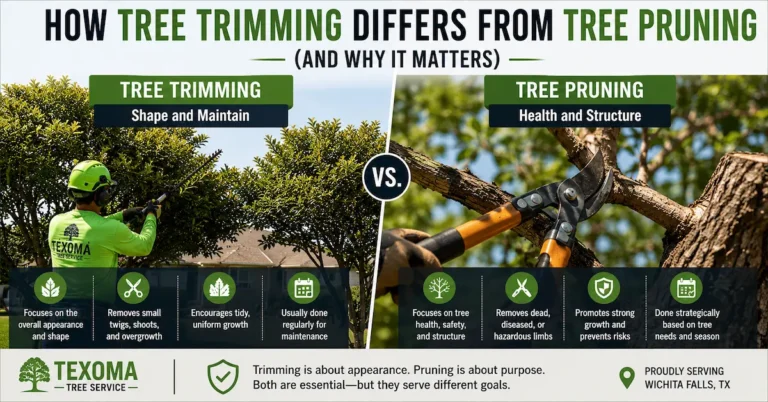
For cedar elms that are not yet in serious decline but have accumulated deadwood, structural branch issues, or canopy density problems that make them more vulnerable to storm damage and disease during the Wichita Falls severe weather season, our tree trimming and pruning service addresses these conditions during the October through January window when disease transmission risk is lowest, and the tree’s dormant state makes structural work most effective.
How Do You Keep Cedar Elms Healthy Long Term in Wichita Falls?
A cedar elm that survives a bout of drought stress or recovers from early-stage native elm wilt does not automatically remain safe from recurrence. The long-term health of cedar elms in Wichita Falls depends on a set of consistent management practices that reduce the environmental stress that makes trees vulnerable to the pathogens that thrive in North Texas conditions.
Annual professional inspection is the most cost-effective long-term investment for any cedar elm over twelve inches in trunk diameter. An inspection during the dormant season, from November through February, allows a qualified arborist to identify deadwood accumulation, early structural problems at major branch unions, bark abnormalities that might indicate early disease activity, and root flare conditions that could be limiting the tree’s health without producing obvious above-ground symptoms. Catching any of these conditions a year or two before they become serious problems dramatically reduces the management cost and the likelihood of losing the tree.
Deep root fertilization in late winter using a balanced slow-release fertilizer applied through the soil profile rather than as a surface application reaches the feeder root zone of cedar elms growing in Wichita County clay soil more effectively than standard broadcast surface application. The Texas A&M AgriLife Extension Service recommends nitrogen applications timed to early spring root activity for established urban trees showing signs of stress-related decline.
Frequently Asked Questions
Is native elm wilt or Dutch elm disease more common in Wichita Falls cedar elms?
Based on Texas A&M AgriLife research led by Dr. Dave Appel, native elm wilt caused by Dothiorella ulmi is currently a far more pervasive problem across Texas than Dutch elm disease for cedar elms specifically. Cedar elm’s intermediate resistance to Dutch elm disease means that Dothiorella wilt, which exploits wound entry points created by drought, hail, and insect activity, is the more likely culprit for cedar elms showing decline symptoms in Wichita Falls and across Wichita County. Dutch elm disease cannot be ruled out without laboratory confirmation, but native elm wilt should be the primary diagnostic consideration for most cedar elm decline cases in this region.
How quickly does Dutch elm disease kill a cedar elm compared to an American elm?
American elms infected with Dutch elm disease can die within a single growing season, with wilting spreading from a few branches throughout the entire tree rapidly. Cedar elms, classified as intermediate in susceptibility by Dr. David Appel’s research published through the Texas Invasives resource network, are significantly more resistant and may decline more slowly if infected. A cedar elm showing Dutch elm disease symptoms caught at the early flagging stage may have weeks to months before the decline becomes irreversible, which makes prompt professional assessment genuinely time-sensitive but not necessarily an immediate emergency in the same way it would be for an American elm.
Can I save my cedar elm by removing the affected branches myself?
For native elm wilt, early pruning of affected branches at least five feet below the lowest visible symptom is one of the recognized management responses, as documented by TreeNewal’s North Texas disease guidance. However, doing this without professional confirmation of the diagnosis risks either cutting too conservatively if the disease has already spread further than the visible symptoms suggest, or making wounds with unsterilized tools that accelerate the very spread you are trying to stop. For any cedar elm where Dutch elm disease is a possibility, tool sterilization between every cut is non-negotiable and root connection severing between adjacent elms may also be needed. Professional guidance before pruning is strongly recommended for any diseased cedar elm.
When is the best time to prune a cedar elm in Wichita Falls to minimize disease risk?
The October through January window offers the lowest disease transmission risk for cedar elm pruning in Wichita Falls. During this period, elm bark beetle populations are at their lowest activity, the tree is entering or is in dormancy, and Dothiorella ulmi spore dispersal from infected twig surfaces is reduced by cooler temperatures and lower humidity. Spring pruning during the February through June window creates fresh wounds during the period when both bark beetle activity and pathogen spore dispersal are highest, which is why professional tree services experienced with North Texas tree disease management schedule cedar elm pruning work outside this window wherever possible.
Concerned About Your Cedar Elm in Wichita Falls?
Texoma Tree Service provides professional cedar elm assessment, ISA-standard pruning management, and tree removal for declined specimens across Wichita Falls, Burkburnett, Iowa Park, Henrietta, Electra, and the Texoma region. Get a free on-site consultation today.
Get your free on-site assessment today.
Call us: +1 940 223-7713