How Long Does Tree Removal Take? A Wichita Falls Guide
Quick Answer
Tree removal in Wichita Falls takes anywhere from 30 minutes to a full day or more, depending on the size, species, location, and structural condition of the tree. A small ornamental tree under 20 feet tall in an open area takes one to two hours. A medium cedar elm or hackberry between 30 and 60 feet takes three to six hours. A large post oak or pecan tree over 60 feet, especially near a structure or utility line, can take six to eight hours or an entire working day. Crane-assisted removals of structurally compromised or oversized trees can extend to two days when equipment setup, staging, and cleanup are factored in. In Wichita Falls, North Texas weather, Wichita County clay soil conditions, and the specific wood density of common local species all influence how long your tree removal will actually take from first cut to final cleanup.
Most Wichita Falls homeowners ask the same question when they call for a tree removal estimate: how long is this going to take? It sounds like a simple question until you realize how many variables feed into the answer. Tree removal duration is not simply a function of how tall the tree is. The species, the wood density, the location relative to your home and utility lines, the condition of the root system in Wichita County clay soil, the equipment your crew is using, and what the weather is doing that week all play a meaningful role in how a single day’s schedule unfolds.
This guide is specifically written for Wichita Falls property owners who want a realistic, locally grounded answer before they schedule a crew, plan around their workday, or set expectations with neighbors. Every time estimate in this guide reflects the actual conditions and tree species that crews encounter across Wichita Falls neighborhoods from Tanglewood and Sikes Senter to rural properties out along Iowa Park Road and Burkburnett.
Tree Removal Timelines at a Glance: What to Expect by Tree Size
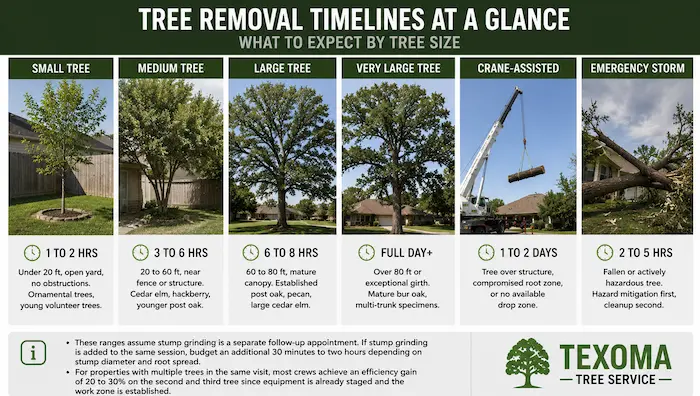
Before diving into the factors that affect tree removal duration, here is a practical reference framework based on tree size. These ranges apply to straightforward residential removals in Wichita Falls under typical conditions, meaning reasonable equipment access, no active utility line contact, and a crew of three to four experienced workers with appropriate equipment for the job.
🌱
Small Tree
1 to 2 hrs
Under 20 ft, open yard, no obstructions. Ornamental trees, young volunteer trees.
🌿
Medium Tree
3 to 6 hrs
20 to 60 ft, near fence or structure. Cedar elm, hackberry, younger post oak.
🌳
Large Tree
6 to 8 hrs
60 to 80 ft, mature canopy. Established post oak, pecan, large cedar elm.
🌲
Very Large Tree
Full Day+
Over 80 ft or exceptional girth. Mature bur oak, multi-trunk specimens.
🏗️
Crane-Assisted
1 to 2 Days
Tree over structure, compromised root zone, or no available drop zone.
⚡
Emergency Storm
2 to 5 hrs
Fallen or actively hazardous tree. Hazard mitigation first, cleanup second.
These ranges assume stump grinding is a separate follow-up appointment. If stump grinding is added to the same session, budget an additional 30 minutes to two hours depending on stump diameter and root spread. For properties with multiple trees in the same visit, most crews achieve an efficiency gain of 20 to 30 percent on the second and third tree since equipment is already staged and the work zone is established.
The Full Tree Removal Process in Wichita Falls: Every Phase Accounted For
One of the most consistent gaps in competitor content on how long tree removal takes is that it focuses almost entirely on the cutting phase and ignores the other phases of the job that add up to a significant portion of total time. For a Wichita Falls homeowner trying to plan their day, understanding the full timeline from crew arrival to equipment departure is far more useful than knowing only how long the actual cutting takes.
15 to 30 minutes
Arrival, Setup, and Final Site Assessment
The crew arrives, unloads equipment, and the lead arborist or crew lead walks the tree with you one final time. On a dead or storm-damaged tree, this assessment identifies any changed conditions since the original estimate visit, including new widow maker positions, additional structural deterioration, or changes in the surrounding area that affect the removal plan. Equipment staging, work zone marking, and protective placement for landscaping and structures are all completed before any cutting begins.
Variable: core of total time
Canopy and Branch Removal
Working from the top of the canopy downward, the crew removes large limbs first using a combination of climbing, bucket truck access, and rigging to control the descent of each section. For large post oaks and mature pecan trees in Wichita Falls, where the canopy can spread 40 to 60 feet in diameter, the canopy phase alone can take two to four hours on a large tree. Dense hardwood species slow cutting speed significantly compared to softer wood ornamental trees.
30 minutes to 2 hours
Trunk Sectioning and Removal
Once the canopy is cleared, the trunk is sectioned from top to bottom. Trunk section time scales directly with trunk diameter. A cedar elm trunk at 18 inches diameter cuts very differently from a bur oak trunk at 36 inches under the same chainsaw. Severely decayed trunks require more deliberate technique to manage unpredictable wood behavior, which adds time compared to a structurally sound tree of the same size.
30 minutes to 1.5 hours
Chipping, Loading, and Debris Processing
Every branch and section removed during the cutting phases must be processed. Smaller material goes through the wood chipper. Large trunk rounds are carried or rolled to the truck. On large trees with extensive canopies, the cleanup and processing phase takes as long as the actual cutting phase. This is frequently the part of the tree removal duration that surprises Wichita Falls homeowners who expected the crew to be finished and packed up much sooner than they actually are.
15 to 25 minutes
Final Site Cleanup and Equipment Loading
Once all debris is processed, the crew rakes and blows the work area, inspects for any remaining wood chips, hardware, or rigging materials, and does a final walkthrough with you before loading equipment and departing. This phase is non-negotiable for a professional crew and should not be skimped on. Any crew that leaves without this final walkthrough with the property owner is a crew that may leave problems behind that you will discover only after they are gone.
How Common Wichita Falls Tree Species Affect Removal Duration
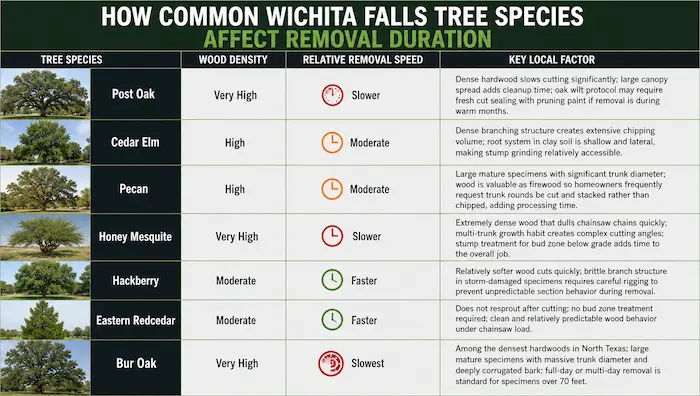
This is where local knowledge matters in a way that no generic national guide can replicate. The tree species most common in Wichita Falls and Wichita County each bring their own wood density, canopy structure, root behavior in North Texas clay soil, and cutting characteristics that experienced local crews know by feel. Understanding how your specific tree species affects the timeline helps you set accurate expectations before the crew arrives.
| Tree Species | Wood Density | Relative Removal Speed | Key Local Factor |
|---|---|---|---|
| Post Oak | Very High | Slower | Dense hardwood slows cutting significantly; large canopy spread adds cleanup time; oak wilt protocol may require fresh cut sealing with pruning paint if removal is during warm months |
| Cedar Elm | High | Moderate | Dense branching structure creates extensive chipping volume; root system in clay soil is shallow and lateral, making stump grinding relatively accessible |
| Pecan | High | Moderate | Large mature specimens with significant trunk diameter; wood is valuable as firewood so homeowners frequently request trunk rounds be cut and stacked rather than chipped, adding processing time |
| Honey Mesquite | Very High | Slower | Extremely dense wood that dulls chainsaw chains quickly; multi-trunk growth habit creates complex cutting angles; stump treatment for bud zone below grade adds time to the overall job |
| Hackberry | Moderate | Faster | Relatively softer wood cuts quickly; brittle branch structure in storm-damaged specimens requires careful rigging to prevent unpredictable section behavior during removal |
| Eastern Redcedar | Moderate | Faster | Does not resprout after cutting; no bud zone treatment required; clean and relatively predictable wood behavior under chainsaw load |
| Bur Oak | Very High | Slowest | Among the densest hardwoods in North Texas; large mature specimens with massive trunk diameter and deeply corrugated bark; full-day or multi-day removal is standard for specimens over 70 feet |
Post oak and pecan removal timing in Wichita Falls: Beyond the cutting time itself, the Texas A&M Forest Service recommends sealing all fresh oak wounds with latex-based pruning paint immediately after cutting during warm months to reduce oak wilt transmission risk via sap-feeding nitidulid beetles. This adds a few minutes per cut on oak removals but is standard protocol for responsible oak removal in North Texas regardless of whether the tree being removed is showing oak wilt symptoms.
How Location on Your Wichita Falls Property Affects Removal Time
A tree that takes two hours in an open backyard with clear equipment access can easily take five to six hours for the same species and size when the location creates access, rigging, and clearance challenges. Location is consistently the most underestimated time variable among Wichita Falls homeowners comparing quotes, and it is the variable that most often explains why one estimate says half a day and another says a full day for what appears to be the same job.
Location factors that extend tree removal time in Wichita Falls
- Tree directly over or touching the roofline: Any tree that cannot be felled in an open direction must be sectionally dismantled with full rigging control on every piece. This approach is significantly slower than directional felling but is the only safe method when the fall zone is blocked by a structure. In established Wichita Falls neighborhoods near Midwestern Parkway or along older streets near MSU Texas, where homes and trees have grown together over decades, this is one of the most common conditions crews encounter.
- Tree within Oncor Electric Delivery line clearance zone: Any tree that is growing into or adjacent to Oncor primary distribution lines or the service drop running to your home requires coordination with Oncor before work begins. Waiting for an Oncor representative to attend or confirm line clearance adds time to the overall project that is simply non-negotiable. Never let a crew cut a tree in contact with energized lines without Oncor involvement.
- Tight gate or access restrictions: Commercial stump grinders and large chippers cannot fit through a standard residential gate. If equipment access requires hand-carrying debris from a fenced backyard to the front street for chipping, that physical labor adds substantially to total job time. Some Wichita Falls backyards require temporary fence panel removal to allow equipment access, which adds setup and restoration time to the overall schedule.
- Steep terrain or compromised root zone: Wichita County’s clay soil expands and contracts significantly through wet and dry cycles. A tree on a slope with saturated clay around the root zone presents equipment footing challenges that a flat, dry yard does not. Crews work more cautiously and position equipment differently to maintain stability, adding time proportional to the difficulty of the terrain.
- Multiple trees with intertwined canopies: When two or more trees have grown with overlapping canopies, removing one without damage to the other requires deliberate section-by-section rigging that takes significantly longer than removing a standalone specimen. This situation is extremely common in mature Wichita Falls neighborhoods where trees planted decades ago have grown together over time.
Wichita Falls Specific Delays: Weather, Storm Season, and Scheduling Backlogs
In addition to the tree-specific and site-specific variables, Wichita Falls homeowners need to understand several local scheduling realities that affect not just how long the job takes on the day but how far in advance they need to book.
Spring Storm Season Backlogs
The Texoma region’s severe weather season runs roughly from March through June, and after major storm events the entire local tree service industry sees an immediate surge in emergency calls. Following a significant derecho or tornado event, removal crews across Wichita Falls, Burkburnett, Iowa Park, Henrietta, and Electra simultaneously face a backlog of emergency calls that can push non-emergency scheduled removals back by one to three weeks. If you have a tree that needs to come down before storm season, booking in January or February is a much smarter move than waiting until April, when every crew in the Texoma market is already running at capacity on storm work.
Summer Heat Limitations
Wichita Falls summers regularly produce temperatures above 100 degrees Fahrenheit for extended stretches. Crew safety protocols during peak summer heat require more frequent rest periods, earlier start times, and, in some cases, weather-related job holds when conditions pose an unacceptable risk of heat stress for workers performing demanding physical labor. A job that would take five hours in March may take six to seven hours in August when heat management breaks are factored into the work schedule.
When to Schedule for the Fastest Completion
The best seasons for tree removal in Wichita Falls
Based on local weather conditions, crew availability, and North Texas tree biology, the following windows offer the best combination of fast scheduling and efficient execution for tree removal in Wichita Falls.
- January to February: Prime removal season. Trees are dormant, wood is dry and cuts cleanly, heat is not a factor, ground is firm enough for equipment, and storm season backlogs have not yet begun. This is when most experienced Wichita Falls crews have the most calendar availability and the conditions most favorable for efficient work.
- October to November: Second-best window. Post-storm season, temperatures are dropping, and summer drought stress has passed. Good equipment footing after summer soil contraction. Scheduling availability is typically better than summer months.
- March to April: Acceptable but increasingly busy as storm season approaches. Booking early in this window gives you reasonable scheduling access before the post-storm surge fills the calendar.
- June to September: Least ideal for scheduling and execution. Peak heat, maximum crew demand from storm aftermath, and equipment operation in extreme temperature conditions. Emergency removals proceed regardless of season, but elective removals benefit from being pushed to a cooler window when possible.
Adding Stump Grinding: How It Affects Your Total Project Time
Stump grinding is the most common add-on to a tree removal job, and understanding how it affects your total time commitment helps you plan the day accurately rather than being surprised when the crew is still working two hours after the tree is down.
For a standard residential stump under 18 inches in diameter, stump grinding adds 30 to 45 minutes to the project. For larger stumps between 18 and 36 inches, add 45 minutes to 90 minutes. For exceptional stumps from large post oaks or pecan trees over 36 inches, budget an additional one to two hours depending on how deep grinding is required and whether the access conditions allow the grinder to work from optimal angles.
One important scheduling consideration specific to Wichita Falls and Wichita County: if your tree is a honey mesquite or hackberry that requires grinding below the dormant bud zone for effective regrowth prevention, the grinder will need to work deeper than standard residential grinding depth. This increases grinding time but eliminates the need for a return visit to address resprouting, which saves money and scheduling friction over the following growing season. Our stump grinding and removal service handles this depth specification as part of the initial job scope discussion so there are no surprises on the day of removal.
Why you should schedule stump grinding on the same day as removal
Convenience and cost: When the grinding equipment is already on site, and the crew is already staged, grinding costs less and takes less time than scheduling a separate mobilization. Most Wichita Falls tree services apply a combined-service discount when stump grinding is requested at the time of tree removal booking.
Pest control: A freshly cut stump of a formerly infested dead tree is an active invitation for subterranean termites and bark beetles if left standing. Eastern subterranean termites, which are active throughout Wichita County, can establish colonies in a fresh stump within a single warm season. Grinding the stump on removal day eliminates this risk without giving it time to develop.
When Your Tree Removal Will Take Longer Than the Estimate
Even the most experienced Wichita Falls tree crew can encounter conditions on the day of removal that extend the job beyond the original estimate. Understanding what causes these extensions helps you plan a realistic buffer into your schedule and avoids frustration when a morning job runs into early afternoon.
Hidden internal decay is the most common culprit. A tree that appeared structurally sound during the estimate visit may reveal a hollow trunk section during cutting that requires the crew to slow down, reassess the rigging plan, and proceed more cautiously than the original timeline assumed. This is particularly common with post oaks and cedar elms that have been under drought stress in Wichita County clay soil, where internal fungal decay progresses without predictable external indicators.
An ISA Certified Arborist who leads the estimate visit rather than sending a sales representative is better equipped to identify these hidden conditions before removal day, producing a more accurate timeline estimate and a better-prepared crew. The difference between a crew that discovers unexpected decay on the day of the job and one that anticipated it during the estimate is often the difference between a five-hour removal and an eight-hour one.
Other common causes of extended removal time include unexpected utility contact discovered only after canopy branches are cleared, neighbor disputes over tree placement that delay work start while ownership and permission questions are resolved, and equipment breakdowns that require a substitute machine to be sourced mid-job. Building a one to two-hour buffer into your planned schedule around any tree removal appointment is simply good practice regardless of how experienced the crew is.
For trees that need emergency attention following a storm event rather than a scheduled removal, our emergency tree removal service operates 24 hours a day across the Wichita Falls and Texoma area. Emergency removals prioritize hazard mitigation first and full cleanup second, which means the immediate danger is resolved quickly even when the complete removal and debris processing take longer to complete. Pairing emergency removal with our tree trimming and pruning service for remaining damaged limbs on surviving trees helps you address the full scope of storm damage in a single coordinated project.
Frequently Asked Questions
Will the crew finish in one day, or might they need to come back?
The vast majority of residential tree removals in Wichita Falls are completed in a single day. The only common exceptions are very large trees requiring crane assistance, multi-tree commercial projects scheduled around business hours, and situations where unexpected structural complexity is discovered on the day and requires a modified approach that extends beyond available daylight. If there is any realistic chance your job will require a second visit, a professional crew will tell you during the estimate rather than discovering it on site.
Do I need to be home during the tree removal?
You do not need to be physically present for the entire job, but you should be available at the start for the final site walkthrough and at the end for the completion inspection. If you cannot be on site, designate a trusted contact who has authority to make decisions about any unexpected conditions the crew encounters during removal. At minimum, confirm that gates and access points are unlocked before the crew arrives.
How much notice do I need to give for a tree removal appointment in Wichita Falls?
Outside of storm season, most Wichita Falls tree services can schedule non-emergency removals within one to two weeks. During the March to June storm season, demand increases significantly and scheduling windows extend to two to four weeks or longer. Emergency removals with active hazard conditions are prioritized and scheduled as quickly as possible regardless of the general calendar backlog.
Can a tree removal be completed if it is raining or has recently rained?
Drizzle generally does not stop a tree removal that is already scheduled, but heavy rain, thunderstorms, and lightning create conditions that make arborist climbing and chainsaw work genuinely dangerous. Most professional tree services in Wichita Falls follow a policy of postponing jobs when the forecast shows a meaningful chance of lightning within the service window. Recent heavy rain that has saturated Wichita County clay soil to the point where heavy equipment creates damaging ruts in your lawn may also prompt a postponement until ground conditions firm up.
Why did my neighbor’s tree removal take less time than mine when their tree looked bigger?
Tree size is only one variable in removal duration. Your neighbor’s tree may have been in an open area with a clear fall zone, used faster-cutting softwood, and required minimal rigging. If your tree was a dense post oak near your roofline in a tight backyard with no clear fall direction, the same-height removal could easily take twice as long. Location, species, and structural condition account for more of the time variance than most homeowners expect when they compare their experience to a neighbor’s.
Get an Accurate Timeline for Your Wichita Falls Tree Removal
Texoma Tree Service provides free on-site estimates across Wichita Falls, Burkburnett, Iowa Park, Henrietta, Electra, and surrounding Texoma communities. Know exactly how long your removal will take before the crew arrives.
Call us: +19406548157