Land Clearing Services in Wichita Falls: When Do You Need Them?
Quick Answer
You need land clearing services in Wichita Falls when your property has overgrown brush, invasive species like honey mesquite or eastern redcedar, storm debris, or when you are preparing land for new construction, agriculture, or sale. Land clearing in Wichita Falls typically costs between $250 for a small overgrown lot and $10,000 or more for multi-acre rural tracts. The right method, whether traditional clearing, forestry mulching, or grubbing, depends on the size of your property, your intended land use, and whether your project falls within Wichita Falls city limits, where local zoning and site preparation regulations may apply.
Most Wichita Falls property owners do not think about land clearing services until a problem forces the conversation. Maybe a vacant lot you bought off Loop 11 has gone from manageable brush to an impenetrable wall of honey mesquite. Maybe a cedar elm thicket on the back half of your Iowa Park Road acreage has crowded out the pasture you used to run cattle on. Maybe you just bought a raw parcel in Wichita County and need it cleared, graded, and ready for construction before the permit clock starts ticking.
Whatever brought you here, this guide covers the full picture: what land clearing services actually include in the Texoma region, the specific scenarios that genuinely require them, which method is right for your property type, what it costs, and what local regulations you need to know before any equipment rolls onto your land.
What Land Clearing Services Actually Include in Wichita Falls
Land clearing is one of those umbrella terms that covers a wide range of work depending on who you ask. At its most basic, land clearing in Wichita Falls means removing trees, brush, stumps, roots, debris, and invasive vegetation from a property to make it usable for a specific purpose. But that definition does not fully capture how different one land clearing project can look from the next.
A residential lot clearing project on a half-acre parcel near Sikes Senter is completely different from a fifty-acre ranch clearing project in rural Wichita County. One involves a stump grinder and a brush chipper. The other may require a bulldozer, a forestry mulcher, a skid steer with a brush cutter attachment, and multiple days of work. Understanding what your specific project requires starts with understanding which category it falls into.
What is typically included in professional land clearing services
- Tree removal and felling: Cutting and removing trees of all sizes, from small cedar saplings to large mature post oaks, including controlled felling and sectional dismantling near structures
- Brush and shrub removal: Clearing dense undergrowth, thorny brush, invasive shrubs, and overgrown vegetation using mechanical cutting equipment
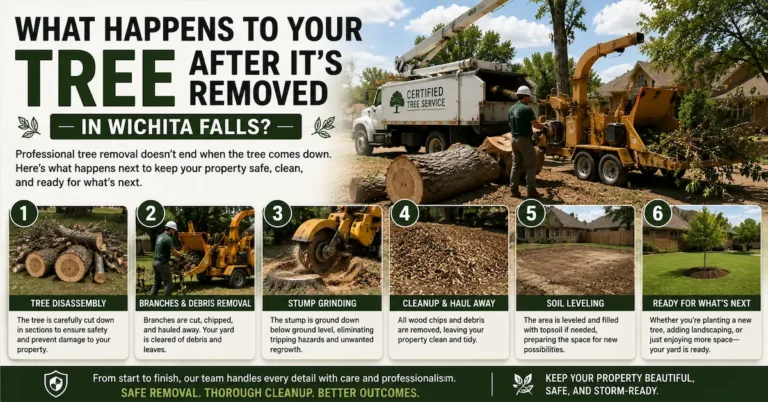
- Stump grinding and grubbing: Removing stumps at or below grade, or full root ball extraction for sites requiring clean, level subsurface conditions
- Forestry mulching: Grinding trees, brush, and stumps in place using a forestry mulcher, which processes all vegetation into wood chip mulch on site without hauling
- Debris removal and haul-off: Collecting, loading, and transporting cleared material off the property when on-site processing is not feasible or desired
- Site grading and soil preparation: Leveling and preparing the cleared surface for construction, seeding, or agricultural use after vegetation removal is complete
- Fence line and right-of-way clearing: Removing vegetation along property boundaries, access roads, utility easements, or fence lines
- Mesquite grubbing: The specialized removal of honey mesquite root systems, which requires equipment capable of cutting below the bud zone to prevent regrowth
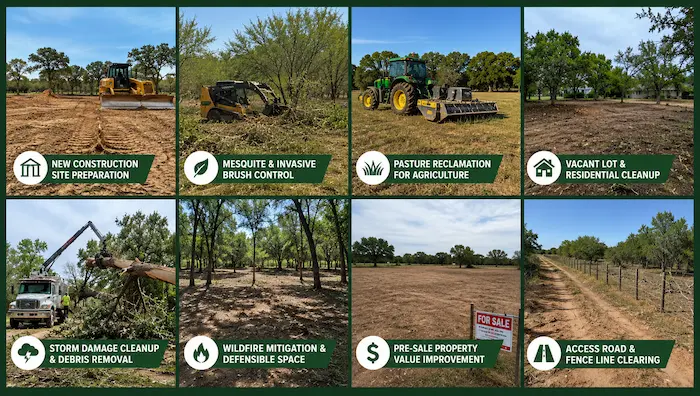
Eight Situations That Require Land Clearing Services in Wichita Falls
Land clearing services in Wichita Falls are not a one-size scenario. The situations that drive homeowners, ranchers, and developers to call a land clearing company are genuinely different from one another, and recognizing which category your situation fits helps you communicate your needs clearly and get an accurate estimate the first time.
🏗️
New Construction Site Preparation
Before any foundation can be poured in Wichita Falls, the building site must be cleared of all trees, roots, and subsurface organic material. Wichita County clay soil is particularly unforgiving when organic material is left below a slab or pier-and-beam foundation, since decomposing roots create voids that cause settling and structural problems over time.
🌿
Mesquite and Invasive Brush Control
Honey mesquite is the most persistent land management challenge facing Wichita Falls area property owners. Left unchecked, mesquite spreads from pastureland into residential lots and agricultural tracts within a single growing season. Its deep root system and aggressive resprouting behavior make it one of the most difficult species to control without professional equipment and proper technique.
🌾
Pasture Reclamation for Agriculture
Wichita County has a strong agricultural heritage, and many property owners in the areas surrounding Wichita Falls are actively reclaiming brush-encroached pastureland for cattle grazing, hay production, or dryland farming. Land clearing services restore these parcels to productive use and can dramatically increase the usable acreage on rural tracts that have been understocked or neglected.
🏡
Vacant Lot and Residential Property Cleanup
Wichita Falls has a significant inventory of vacant in-fill lots, many of which have been sitting unimproved for years and have developed heavy brush, volunteer trees, and debris accumulation. Whether you are preparing to build, staging the lot for sale, or simply bringing the property into compliance with local nuisance ordinances, professional land clearing is the fastest path to a clean, usable lot.
⚡
Storm Damage Cleanup and Debris Removal
Following the severe thunderstorms and straight-line wind events that affect Wichita Falls each spring, large-scale debris and downed tree material can make portions of a property completely inaccessible. Post-storm land clearing addresses this material systematically, restoring access and eliminating the pest habitat and fire fuel that accumulated storm debris creates.
🔥
Wildfire Mitigation and Defensible Space
North Texas wildfire risk is real and underappreciated by many Wichita Falls property owners. Dense dry brush, accumulated dead material, and overgrown vegetation adjacent to structures create the fuel load that turns a controlled burn or stray spark into a property-threatening fire. Creating defensible space through strategic land clearing around homes and outbuildings is one of the most effective wildfire risk reduction steps available to rural property owners in Wichita County.
💰
Pre-Sale Property Value Improvement
An overgrown or brush-choked property appraises and shows significantly worse than a clean, cleared parcel. Land clearing services in Wichita Falls are one of the highest-return investments available to property owners preparing to list rural land, infill lots, or large residential properties, because cleared land is visually appealing, easier to walk and inspect, and signals active ownership and maintenance to buyers.
🛤️
Access Road and Fence Line Clearing
Rural and semi-rural properties in Wichita County frequently have access roads and fence lines that have been encroached upon by cedar elm, hackberry, and eastern redcedar. Clearing these corridors restores access, simplifies fence maintenance, reduces the risk of livestock escapes from compromised fence sections, and eliminates the habitat where mesquite and brush seed into fence lines from neighboring properties.
The Mesquite Problem: Why Land Clearing in Wichita Falls Is Different
Any honest discussion of land clearing services in Wichita Falls has to address honey mesquite directly, because it is the single most common driver of land clearing projects throughout the Texoma region and the species that most clearly separates experienced local operators from generalist tree companies.
Honey mesquite has been encroaching on North Texas grassland and pastureland for over a century, driven by decades of overgrazing, fire suppression, and bird-dispersed seed distribution from established trees. Wichita County, with its mix of sandy loam river bottoms near the Wichita River and clay-heavy uplands throughout the county, provides nearly ideal conditions for mesquite establishment and spread.
The reason mesquite is so difficult to control comes down to its dormant bud zone, which sits two to six inches below the soil surface along the basal root collar. Standard tree cutting leaves this bud zone intact, and the plant responds within weeks by sending up multiple new shoots that grow faster and more densely than the original trunk. Effective mesquite control requires either:
The three effective approaches to mesquite control in Wichita County
- Mechanical grubbing: Using a root plow, grubbing blade, or specialized skid steer attachment to cut below the bud zone at three to six inches below grade. This is the gold standard for permanent mesquite control without herbicide and is particularly effective on properties being converted to pasture or prepared for construction.
- Forestry mulching with deep grinding: A forestry mulcher that cuts the stump to sufficient depth and grinds the root collar material can disrupt the bud zone enough to prevent or significantly delay regrowth. Not as reliably permanent as root plowing but faster and less disruptive to the surrounding soil structure.
- Mechanical cutting plus herbicide treatment: Cutting the mesquite to ground level and immediately applying a cut-surface herbicide such as Remedy Ultra or Tordon 22K to the freshly cut stump. The Texas A&M AgriLife Extension Service recommends this combination approach for properties where mechanical grubbing is not feasible due to terrain or soil conditions.
Eastern redcedar is the other significant invasive species driving land clearing demand in Wichita County. Unlike mesquite, eastern redcedar does not resprout after cutting, which makes it considerably easier to control mechanically. However, it establishes densely, grows quickly, and dramatically increases wildfire intensity when dry, making timely control equally important.
Land Clearing Methods: Which One Does Your Property Need?
The method used to clear your land affects cost, timeline, soil condition afterward, regrowth risk, and whether a permit is required inside Wichita Falls city limits. Understanding the differences before your first conversation with a land clearing contractor puts you in a far stronger position to evaluate bids and ask the right questions.
| Method | Best For | Permit (City Limits)? | Mesquite Regrowth Risk | Relative Cost |
|---|---|---|---|---|
| Forestry Mulching | Residential lots, pasture prep, brush control, erosion-sensitive land | Often Exempt | Moderate | $$ Moderate |
| Traditional Clearing with Haul-off | Construction sites, lots requiring a clean, debris-free surface | Often Required | High if no grubbing | $$$ Higher |
| Root Plowing / Grubbing | Agricultural pasture conversion, permanent mesquite control | Typically Rural | Low | $$$ Higher |
| Bulldozer Clearing | Large acreage, heavily wooded tracts, commercial development pads | Often Required | Moderate to High | $$$$ Highest |
| Brush Hog Mowing | Light brush maintenance, open areas with minimal woody growth | Generally No | Very High | Construction sites, lots requiring clean, debris-free surface |
Forestry mulching has emerged as the preferred method for most Wichita Falls residential and semi-rural land clearing projects over the past decade. The Hydro-Ax mulcher processes all vegetation, including trees up to eight inches in diameter, into wood chips in a single pass without hauling material off site. The resulting mulch layer suppresses regrowth, retains soil moisture during Wichita Falls summer droughts, and eliminates the permit requirement that traditional clearing within city limits often triggers. Stewart Ranch Services, which operates in Wichita Falls and Wichita County, specifically notes that forestry mulching frequently avoids the permit requirement that applies to traditional land clearing inside the city, making it a faster and more cost-effective starting point for residential projects.
Land Clearing Permits and Regulations in Wichita Falls
Permit requirements for land clearing in Wichita Falls depend on two things: whether your property is inside city limits, and the method you are using to clear. Getting this wrong before you start can expose you to code violations, stop-work orders, and fines from the City of Wichita Falls Development Services Department.
Wichita Falls Land Clearing Permit Overview
What You Need to Know Before Any Equipment Arrives
Inside city limits, traditional land clearing that involves removing trees and vegetation as part of a development project typically requires site plan approval and may require tree removal documentation as part of the City of Wichita Falls zoning and subdivision regulations. Projects that alter drainage patterns or disturb significant ground area may also require a grading permit through Development Services.
- Forestry mulching inside city limits frequently falls outside the permit requirement that applies to traditional tree removal and clearing, because it does not involve grading, haul-off, or site alteration in the same manner. Confirm this for your specific parcel with the city before assuming exemption.
- Rural properties in unincorporated Wichita County generally have minimal permit requirements for land clearing, but any project involving grading near drainage channels, wetlands, or the Wichita River floodplain falls under Texas Commission on Environmental Quality (TCEQ) and Army Corps of Engineers jurisdiction regardless of county location.
- The City of Wichita Falls zoning ordinance Appendix B includes a specific approved tree list for landscaping that reflects the local species palette, including cedar elm, post oak, and golden rain tree. Development projects that remove existing trees may require replacement planting as a condition of site plan approval.
- Always call Texas 811 before any land clearing project. Underground utility lines, buried irrigation, septic systems, and Oncor Electric Delivery infrastructure must be located and marked before grubbing or excavation equipment begins operating on any property.
For any property inside city limits, the safest first step is a conversation with the City of Wichita Falls Development Services Department to confirm what approvals your specific scope of work requires before you sign a contract with a land clearing company.
How Much Do Land Clearing Services Cost in Wichita Falls?
Land clearing costs in Wichita Falls vary significantly based on acreage, vegetation density, access conditions, and the method required. The figures below reflect the range for typical projects in the Texoma market based on current local contractor pricing and regional data from Texas land clearing operators.
| Project Type | Typical Size | Estimated Cost Range |
|---|---|---|
| Small residential lot clearing | Under 0.5 acre | $250 to $600 |
| Medium lot, light to moderate brush | 0.5 to 1 acre | $600 to $1,500 |
| Residential acreage, moderate density | 1 to 5 acres | $1,500 to $5,000 |
| Agricultural or rural land clearing | 5 to 20 acres | $5,000 to $12,000 |
| Large ranch or commercial site preparation | Over 20 acres | $12,000 and above |
| Forestry mulching per acre | Per acre rate | $300 to $600 per acre (light to moderate) |
| Mesquite grubbing per acre | Per acre rate | $400 to $900 per acre depending on density |
The density of honey mesquite on a Wichita County property is the single biggest cost variable that most homeowners and landowners underestimate. A one-acre parcel with light to moderate brush may clear in a day at a reasonable cost. The same parcel with a dense established mesquite stand may require root plowing equipment, additional passes, and a herbicide follow-up treatment that collectively more than doubles the initial clearing cost. Having an experienced local operator walk the property before committing to a price is essential for accurate budgeting.
Best time to schedule land clearing in Wichita Falls:
Winter, from November through February, is generally the optimal window for land clearing in North Texas. Vegetation is dormant, ground conditions are firmer and less likely to create equipment ruts in clay soil, and the lower humidity reduces the operational risk associated with brush fires from clearing debris. Scheduling before peak storm season also ensures your cleared land is ready before the spring construction and agricultural window opens.
What to Look for When Hiring a Land Clearing Company in Wichita Falls
The land clearing market in Wichita Falls includes a mix of established operators, regional companies, and general contractors who add clearing as a side service. The difference between a qualified land clearing crew and an underequipped one is most apparent when the project involves challenging terrain, invasive species management, or proximity to structures and utilities.
- Verify insurance coverage. Land clearing involves heavy equipment operating in proximity to structures, fences, utilities, and neighboring properties. Any company you hire should carry comprehensive general liability insurance and workers’ compensation. Ask for proof of both before signing a contract.
- Request a walk-through and written scope. A reputable land clearing company will visit your property before quoting. Any contractor who quotes by phone or satellite image alone without visiting the site is not accounting for the access conditions, vegetation density, and subsurface considerations that directly affect the actual cost and scope of the work.
- Ask specifically about mesquite control methods. If mesquite is present on your property, ask the contractor what equipment and approach they use for the root collar. A contractor who simply plans to cut at grade level without addressing the bud zone is setting you up for heavy regrowth within a single growing season
- Confirm permit responsibility. Clarify in your contract who is responsible for obtaining any required city permits before work begins. A professional land clearing company familiar with Wichita Falls development regulations should be able to advise you directly on what your project requires.
- Ask for references from comparable local projects. Experience with Wichita County terrain, clay soil conditions, and North Texas vegetation species matters significantly. Ask for references from property owners in the area whose projects were similar in scope and species composition to yours.
- Discuss what happens to the cleared material. With forestry mulching, all material stays on site as mulch. With traditional clearing, debris is hauled or burned. Confirm the plan for material disposal in writing, including who covers any associated haul-off or disposal fees, before work begins.
For complex projects involving significant tree removal alongside your land clearing scope, consulting with an ISA Certified Arborist before clearing begins ensures that any trees on your property worth preserving are identified and protected before the equipment arrives. The International Society of Arboriculture maintains a searchable database of certified arborists by location, and their professional assessment can inform decisions about which trees to retain for shade, wildlife habitat, or windbreak value on agricultural and rural properties.
How Land Clearing Connects to Your Broader Property Plan
Land clearing services in Wichita Falls rarely stand alone. Most clearing projects are the starting point for a broader sequence of property improvements that unfold over the months following the initial clearing work. Understanding this sequence helps you plan the full scope, budget accurately, and avoid having to return to partially addressed areas later.
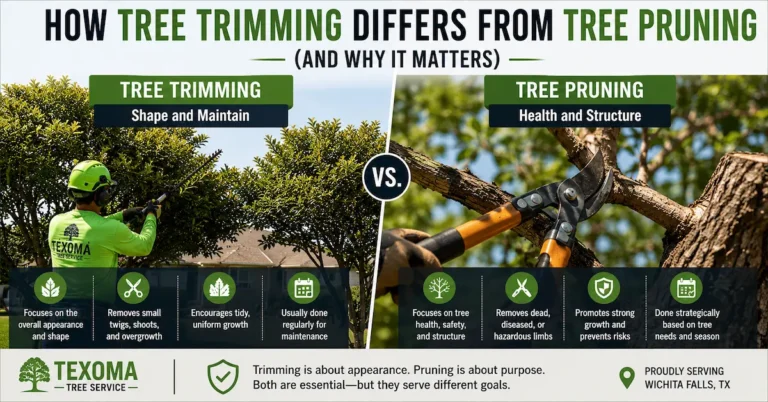
After clearing, many properties benefit from targeted tree trimming and pruning to shape and maintain any trees that were intentionally preserved during the clearing process. Trees that were growing in a competition environment often have uneven canopy structure and dead wood accumulation that should be addressed once the surrounding vegetation is removed and the retained trees are carrying the full visual and functional load of the property.
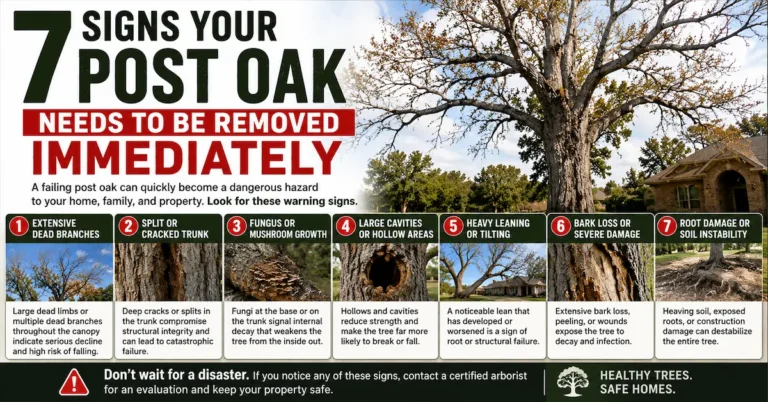
Properties with individual large trees that could not be addressed efficiently with clearing equipment require professional tree removal as a separate scope item. This is particularly common on residential lots where a large post oak or pecan is positioned too close to a planned structure footprint to be left in place, but requires careful sectional removal rather than simple felling.
Stumps left behind after a clearing operation, particularly mesquite and hackberry stumps that were not grubbed below the bud zone, can be addressed with professional stump grinding and removal services as a follow-up step. This is also the point at which any stump treatment to prevent resprouting should be evaluated and applied if it was not done during the initial clearing scope.
Frequently Asked Questions About Land Clearing Services in Wichita Falls
How long does land clearing take for a typical Wichita Falls property?
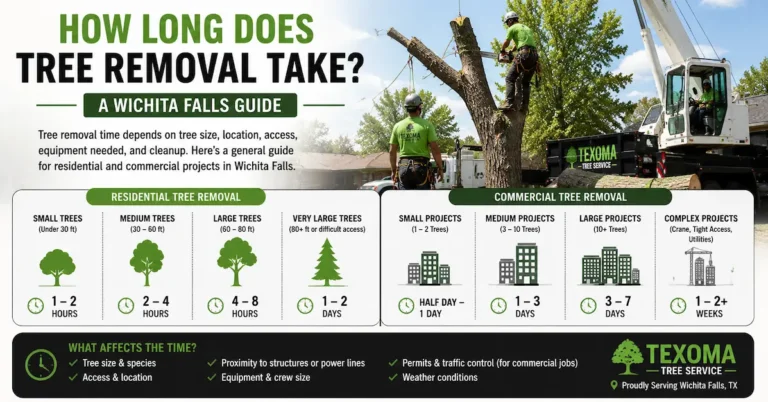
A residential infill lot under one acre typically takes one to two days with a professional crew using a forestry mulcher or combination of equipment. Mid-sized properties from one to five acres generally require two to four days. Larger agricultural or commercial tracts are scoped individually, but a professional operator can typically clear two to five acres per day under moderate vegetation conditions. Extreme mesquite density, rocky terrain, or wet clay soil conditions from recent rainfall can slow these timelines significantly.
Will land clearing damage the soil on my Wichita Falls property?
The impact on your soil depends heavily on the method used. Forestry mulching is the least invasive option, as it processes vegetation in place without stripping topsoil and leaves a wood chip layer that actually improves soil structure and moisture retention over time. Traditional bulldozer clearing is the most disruptive, as it strips topsoil along with vegetation and can leave compacted subsoil that drains poorly and supports weak grass establishment. For most Wichita Falls properties where Wichita County clay soil is already a management challenge, forestry mulching is the recommended approach for this reason alone.
Can mesquite be fully eliminated through a single land clearing project?
Not always, and any contractor who promises permanent elimination with a single treatment should be pressed on their methodology. Honey mesquite’s deep root system means that root plowing or grubbing below the bud zone, combined with a herbicide treatment on surviving root material, gives the highest single-treatment success rate. However, seed bank activity from neighboring properties and surviving lateral roots can result in some regrowth within one to three years even after a thorough mechanical treatment. Follow-up spot treatment of surviving resprouts in the first and second season after clearing significantly improves long-term control.
Do I need to notify my neighbors before land clearing begins?
While not legally required for most residential and agricultural land clearing in Wichita Falls, professional courtesy and practical risk management both favor notifying immediately adjacent neighbors before heavy equipment arrives. Equipment noise, dust, and the potential for debris to cross property lines during clearing operations can all create friction. A simple heads-up the day before work begins prevents most of these issues and protects your relationship with neighbors who may share a fence line with your cleared property.
What should I do to prepare my property before the land clearing crew arrives?
Walk the property and mark any features you want the crew to avoid: established trees you want retained, irrigation system components, buried utilities, septic tanks, or any structures near the clearing zone. Move any equipment, vehicles, or stored materials out of the work area. Confirm that Texas 811 has been called and underground utilities are marked if any grubbing or excavation is part of the scope. Provide the crew with clear access to the property, including gate codes or key arrangements, and confirm the staging area for equipment and material processing before the crew arrives.
Ready to Clear Your Wichita Falls Property?
Texoma Tree Service provides professional land clearing services for residential, commercial, and agricultural properties across Wichita Falls, Burkburnett, Iowa Park, Henrietta, Electra, and surrounding Texoma communities.
Get a free on-site estimate today. Get Your Free Estimate
Call us: +1 (940) 654-8157