Dead Tree Removal in Wichita Falls: Safety Risks You Can’t Ignore
Quick Answer
Dead tree removal in Wichita Falls is urgent, not optional. A standing dead tree loses structural integrity rapidly as internal decay, fungal rot, and root system deterioration progress beneath the surface. In the Texoma region, where severe thunderstorms, straight-line winds, and prolonged drought cycles are annual realities, a dead or dying tree on your property is a predictable failure waiting for the right weather event. The risks include falling limbs or full tree failure onto your home, vehicle, or utility lines, termite and wood-boring pest infestations that can spread from the dead tree into your structures, and potential liability if a known hazard tree damages a neighboring property. Dead tree removal in Wichita Falls typically costs between $192 and $1,800 depending on size and location, and the City of Wichita Falls now operates a Tree Abatement Program offering up to $4,000 in assistance for qualifying properties within the Heart of the Falls Revitalization Area.
There is a dead tree in a lot of Wichita Falls yards right now that the owner has been meaning to deal with for a season or two. Maybe it died during one of the extended droughts that regularly stress North Texas tree populations. Maybe oak wilt took hold and moved through the canopy last summer. Maybe a cedar elm just gave out after years of fighting the clay soil and heat. Whatever the cause, it is standing there, looking manageable, and the removal keeps getting pushed to the next month’s list.
This guide is written to change that thinking. Not through alarm, but through an honest accounting of what actually happens to a dead tree in Wichita Falls as time passes, what the structural and biological failure modes look like, and why the window between “I should deal with this” and “this tree just came through my roof” is shorter than most homeowners realize in a region that experiences severe weather with the frequency and intensity that Wichita Falls does.
Why a Dead Tree Is a Different Kind of Risk Than a Damaged Living Tree
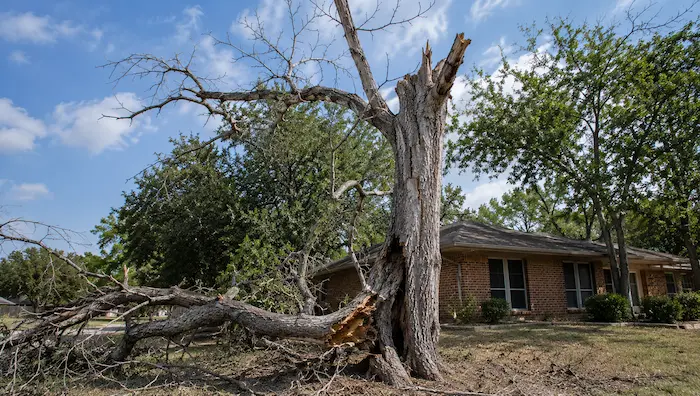
Dead tree removal in Wichita Falls matters precisely because of what a dead tree does not have that a living tree does. A living tree, even a stressed or partially damaged one, is actively managing the structural and biological challenges it faces. It compartmentalizes wounds, redirects growth around damaged tissue, and maintains turgor pressure in its cells that contributes to branch flexibility during wind loading. None of that is happening in a dead tree.
Once a tree dies, the internal processes that maintained its structural resilience stop immediately. The wood begins to dry and check, developing cracks along the grain that reduce bending strength. The bark begins to separate from the cambium layer beneath, creating gaps where moisture collects. Fungal decay organisms, which were already present in most mature trees, accelerate their colonization of the sapwood and heartwood without the tree’s immune response to limit their spread. Root function ceases entirely, meaning the anchoring capacity of the root system begins declining from the moment of death as roots themselves begin to decay in the soil.
In Wichita Falls, the climate accelerates this deterioration significantly. The prolonged summer heat dries dead wood rapidly, creating conditions that favor wood-boring beetle activity. The expansive and contractive cycles of Wichita County clay soil put lateral stress on decaying root systems with each wet and dry period. And when the severe thunderstorms that define the Texoma spring season arrive, a dead tree that has been standing for two or three years may have only a fraction of the structural capacity it appeared to have from the outside.
The Five Safety Risks a Dead Tree Creates on Your Wichita Falls Property
Dead tree removal in Wichita Falls is not just about tidying up your yard. Each category of risk below represents a genuine, documented hazard that becomes more severe the longer a dead tree remains standing. Understanding them clearly is what motivates action before the failure event rather than after it.
🏚️
Structural Failure and Property Damage
The most immediate and dramatic risk of a dead tree in Wichita Falls is structural failure during a storm event. The top of a dead tree can break under cutting pressure alone, a fact that applies with even greater force to wind loading during a severe thunderstorm. A dead post oak or cedar elm that stands sixty feet tall and falls toward a home represents an impact energy that no residential structure is designed to absorb. Dead tree removal removes this risk entirely and should be scheduled before storm season begins each spring.
⚡
Utility Line Contact and Electrical Hazard
Many older Wichita Falls neighborhoods have overhead Oncor Electric Delivery service lines running through or near established tree canopies. A dead tree that falls across these lines creates an immediate life safety emergency and can result in extended outages affecting multiple properties. Dead branches that drop onto energized lines create arcing and fire risk. Oncor-managed lines cannot safely be cleared until the utility confirms power isolation, meaning a fallen dead tree across service lines creates a situation that is dangerous for hours or days after the initial failure.
🐜
Termite and Pest Infestation Spread
Subterranean termites are highly active throughout Wichita Falls and Wichita County, and dead wood is precisely the habitat they exploit most aggressively. A dead tree standing close to your home creates a termite bridge between the soil and your structure. Termites and decay fungi together cause more than two billion dollars in structural damage annually across the United States, and this damage is typically not covered by standard homeowners insurance policies. Removing dead trees eliminates the primary attractant before an infestation establishes.
🔥
Wildfire Fuel Load
North Texas wildfire risk is real and most Wichita Falls homeowners significantly underestimate it. A dead tree represents a concentrated column of dry, combustible material that accelerates fire spread across a property. The Texas A&M Forest Service identifies standing dead trees as a primary component of elevated wildfire fuel loads in the Cross Timbers ecoregion that covers much of North Texas. During the dry, windy conditions that precede spring storm season in the Texoma area, a single ignition source near a dead tree can produce a fire that travels faster than most homeowners can respond.
⚖️
Legal Liability for Neighbor Damage
Under Texas property law, a homeowner who is aware that a tree on their property is dead or hazardous may face liability if that tree or its branches subsequently damage neighboring property or injure a person. The key legal threshold is knowledge: if you know the tree is dead or dangerous and fail to act, the standard negligence defense that applies to unexpected tree failures does not fully apply. Document any professional assessments you receive, and treat a dead tree on your property as a known liability that increases the longer it stands.
🌲
Disease and Pest Spread to Healthy Trees
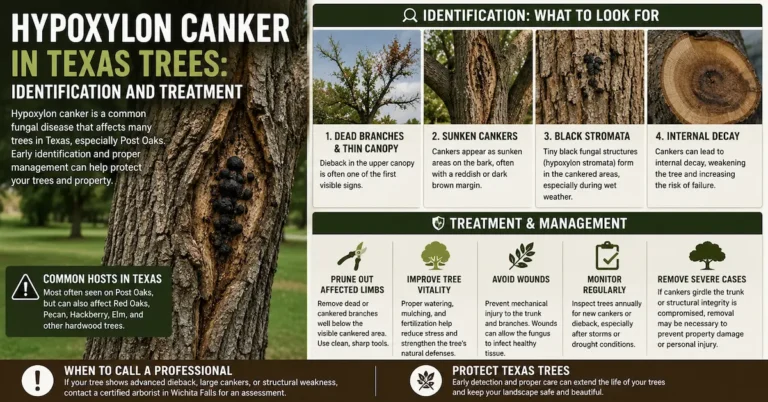
A dead tree on your Wichita Falls property does not only affect structures and utilities. It also affects your remaining healthy trees. Bark beetles and other wood-boring insects that establish in dead wood often target adjacent living trees once their preferred dead wood resource is exhausted or fully colonized. Fungal pathogens responsible for hypoxylon canker, which is extremely common in drought-stressed North Texas trees, can spread from dead wood to adjacent living trees through root contact and spore dispersal. Dead tree removal limits these spread pathways significantly.
The Wichita Falls Tree Abatement Program: Financial Assistance You May Not Know About
One of the most locally significant pieces of information for Wichita Falls homeowners dealing with dead tree removal is a program that most people in the area have never heard of. The City of Wichita Falls launched its Tree Abatement Program to help reduce the inventory of dead and hazardous trees in established neighborhoods, beginning with properties inside the Heart of the Falls Revitalization Area.
According to the City of Wichita Falls official program documentation and coverage by Texoma’s Homepage, the Tree Abatement Program offers eligible property owners up to $4,000 per property in financial assistance for the removal of dead or hazardous trees. The program operates on a first-come, first-served basis until funding is exhausted each program year. Christal Cates, the city’s Neighborhood Revitalization Coordinator, confirmed that continued program funding depends on successful participation, making timely application by eligible homeowners both a financial opportunity and a contribution to the program’s long-term viability.
Wichita Falls Tree Abatement Program eligibility requirements
- Property must be located within the Heart of the Falls Revitalization Area (use the city’s eligibility map to confirm your address)
- Application must be signed by the property owner with proof of ownership provided
- Property owner must not be delinquent on any City of Wichita Falls fees or assessments
- Program is first-come, first-served with a maximum assistance total of $4,000 per property per program year
- Contact the City of Wichita Falls Neighborhood Revitalization office to confirm current program status and application procedures before scheduling removal
For homeowners outside the Heart of the Falls Revitalization Area, this program does not currently apply, but it is worth monitoring as the city has indicated interest in expanding it based on participation levels. Even without program assistance, the cost of dead tree removal in Wichita Falls is almost always significantly less than the cost of repairing the damage a failed dead tree causes.
Nine Warning Signs Your Tree Is Dead or Dying in Wichita Falls
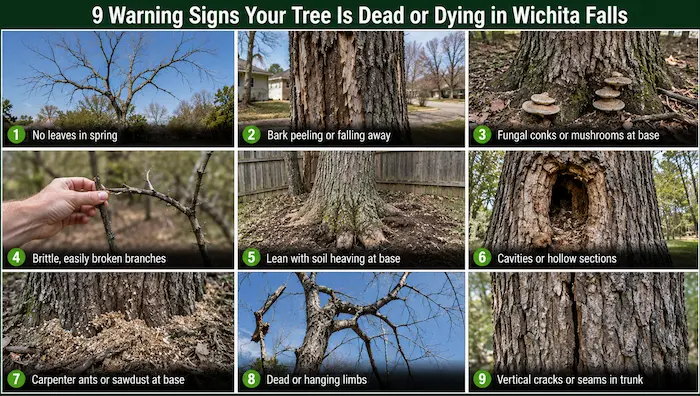
Dead tree removal in Wichita Falls starts with correctly identifying which trees on your property have crossed the threshold from stressed living trees into dead or imminently failing ones. The following signs, individually and in combination, indicate that a tree needs professional assessment and likely removal. An ISA Certified Arborist can conduct a formal hazard assessment to confirm the tree’s condition before removal is scheduled.
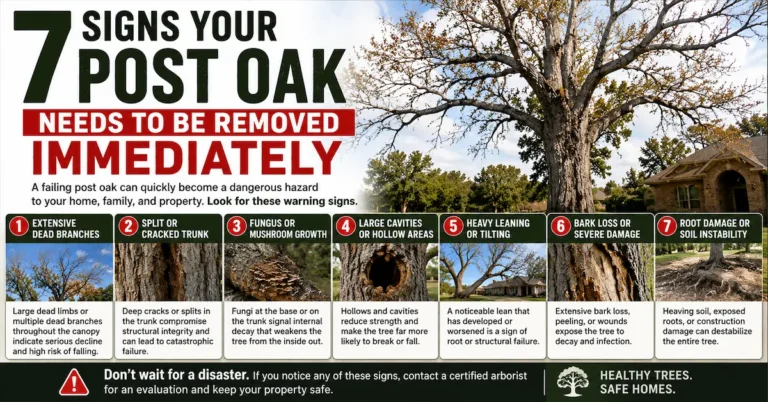
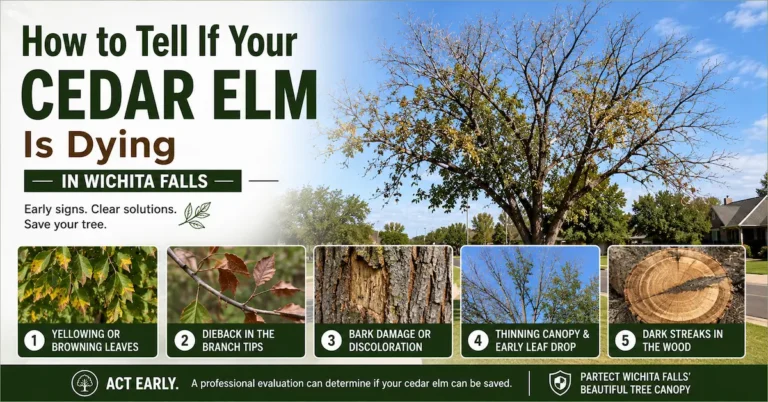
- Complete absence of leaf-out in spring. This is the most definitive indicator for deciduous trees like post oak, cedar elm, hackberry, and pecan. If a tree produces no leaves at all when surrounding trees of the same species leaf out fully, it is almost certainly dead or too far gone to recover. A dead branch here or there is not the same as complete canopy failure.
- Bark peeling, slipping, or falling away in large sections. Live bark is anchored to the cambium layer beneath it by actively growing cells. When a tree dies, this connection is lost and the bark separates from the wood underneath. Large sections of slipping or peeling bark are a reliable indicator that the cambium layer below is dead. Once this process is widespread on the trunk, the tree is not recoverable.
- Fungal conks, bracket fungi, or mushrooms at the base of the trunk. The presence of bracket fungi or conks on the trunk or at the root flare is a sign that advanced internal wood rot is already underway. These fruiting bodies indicate that the decay process has progressed to the point where structural integrity is already compromised. Not all internally decayed trees show external fungal signs, but when they do appear, the situation is serious.
- Brittle, easily broken branches throughout the canopy. Live wood bends under pressure before breaking. Dead wood snaps cleanly with minimal bending. Walking the perimeter of a suspected dead tree and pressing on accessible lower branches gives a useful early signal of how far the drying and decay process has progressed through the canopy.
- Significant trunk lean with soil heaving at the base. A tree that has developed a new lean, particularly one accompanied by raised or cracked soil on the opposite side of the lean, has experienced root zone failure. This indicates that the root system can no longer anchor the tree against gravity or wind loading. In Wichita County clay soil, this condition progresses faster than it would in sandier soils because root decay disrupts the tree’s adhesion in the dense clay matrix around the root ball.
- Visible cavities or hollow sections in the trunk. Cavities in the trunk indicate that the heartwood, which provides the column strength of the tree, has been replaced by hollow space through advanced decay. A tree can sometimes manage for years with a cavity, but as the cavity enlarges, the remaining wall of sound wood becomes insufficient to carry the structural loads the tree experiences during wind events. Cavities on the windward face of the tree are particularly concerning for Wichita Falls properties exposed to prevailing southwest winds.
- Carpenter ant activity or sawdust accumulation at the base. Carpenter ants do not eat wood the way termites do, but they excavate galleries in soft, moist, decaying wood to build their nests. Finding large carpenter ants or piles of coarse wood shavings at the base of a tree indicates that internal wood decay has progressed to the point where the wood is soft enough for ant colonization. This is a reliable secondary indicator of advanced internal rot even when external symptoms are subtle.
- Dead or hanging limbs distributed throughout the canopy. Widow makers, the term arborists use for dead or hanging limbs still caught in the canopy above, are among the most immediate hazards associated with dead trees. Unlike a tree that falls as a unit, widow makers drop with little warning and can fall during periods of no wind simply through the gradual loosening of their connection to the branch stub above. In Wichita Falls, where children and adults regularly spend time in yards beneath these trees, this hazard deserves urgent attention.
- Vertical cracks or seams running along the trunk. Vertical cracks in a dead tree’s trunk are a sign of advanced structural deterioration. According to the Virginia Tech Tree Steward Manual, longitudinal cracks allow fungi and pathogens to invade the wood, leading to further decay. In combination with other signs, vertical cracking indicates a tree that has entered an accelerating decline in structural capacity that cannot be arrested without removal.
Why Wichita Falls Weather Makes Dead Tree Removal More Urgent Than Elsewhere
Generic advice about dead tree removal does not account for the specific conditions of the Texoma region, and this is precisely where competitor content falls short. The combination of environmental factors in Wichita Falls creates a dead tree failure environment that is genuinely more dangerous and more time-compressed than what most homeowners in other parts of the country experience.
Why the Texoma Climate Creates Accelerated Dead Tree Risk
Four factors that make dead tree removal in Wichita Falls more time-sensitive than national averages suggest
- Tornado Alley storm intensity: Wichita Falls sits in one of the most active severe weather corridors in North America. The straight-line winds, microbursts, and tornadoes that occur each spring produce wind loads that expose structural deficiencies in dead trees that would not be tested by storms in other regions. A dead tree that might stand for five years in a calm-weather climate may fail in its second season in the Texoma wind environment.
- Extreme summer heat drying cycles: Temperatures routinely exceeding 100 degrees Fahrenheit in Wichita Falls summers accelerate the drying of dead wood far beyond what occurs in milder climates. Rapid drying creates checking, the longitudinal cracking of wood along the grain, which dramatically reduces bending strength. A dead tree in Wichita Falls may lose structural integrity in a single summer that would take multiple seasons in a cooler climate.
- Clay soil root decay dynamics: The expansive Wichita County clay soil expands and contracts significantly with the wet and dry cycles that define North Texas seasons. This movement places lateral stress on the decaying root systems of dead trees with every precipitation event, progressively loosening the root anchorage without any external visible change to the tree above grade.
- Subterranean termite activity: Wichita Falls is within the high-activity zone for subterranean termite populations across North and Central Texas. Dead trees in this environment do not simply decay slowly on their own. They are actively colonized by termite populations that may number in the millions and that maintain constant foraging trails from the soil into the dead wood column. The combination of termite excavation and fungal decay accelerates structural failure substantially compared to regions with lower termite pressure.
What Dead Tree Removal in Wichita Falls Actually Involves
Dead tree removal in Wichita Falls is technically more demanding than the removal of a comparable living tree, a fact that surprises many homeowners who assume a dead tree would be simpler to deal with. The same structural deterioration that makes a dead tree dangerous also makes it unpredictable during removal. A professional crew approaches a dead tree removal with a different set of protocols than a standard removal job.
- Initial hazard assessment before any equipment is deployed. The crew lead walks the site and evaluates the dead tree’s lean, the condition of the bark and trunk exterior, the presence of fungal indicators, and the location of the root plate relative to surrounding structures. Dead trees can fail unpredictably during cutting because the predictable grain behavior of living wood is replaced by the unpredictable fracture patterns of decayed wood. This assessment determines the felling direction, the rigging strategy, and whether crane assistance is needed.
- Establishment of an expanded fall zone. Dead trees are given a wider fall zone than living trees because the structural failure points may not be where the cuts are being made. A dead trunk with advanced internal decay can fail at the cavity or crack zone rather than at the intended cut. The crew sets a cleared and flagged perimeter before any work begins to account for this unpredictability.
- Sectional dismantling from the top down for trees near structures. For dead trees positioned near homes, fences, vehicles, or utility lines, sectional removal is required. The crew removes the canopy and upper trunk in sections using rigging ropes and controlled lowering techniques, working downward until only the lower trunk and stump remain. This approach eliminates the possibility of an uncontrolled full-tree fall that cannot be redirected once it begins.
- Stump management. Once the trunk is removed, the stump should be addressed through grinding or treatment rather than left in place. Dead stumps from species like hackberry and honey mesquite continue attracting termite colonies even after the above-grade material is gone. Stump grinding eliminates this below-grade attractant and prepares the area for whatever use the cleared space will serve. Our stump grinding and removal service handles this follow-up step as part of the complete dead tree removal process.
- Site cleanup and debris management. All removed material is chipped or hauled from the property. Dead wood should not be left on site as a brush pile, since it continues to attract the same termite and beetle populations that colonized the dead tree. The cleared area is raked clean, and the homeowner is given guidance on replanting options if desired.
How Much Does Dead Tree Removal Cost in Wichita Falls?
Cost is always a factor in the decision timeline for dead tree removal, and understanding the realistic range for Wichita Falls helps homeowners budget appropriately and evaluate whether they qualify for city assistance programs.
| Tree Size and Condition | Estimated Cost Range | Key Variables |
|---|---|---|
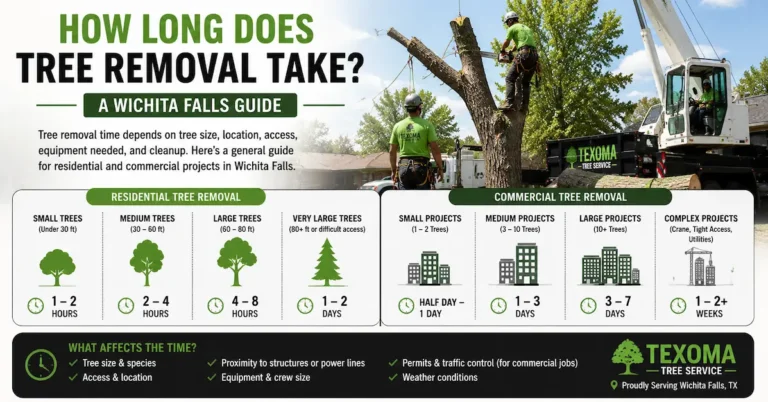
| Small dead tree under 30 feet | $192 to $400 | Access, proximity to structure, stump included or not |
| Medium dead tree 30 to 60 feet | $400 to $700 | Degree of internal decay, sectional removal required or not |
| Large dead tree 60 to 80 feet | $700 to $1,100 | Crane requirement, proximity to power lines or structures |
| Very large dead tree over 80 feet | $1,100 to $1,800+ | Species, advanced decay requiring slower sectioning, location |
| Stump grinding add-on | $175 to $400 | Stump diameter and root system depth |
| City of Wichita Falls Tree Abatement | Up to $4,000 assistance | Must qualify: Heart of the Falls Revitalization Area |
These cost ranges represent the landscape for dead tree removal in Wichita Falls. Note that dead trees with advanced internal decay often take longer to section safely than comparable living trees, which is reflected in the upper end of these ranges. Getting an on-site estimate before scheduling allows the crew to assess the degree of decay and plan the removal approach correctly, so the scope and cost are confirmed before work begins.
Compare removal cost to repair cost before delaying: The average homeowner’s insurance claim for wind-related tree damage in Texas exceeds $4,000, and insurers may deny or reduce claims if the tree was known to be dead or hazardous before the event. The cost of dead tree removal in Wichita Falls is almost always a fraction of the cost of the property damage it prevents.
Why DIY Dead Tree Removal in Wichita Falls Carries Serious Risk
The top of a dead tree can break under pressure during cutting, creating an unpredictable fall direction that is beyond the ability of an untrained individual to control. This is not a theoretical concern. Tree care work is statistically one of the most hazardous occupations in the United States, with approximately 80 worker deaths annually in the professional sector even among trained crews using certified safety equipment.
For homeowners, the risks are higher still. Dead wood does not behave like living wood under a chainsaw. The grain fractures unpredictably, tension in partially supported limbs releases suddenly and in unexpected directions, and bark that appears solid can slip away from the trunk without warning when weight is applied. For a tree with advanced internal decay, the structural failure point is often not visible from the outside and not where the cut is being made.
For any dead tree larger than you can safely handle with both feet on the ground, or any dead tree positioned near a structure, fence, vehicle, or utility line, professional removal is the only responsible approach. The cost of professional dead tree removal is always less than the cost of an emergency room visit, a structural repair, or a liability claim.
Frequently Asked Questions
Does my homeowners insurance cover the removal of a dead tree in Wichita Falls?
Standard Texas homeowners insurance policies do not cover the proactive removal of a dead tree that has not yet fallen. Coverage typically applies when a tree falls onto an insured structure due to a covered peril. However, if the tree was known to be dead or hazardous before it fell, the insurer may investigate whether negligence applies. Proactive dead tree removal protects both your property and your ability to make a successful future claim for damage caused by trees that were not known hazards.
How long can a dead tree safely stand before it becomes an emergency?
There is no universal timeline because the deterioration rate depends on species, the cause of death, soil conditions, moisture levels, and pest activity. In Wichita Falls conditions, including summer heat, clay soil expansion cycles, termite activity, and severe storm exposure, a dead tree may deteriorate to a critical failure risk within one to two years of death for medium to large specimens. Small trees may retain structural integrity longer. The only reliable answer is a professional hazard assessment, which evaluates the specific tree’s current condition rather than applying a general timeline.
Can a dead tree be saved or treated rather than removed?
No. Once a tree is dead, it cannot be revived through any treatment or intervention. There is no arboricultural service that restores vitality to a dead tree. The only meaningful question is whether removal can be scheduled on a planned timeline or whether the tree’s current condition requires emergency response. If a tree is dying but not yet fully dead, a certified arborist may identify treatments that slow further decline or address the underlying cause, but this requires early intervention before the point of no return is reached.
What happens to my property if I do not remove a dead tree and it falls?
If a dead tree falls onto your home, the structural damage can range from minor roof damage to major collapse depending on the tree’s size and fall trajectory. Your homeowners insurer will investigate the claim and may engage an independent adjuster to evaluate whether the tree was known to be dead or hazardous before the event. If negligence is established, coverage may be reduced or denied. Beyond the insurance implications, you face the immediate costs of emergency tree removal, structural repair, temporary accommodations if the damage is severe, and potential liability if the tree damages a neighboring property or injures a person.
Should I replace a removed dead tree with a new planting?
In most cases, yes, replanting is worthwhile both for property value and for the environmental benefits that established trees provide. For Wichita Falls properties, choose a drought-tolerant species suited to the clay soil conditions of Wichita County. Texas red oak, chinkapin oak, and desert willow establish reliably in North Texas conditions. Avoid replanting the same species in the same location if disease, such as oak wilt or hypoxylon canker, contributed to the original tree’s death, since the underlying pathogen may persist in the root zone. Our tree removal service includes guidance on replanting options appropriate for your specific property conditions.
Dead Tree on Your Wichita Falls Property? Do Not Wait.
Texoma Tree Service provides professional dead tree removal across Wichita Falls, Burkburnett, Iowa Park, Henrietta, Electra, and surrounding Texoma communities. Schedule your free on-site assessment today before the next storm season arrives.
Call us 24 hours a day: +19406548157