Hazardous Tree Removal Wichita Falls, TX: Act Before It Falls
Quick Answer
Hazardous tree removal in Wichita Falls TX, is required when a tree poses an imminent risk of failure that threatens people, structures, vehicles, or utility infrastructure. The eight most urgent conditions triggering immediate hazardous tree removal in Wichita Falls are: a visible sudden lean with soil heaving at the root base, hypoxylon canker stroma covering the trunk, deep vertical trunk cracks or included bark splits, contact with Oncor Electric Delivery power lines, more than 50 percent canopy dieback with no new growth, multiple large widow maker limbs hanging over occupied structures, hollow trunk sections where decay exceeds one-third of the diameter, and confirmed root zone failure following saturated clay soil events. Hazardous tree removal in Wichita Falls TX typically costs $300 to $2,000 for residential trees, with emergency removals averaging $731. The City of Wichita Falls Tree Abatement Program offers up to $4,000 in financial assistance for qualifying properties within the Heart of the Falls Revitalization Area. Texoma Tree Service provides 24-hour hazardous tree removal across Wichita Falls, Burkburnett, Iowa Park, Henrietta, and Electra.
A hazardous tree is not defined by how it looks from the curb. It is defined by what it can do when the next severe North Texas storm arrives. Wichita Falls sits at the center of some of the most intense convective weather in the United States, with spring storm systems capable of producing straight-line winds above 90 mph, large hail, and occasional tornadoes tracking through Wichita County neighborhoods. A tree that appears stable today can become the thing that takes down your fence, crushes your vehicle, or punches through your roof before dawn tomorrow.
Every experienced tree service professional in Wichita Falls will tell you the same thing: the homeowners who call after the storm wish they had called before it. Hazardous tree removal in Wichita Falls, TX, is almost always a planned, manageable project when it happens before a failure event. It becomes a complicated, expensive emergency when it does not. This guide covers what makes a tree legally and structurally hazardous in Wichita Falls, what the removal process involves, what it costs, who can help you pay for it, and what the legal and insurance consequences are of leaving a known hazard tree in place.
What Makes a Tree Hazardous in Wichita Falls, TX?
The ISA Tree Risk Assessment Qualification (TRAQ) framework, the professional standard used by certified arborists across the United States, defines a hazard tree using three interacting factors: the likelihood of failure, the likelihood that failure would strike a target, and the likely consequences of that strike. In Wichita Falls, all three of these factors are elevated compared to many other parts of Texas because of the severe storm wind climate, the Wichita County clay soil conditions that compromise root anchoring, and the density of established neighborhoods where failure zones overlap with occupied structures.
This local context matters. A post oak with 40 percent internal decay standing in the open center of a five-acre rural property in Wichita County may not qualify as an urgent hazard because its failure would not strike any occupied target. The same tree with the same 40 percent decay positioned over a home in a Tanglewood neighborhood or along a street near the Midwestern State University campus is a high-priority hazard regardless of whether any other defects are present. The tree’s condition is only one part of the equation. Its position relative to the people and structures below it determines the urgency level.
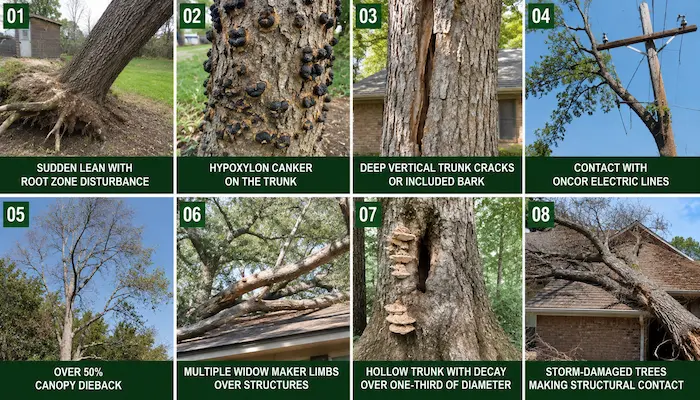
Condition 01
Sudden Lean With Root Zone Disturbance
A lean that developed noticeably over a short period, particularly paired with soil heaving, cracking, or visible root crowns being pushed upward on one side, indicates active root system failure. In Wichita County’s clay soil, this most often follows a saturated soil event after extended drought conditions. Remove immediately.
Condition 02
Hypoxylon Canker on the Trunk
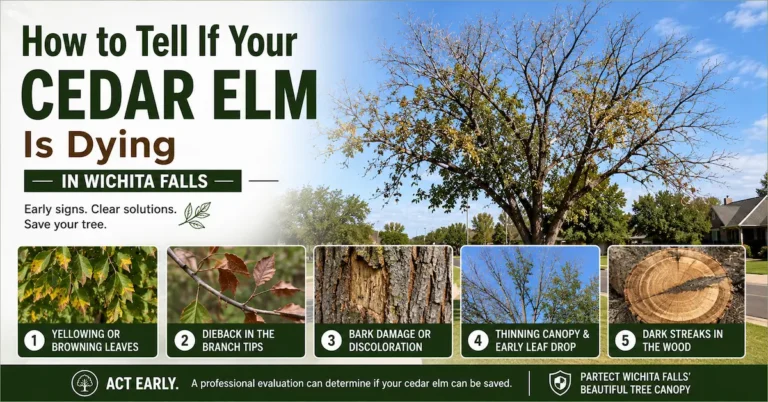
Visible hypoxylon canker stroma in any of their four color stages from buff-gray to charcoal-black on the main trunk indicates structural wood decay that cannot be reversed. Trees showing advanced stage three or four stroma are immediate removal candidates due to brittle and unpredictable wood behavior.
Condition 03
Deep Vertical Trunk Cracks or Included Bark
A crack penetrating into the structural wood, or a split forming at an included bark union between major co-dominant stems, indicates a structural failure point that Wichita Falls storm winds can exploit with no additional warning. Particularly urgent on trees positioned over occupied areas.
Condition 04
Contact With Oncor Electric Lines
Any branch or trunk section making direct contact with Oncor Electric Delivery primary or secondary distribution lines is both a fire hazard and an electrocution hazard. Do not approach the tree. Contact Oncor and a professional tree service before any work begins near energized lines.
Condition 05
Over 50 Percent Canopy Dieback
A tree that has lost more than half its live canopy with no meaningful new growth response has depleted the carbohydrate reserves needed for structural maintenance. The risk of sudden branch or trunk failure increases significantly once this threshold is crossed, regardless of how stable the remaining structure appears.
Condition 06
Multiple Widow Maker Limbs Over Structures
Large dead branches suspended in the canopy over a home, driveway, pool, or play area do not need storm winds to fall. Temperature changes, vibration, moisture absorption, and ongoing decay at attachment points can release these limbs without any weather event. The larger and higher they are, the less warning precedes their fall.
Condition 07
Hollow Trunk With Decay Over One-Third of Diameter
Internal decay confirmed by hollow sound on impact and visible fungal conks or bracket fungi at the base indicates structural wood loss. When decay occupies more than one-third of the trunk diameter at any cross-section, the ISA TRAQ standard considers the structural risk to have escalated beyond normal monitoring into active assessment and probable removal territory.
Condition 08
Storm-Damaged Trees Making Structural Contact
A tree already resting on a structure, making contact with a roofline, or suspended partially over a vehicle or occupied area after a storm event is an active hazard requiring immediate professional assessment. Do not attempt removal yourself when the tree is under tension against a structure or utility line.
How Does Wichita Falls Weather Turn a Declining Tree Into an Immediate Hazard?
Understanding the local weather context for hazardous tree removal in Wichita Falls TX is essential because the same structural condition that represents a long-term monitoring situation in a calm climate represents an imminent hazard in the Texoma region. Wichita Falls sits squarely in Tornado Alley and experiences some of the most severe convective weather on the North American continent, with documented severe thunderstorm events producing straight-line winds in excess of 90 mph and tornadoes including the catastrophic Terrible Tuesday F4 tornado of April 10, 1979.
The National Weather Service office in Norman, Oklahoma, which covers the Wichita Falls forecast area, classifies this region as one of the highest-frequency severe thunderstorm zones in the United States. The storm window of March through June delivers the highest risk, but significant wind events have been documented in every month of the year in Wichita County. A tree that a structural engineer might assess as having a 15 percent annual failure probability in a calm weather zone becomes a significantly higher-probability failure event in the first major convective storm of the spring season in Wichita Falls.
The Wichita County clay soil adds another layer of risk that is specific to this region. During the extended drought conditions that Wichita Falls experiences during summer, the clay soil contracts and pulls away from feeder roots, weakening root anchoring. When spring rains follow a dry season, the same clay saturates rapidly and loses a portion of its bearing capacity. Trees with already-compromised root systems, particularly those showing lean or root zone heaving, can tip or uproot during the first major rainfall of the season without any wind load at all. This saturation-triggered failure pattern is something that experienced local hazardous tree removal crews recognize and that out-of-town services often underestimate.
How Much Does Hazardous Tree Removal in Wichita Falls, TX Cost?
According to Today’s Homeowner’s 2025 cost data for the Wichita Falls market, the average tree removal cost is $490, with routine residential removals typically ranging from $192 to $767. Emergency tree removal in Wichita Falls averages $731. These figures reflect standard removal conditions. Hazardous tree removal often involves additional complexity that affects the final cost beyond standard removal pricing.
| Service Scenario | Typical Cost Range | Key Cost Driver |
|---|---|---|
| Standard hazardous tree removal (small, open area) | $300 to $600 | Under 30 ft with clear access, no structural contact |
| Medium hazardous tree removal (30 to 60 ft) | $600 to $1,200 | Sectional dismantling required, near fence or structure |
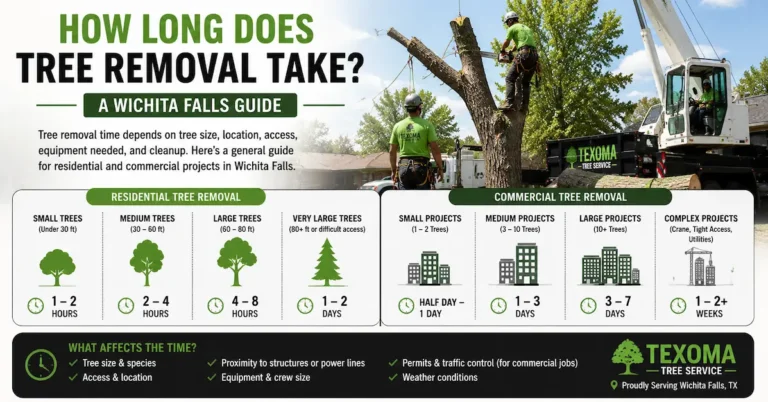
| Large hazardous post oak or pecan (60 to 80 ft) | $1,200 to $2,500 | Full rigging, possible crane, advanced decay wood behavior |
| Crane-assisted removal over structure | $2,500 to $4,500 | No drop zone available, tree over roof or near pool |
| Emergency storm damage removal | $731 average, up to $3,000 | After-hours response, structural contact, active hazard |
| Stump grinding after hazardous removal | $150 to $400 | Quoted separately from removal in most cases |
Trees with hypoxylon canker at advanced stages, significant internal decay, or hollow trunk sections cost more than the same-sized structurally sound tree because the brittle, unpredictable wood behavior requires additional crew caution, more deliberate rigging setups, and in some cases crane assistance where a standard removal would not require it. Texas Tree Surgeons specifically identify advanced Hypoxylon canker cases as dangerous removals requiring special equipment, and this specialized handling is reflected in the cost.
Do not choose your hazardous tree removal company on price alone: A crew that quotes significantly below market rate for a complex hazardous removal in Wichita Falls may be cutting corners on insurance coverage, rigging quality, or crew experience with high-risk wood conditions. The financial consequences of an improperly executed hazardous removal landing on your roof, your neighbor’s fence, or an active utility line far exceed any savings from a low-bid contractor.
Does the City of Wichita Falls Help Pay for Hazardous Tree Removal?
Yes, for qualifying properties. The City of Wichita Falls launched its Tree Abatement Program through the Heart of the Falls Revitalization Initiative specifically to help reduce the hazardous tree burden in established Wichita Falls neighborhoods. Christal Cates, Neighborhood Revitalization Coordinator for the City of Wichita Falls, confirmed that the program provides up to $4,000 per property in financial assistance for the removal of dead or hazardous trees.
City of Wichita Falls Tree Abatement Program: Eligibility and Application
- Location requirement: Your property must be located within the Heart of the Falls Revitalization Area boundary. The eligibility map is available through the City of Wichita Falls official website at wichitafallstx.gov.
- Ownership verification: The application must be signed by the verified property owner. Proof of ownership is required.
- Account status: The property owner must not be delinquent on any City of Wichita Falls fees or assessments at the time of application.
- Funding availability: The program operates on a first-come, first-served basis until annual funding is exhausted. Christal Cates indicated the program may expand beyond the current Heart of the Falls zone if participation is strong enough to secure continued funding.
- Application methods: Apply online through the City of Wichita Falls website or in person at the City Planning Office, 705 8th Street, 6th Floor. Phone: (940) 761-7451. Submit completed applications to Christal Cates at christal.cates@wichitafallstx.gov.
- Maximum assistance: Up to $4,000 per property per program year.
If your property is outside the Heart of the Falls zone, the City of Wichita Falls Hazard Abatement ordinance under Sec. 102-39 addresses vegetation that creates safety hazards in public areas. For vegetation that endangers public infrastructure, adjacent properties, or public right-of-way, the city has enforcement authority to require property owners to address hazardous conditions. Consulting with the City of Wichita Falls Development Services Department at (940) 761-7451 before scheduling removal on properties with any public-interface concerns is always the prudent first step.
What Does Professional Hazardous Tree Removal in Wichita Falls Actually Involve?
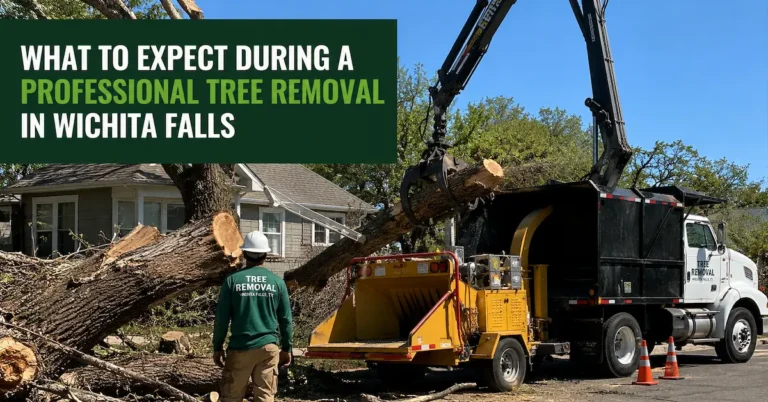
Hazardous tree removal in Wichita Falls, TX, is a fundamentally different operation from standard tree removal, and the differences matter for your safety and your property. The presence of structural defects, decayed wood, hollow sections, or utility line proximity changes the planning, equipment, and techniques required for every step of the job.
- Pre-removal hazard assessment by a qualified crew lead. Every hazardous tree removal begins with a deliberate on-site assessment before equipment is staged or any cuts are made. The crew lead evaluates the specific defects present, the wood condition throughout the tree, the proximity and occupancy of the target zone, Oncor line clearance requirements, and equipment access. For trees with significant decay, the assessment includes a mallet sound test and, where warranted, resistograph probing to map decay extent before planning the removal approach.
- Work zone security and traffic management. The fall radius and equipment staging area are secured before any work begins. In established Wichita Falls neighborhoods where homes, driveways, and sidewalks are within tree-fall distance, this zone management requires coordination with neighbors, temporary blocking of vehicle access in the immediate area, and sometimes flagging arrangements for foot traffic on adjacent sidewalks or roadways near properties on busier corridors.
- Specialized rigging for unpredictable wood behavior. Trees with hypoxylon canker, internal decay, or hollow trunk sections cannot be managed with the same rigging assumptions as structurally sound trees. Every section is cut, tensioned, and lowered under controlled rigging rather than allowed to free-fall, because brittle decayed wood can shatter or redirect during the fall in ways that sound wood does not. For trees directly over structures, crane-assisted lift-and-carry removal eliminates the drop zone problem.
- Oncor line coordination when applicable. Any hazardous tree removal in Wichita Falls, TX that involves branches or trunk sections within the clearance zone of Oncor Electric Delivery distribution lines requires pre-coordination with Oncor before work begins. Crews operating near energized lines without proper Oncor clearance are working in a life-threatening environment. A reputable hazardous tree removal company confirms this coordination as a standard part of the pre-job process, not an afterthought.
- Post-removal stump and debris management. After the canopy and trunk are down, stump handling and debris processing complete the job. For hazardous trees that were hosting termite colonies or bark beetle populations, stump grinding on the same day as removal is the responsible practice to eliminate the remaining pest habitat. Our stump grinding and removal service handles this step on the same visit when requested.
- Final site walkthrough with property owner. Before equipment is loaded, a final walkthrough confirms all debris is cleared, no hardware or rigging materials remain in the work area, and the property owner has had the opportunity to inspect the results. Written documentation of the work performed, including photographs taken before and after, supports any insurance claim the property owner files for a tree that was positioned over an insured structure.
What Is Your Legal Liability for a Hazardous Tree in Wichita Falls TX?
This is where most competitor content on hazardous tree removal in Wichita Falls falls silent, and it is one of the most important things a property owner needs to understand before deciding to delay action on a known hazard tree.
Texas follows a negligence-based standard for tree liability. If a Wichita Falls property owner knows, or should reasonably know, that a tree on their property is dead, structurally compromised, or poses a hazard to neighboring properties and persons, and that tree subsequently fails and causes damage or injury, the property owner faces potential civil liability for the resulting losses. The standard is not actual knowledge but constructive knowledge. A visible lean, visible dead wood accumulation, visible hypoxylon canker stroma, or any other condition that a reasonable person examining the property would identify as a hazard satisfies the constructive knowledge threshold.
Texas Homeowners Insurance and Hazardous Tree Removal
What your policy covers and what it does not
Understanding how Texas homeowners insurance applies to hazardous trees in Wichita Falls helps property owners make financially informed decisions about timing and approach.
City program eligibility: Check whether your property qualifies for the City of Wichita Falls Tree Abatement Program before paying for removal out of pocket. Up to $4,000 in assistance is available for qualifying properties within the Heart of the Falls Revitalization Area.
Tree falls on your insured structure during a covered storm event: Generally covered under your homeowners policy as storm damage, with tree removal costs typically covered up to $500 to $1,000 per tree. Document the damage thoroughly before any cleanup or removal begins.
Known hazardous tree falls on your structure: The Texas Department of Insurance confirms that insurers can deny or reduce claims when they can establish that the tree was a known pre-existing hazard that the homeowner failed to address. A visible dead or structurally compromised tree that has been standing for months before it falls represents exactly this scenario.
Your hazardous tree falls on a neighbor’s property: Your homeowners liability coverage applies, but if the neighbor can demonstrate you had constructive knowledge of the hazard and failed to act, the claim exposure can exceed standard policy limits for significant structural damage cases.
Proactive hazardous tree removal cost: Not covered as an insurance claim. This is a property maintenance cost borne by the homeowner. The financial argument for proactive removal is that the removal cost is almost always less than the insurance deductible on the structural repair claim that follows a failure event.
City program eligibility: Check whether your property qualifies for the City of Wichita Falls Tree Abatement Program before paying for removal out of pocket. Up to $4,000 in assistance is available for qualifying properties within the Heart of the Falls Revitalization Area.
What Should You Look for When Choosing a Hazardous Tree Removal Company in Wichita Falls TX?
The Wichita Falls tree service market includes a range of operators from established local companies to out-of-area contractors who respond after major storm events. For hazardous tree removal specifically, the qualifications and capabilities of the company you hire matter significantly more than for routine tree trimming or light brush work.
What to verify before hiring a hazardous tree removal company in Wichita Falls
- General liability insurance of at least $1 million per occurrence: Request the certificate of insurance directly from the insurer, not just a copy from the contractor. Confirm the policy is active and the coverage level is appropriate for the risk profile of your job.
- Workers’ compensation coverage: Texas does not require workers’ compensation for private employers. Tree service is classified among the most dangerous occupations in the United States. An uninsured worker injured on your property during a hazardous tree removal may have a direct claim against you as the property owner.
- ISA certification or TRAQ qualification: An ISA Certified Arborist or TRAQ-qualified professional on the crew means the company follows the professional standard for tree risk assessment rather than making informal judgments about structural safety. The ISA’s searchable database helps you verify any claimed certification.
- Experience with the specific hazard condition on your property: Not all tree service companies have experience with crane-assisted removals, advanced hypoxylon canker cases, or trees in contact with Oncor Electric lines. Ask specifically about their experience with the condition your tree presents before committing.
- Local Wichita Falls operational history: Companies with established roots in Wichita Falls and the Texoma area understand Wichita County clay soil behavior, the local storm wind patterns, and the specific species challenges of North Texas hardwoods in ways that traveling crews and recently established operators do not.
For hazardous tree removal specifically, the key differentiator is the combination of appropriate insurance, ISA-qualified personnel, and equipment appropriate for the specific hazard conditions, including crane access for trees over structures and Oncor line coordination for utility contact cases. Texoma Tree Service maintains 24-hour hazardous tree removal response across Wichita Falls, Burkburnett, Iowa Park, Henrietta, and Electra with the full equipment complement that complex hazardous removals require.
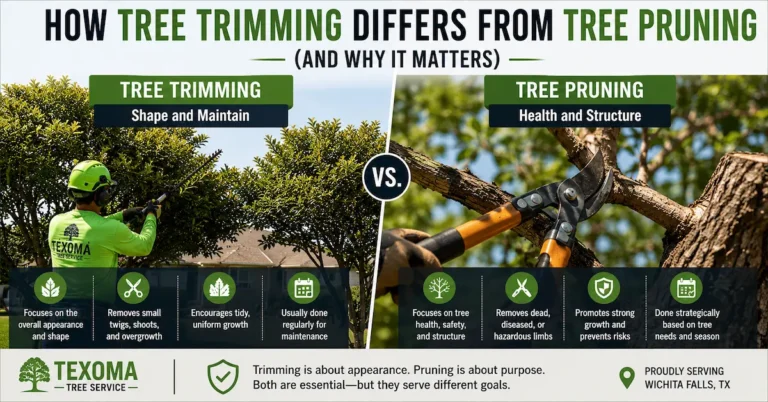
For trees that are declining but have not yet reached emergency removal threshold, our tree trimming and pruning service can address dead wood accumulation, widow maker limbs, and structural defects that reduce hazard risk while extending the serviceable life of trees still worth preserving. For trees already involved in an active storm damage situation, our emergency tree removal service operates around the clock to address the situation before it causes additional damage.
Frequently Asked Questions
How do I know if my tree is a legal hazard in Wichita Falls?
Under the ISA TRAQ framework, a tree meets the hazard threshold when it shows one or more structural defects, is positioned where its failure would strike a target of significance such as an occupied structure, person, or public right-of-way, and the failure probability under foreseeable conditions such as a Wichita Falls spring storm is non-negligible. You do not need a legal ruling to take action on a tree you can visually identify as showing structural compromise. A professional assessment from an ISA-certified arborist provides the documented professional opinion that supports both insurance claims and city program applications.
Can I remove a hazardous tree in Wichita Falls myself?
For any tree that meets the hazard criteria described above, self-removal is not a safe option. The same structural defects that make a tree hazardous to people and property standing beneath it also make it hazardous to anyone cutting it. Hollow trunks, advanced decay, brittle hypoxylon-infected wood, and the unpredictable behavior of a tree under tension against a structure all create cutting conditions that require professional training, appropriate personal protective equipment, and equipment suited to managing the hazard safely. The cost of a hospital visit from an amateur hazardous tree removal gone wrong in Wichita Falls exceeds the cost of professional removal by a significant margin.
How quickly can Texoma Tree Service respond to a hazardous tree emergency in Wichita Falls?
Texoma Tree Service operates 24-hour emergency response for active hazardous tree situations across Wichita Falls and the surrounding Texoma area. Response time for genuine structural emergencies, trees on structures, trees blocking access, or trees in active contact with Oncor power lines is prioritized over non-emergency scheduled removals. When calling for emergency response, describe the specific hazard condition as accurately as possible so the dispatcher can confirm the right equipment and crew for the situation.
What happens to the wood from a hazardous tree removal in Wichita Falls?
Standard debris from a hazardous tree removal in Wichita Falls follows the same disposition options as any removal: branches and smaller material are chipped on site, larger trunk rounds can be cut for firewood and left on your property if requested, or all material can be hauled away. One important exception: if the tree was confirmed or suspected to have hypoxylon canker or another fungal disease, the wood should be burned locally, covered with sealed plastic, or hauled directly to the City of Wichita Falls Transfer Station on Rhea Road rather than stockpiled near other healthy trees on your property.
Hazardous Tree on Your Wichita Falls Property? We Are Available 24 Hours a Day.
Texoma Tree Service provides professional hazardous tree removal in Wichita Falls, TX, and across Burkburnett, Iowa Park, Henrietta, Electra, and the Texoma region. Free on-site assessments. 24-hour emergency response. ISA-standard removal for every job.
Book Your Free Hazard Assessment
Call us: +1 940 223-7713